
Home » State FAQs for Nationwide Private Real Estate Loans
State FAQs
For Private Real Estate Loans
Nationwide private real estate loan FAQs help investors, builders, developers, brokers, and business-purpose borrowers understand how state eligibility, documents, property type, underwriting, and lender/investor guidelines may affect financing options. Direct Private Capital Group, Inc. reviews loan purpose, collateral, borrower qualifications, valuation, exit strategy, and state requirements to help qualified borrowers explore available private lending options.
What This Page Helps Borrowers Understand
Private real estate loan requirements are not always the same in every state. A borrower may qualify for one loan structure in one market, while a similar project in another state may require different documents, leverage, title review, insurance, licensing, or investor approval.
This page helps borrowers and brokers understand how state hard money loan questions, nationwide bridge loan FAQ topics, construction loan requirements by state, and private lending state availability may affect a loan review.
The main problem this page solves is confusion. Many real estate investors ask, “Can I get a private loan in this state?” The better question is usually: “Does my property, loan purpose, borrower profile, title position, valuation, and exit strategy fit an available lender or investor program for that state?”
Private real estate financing may be available for qualified borrowers across eligible U.S. markets, but loan availability depends on underwriting, collateral review, property type, loan purpose, state eligibility, and lender/investor guidelines.

Who This Page Is For
This page is designed for business-purpose borrowers seeking private real estate financing in the United States.
It may be useful for:
- Real estate investors buying, refinancing, or repositioning investment property
- Builders and developers seeking ground-up construction or completion financing
- Brokers preparing a loan scenario for private lender review
- Commercial property owners seeking bridge or refinance options
- DSCR borrowers using rental income to support loan review
- Hospitality investors reviewing hotel financing options
- Gas station and convenience store operators seeking commercial property financing
- Foreign national investors buying or refinancing U.S. investment property
- Borrowers comparing real estate loans by state before submitting a scenario
This page does not provide legal advice, state licensing advice, tax advice, or a guarantee that a specific program is available in every state.
Why State Private Lending Questions Matter
State requirements matter because private lending is affected by more than the property value. A lender or investor may also review state-specific legal, title, licensing, foreclosure, insurance, construction, and documentation factors.
For example, a bridge loan secured by a commercial property may require different review steps than a ground-up construction loan secured by vacant land. A rental DSCR loan may be reviewed differently than a fix-and-flip loan, hotel loan, or gas station loan. A foreign national investor may also need different identity, entity, and funds documentation.
State availability may be influenced by property location, business-purpose use, title condition, loan type, construction permit status, insurance requirements, environmental review for certain commercial properties, borrower experience, borrower liquidity, and the exit strategy.
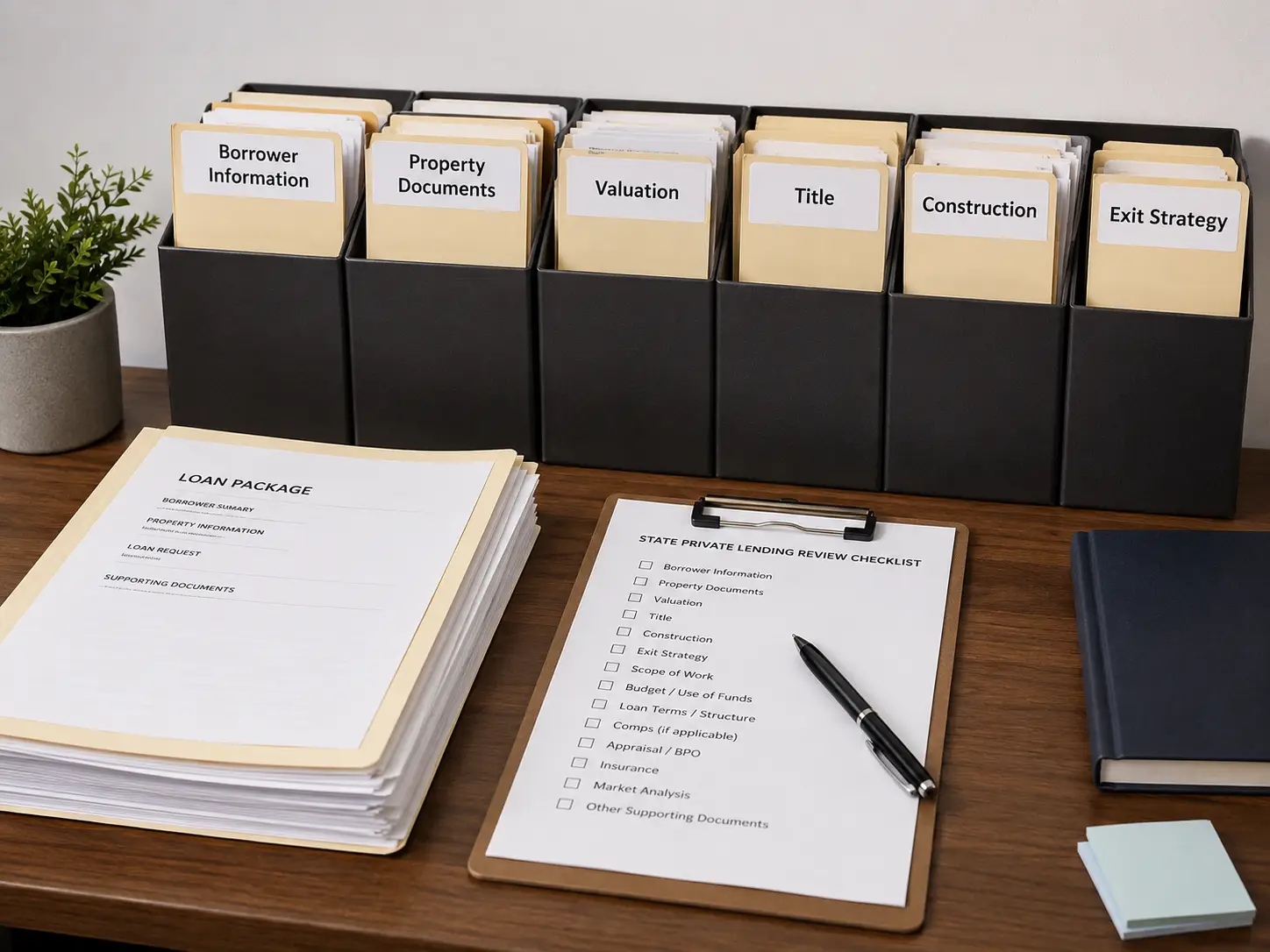
KEY STATE REQUIREMENTS & DOCUMENTS

Borrower Information
- Legal borrower name and contact information
- Borrowing entity name, if applicable
- Government-issued identification
- Entity documents such as Articles, Operating Agreement, EIN letter, or good standing documents
- Credit profile or credit authorization
- Proof of funds or liquidity documentation
- Experience with similar projects or property types
- Personal financial statement, when requested
- Foreign national documentation, when applicable
PROPERTY INFORMATION
- Full property address and state
- Property type and current use
- Purchase contract, payoff statement, or refinance details
- Appraisal, broker price opinion, valuation, or comparable sales
- Photos, rent roll, leases, operating statements, or income documentation
- Title report or ownership documentation
- Insurance information
- Environmental reports for certain commercial property types
- Construction plans, permits, budget, and draw schedule when applicable
- Zoning, entitlement, or approval information when applicable
LOAN SCENARIO INFORMATION
- Requested loan amount
- Purchase price or current loan payoff
- Estimated as-is value
- After-repair value, when applicable
- Loan-to-value request
- Loan-to-cost request
- Rehab or construction budget
- Desired loan term
- Use of funds
- Lien position
- Exit strategy
- State and property eligibility information
Exit Strategy or Repayment Plan
Private real estate financing is often short-term or project-based. A clear exit strategy is important because it explains how the loan may be repaid.
Common exit strategies may include:
- Sale of the completed or stabilized property
- Refinance into long-term rental or DSCR financing
- Refinance into conventional, commercial, or agency financing
- Completion of construction and sale
- Business stabilization and cash-flow refinance
- Payoff from another verified capital source
An exit strategy should be realistic, documented when possible, and aligned with the property type, market, project timeline, and borrower qualifications.
Common Reasons a Loan File Gets Delayed
A private loan file may be delayed when key information is missing, inconsistent, or not aligned with underwriting requirements.
- No complete property address or state identified
- Missing purchase contract, payoff statement, or loan request details
- Unclear borrower entity documents
- Incomplete title report or unresolved liens
- No valuation support or unrealistic after-repair value
- Rehab or construction budget missing line items
- Construction project missing permits, plans, or contractor information
- Rental property missing leases, rent roll, or DSCR support
- Commercial property missing operating statements or tenant information
- Insurance requirements not yet confirmed
- Environmental reports needed for certain property types
- Exit strategy is unclear or unsupported
- Borrower liquidity is not documented
- Loan purpose appears consumer instead of business-purpose
Submitting accurate documents at the beginning may help the review process stay organized. It does not guarantee approval, terms, timing, or funding.
Loan Review Factors Table
| Review Factor | Why It Matters |
|---|---|
| State eligibility | Some loan programs may be available only in certain states or markets. |
| Loan purpose | Purchase, refinance, cash-out, construction, rental, and bridge loans may be reviewed differently. |
| Property type | Residential investment, commercial, hotel, gas station, land, and mixed-use properties may require different documents. |
| Collateral value | Valuation supports loan-to-value, loan-to-cost, and risk review. |
| Borrower liquidity | Lenders may review funds needed for closing, reserves, rehab, construction, or operating needs. |
| Title condition | Existing liens, ownership issues, judgments, or unresolved title matters can delay review. |
| Construction status | Plans, permits, contractor information, budget, and draw schedule may be required. |
| Rental income | DSCR and rental property loans may review leases, rent roll, and income documentation. |
| Exit strategy | The repayment plan must make sense for the loan type and project timeline. |
| Lender/investor guidelines | Final terms and eligibility depend on underwriting and investor requirements. |
How to Prepare Before Submitting a State Loan Scenario
Before contacting Direct Private Capital Group, Inc., borrowers and brokers should prepare a clear loan summary. The goal is to make the property, state, loan purpose, numbers, documents, and exit strategy easy to review.
Identify Property and State
Explain the Loan Purpose
Provide the Numbers
Organize Borrower Documents
Support Property Value
Explain Exit Strategy
What Loan Types May Fit Different State Scenarios?
Different private real estate loan types may fit different borrower situations. Availability varies by state, collateral, borrower profile, loan purpose, and lender/investor guidelines.
A hard money loan may be used for investment property purchases, fix-and-flip projects, refinance needs, or time-sensitive real estate scenarios. Review may focus on collateral value, borrower experience, liquidity, rehab budget, and exit strategy.
A bridge loan may help business-purpose borrowers transition from one financing event to another. A bridge loan may be reviewed for acquisition, refinance, cash-out, property repositioning, entitlement, stabilization, or sale preparation.
A DSCR loan may be reviewed for rental properties where the property’s rental income supports repayment analysis. Lenders may review leases, rent roll, market rent, expenses, property condition, borrower credit, and debt service coverage ratio.
A ground-up construction loan may require more detailed review because the collateral changes during the project. Plans, permits, budget, contractor information, borrower experience, draw schedule, and exit strategy are important.
A commercial real estate loan may involve office, retail, industrial, mixed-use, multifamily, hospitality, or special-use properties. Review may include operating statements, leases, tenant quality, market value, debt yield, and title condition.
Hotel financing and gas station financing may require additional property-level review. Hospitality files may include occupancy, revenue, franchise information, and operating statements. Gas station files may require fuel volume, store sales, environmental review, leases, and business financials.
Foreign national investor loans may require identity documentation, U.S. entity information, proof of funds, source of funds, property details, and a clear business-purpose use. Requirements vary by lender/investor guidelines and applicable laws.
What Direct Private Capital Group Reviews
Direct Private Capital Group, Inc. reviews the full loan scenario, not only the state name. Items reviewed may include state and property eligibility, borrower qualifications, business-purpose use, collateral type, valuation, loan-to-value, loan-to-cost, after-repair value, debt service coverage ratio, rehab or construction scope, liquidity, title condition, lien position, exit strategy, and lender/investor guidelines.
The review is designed to help qualified borrowers and brokers understand what private lending options may be available. It is not a commitment to lend or guarantee of terms.
Related Financing Topics
Borrowers reviewing state private lending questions may also want to review Foreign National Loans, Hard money loan requirements, Ground up construction Loan financing, commercial property loans, required documents, the loan process, FAQ, contact page, and apply now.
What This Page Does Not Guarantee
This page is educational. It does not guarantee loan approval, loan funding, specific interest rates, specific loan terms, availability in every state, closing timelines, construction draw approval, appraisal value, property eligibility, state legal or licensing conclusions, AI search visibility, or Google rankings.
All loan scenarios must be reviewed based on underwriting, borrower qualification, collateral review, valuation, state eligibility, lender/investor guidelines, and applicable laws.
Ready to Review Your State Loan Scenario?
Submit your loan scenario today and let Direct Private Capital Group, Inc. review available private lending options for your project. For the most organized review, include the property state, property address, loan purpose, requested loan amount, estimated value, borrower entity information, and exit strategy.
Compliance Disclaimer
Direct Private Capital Group, Inc. provides business-purpose real estate financing information. This page is for informational purposes only and is not a commitment to lend, loan approval, or guarantee of terms. All loans are subject to underwriting, borrower qualification, collateral review, valuation, state eligibility, lender/investor guidelines, and applicable federal and state laws.
Helpful Government and Business Resources
Borrowers may review public resources from official government sources when useful for construction, business planning, foreign national documentation, or local requirements. Useful sources may include the U.S. Census Bureau for construction and property data, SBA.gov for business resources, IRS ITIN information for foreign national investors, state contractor licensing boards for construction projects, and local or state building departments for permits, zoning, and entitlement questions.
External resources are educational only. They do not replace underwriting, legal review, tax advice, or state-specific professional guidance.
Frequently Asked Questions About Nationwide Private Real Estate Loan FAQs
Yes. Private real estate loan requirements may vary by state, property type, loan purpose, collateral, borrower profile, licensing rules, title conditions, and lender/investor guidelines.
Yes. Nationwide private real estate loan FAQs help borrowers understand what may affect loan availability, documents, underwriting, state eligibility, and private lending review before submitting a scenario.
Direct Private Capital Group, Inc. may review business-purpose loan scenarios across eligible U.S. markets. State eligibility varies by loan type, collateral, borrower qualifications, and lender/investor guidelines.
Common documents may include borrower identification, entity documents, proof of funds, purchase contract, payoff statement, valuation support, title report, insurance information, rent roll, leases, construction budget, permits, and exit strategy.
Yes. Brokers may submit a complete loan scenario with borrower information, property details, requested loan amount, state, loan purpose, valuation support, and exit strategy. Complete files are easier to review.
Construction loan requirements may vary by state and local jurisdiction. Plans, permits, contractor information, budget, draw schedule, inspections, insurance, and local building requirements may affect review.
Foreign national investors may request review for business-purpose U.S. real estate financing. Documentation may include identification, entity information, proof of funds, property details, and source of funds information.
No. Submitting a loan scenario does not guarantee approval, funding, rates, terms, or timing. All loans are subject to underwriting, collateral review, borrower qualification, state eligibility, and lender/investor guidelines.