
Quadplex Bridge Loans
Short-term, business-purpose financing for the purchase, refinance, renovation, or stabilization of a non-owner-occupied four-unit property. Direct Private Capital Group, Inc. assists investors, owners, buyers, sponsors, and brokers with organizing qualified quadplex loan scenarios and presenting eligible files to potential financing sources. Each transaction is reviewed individually based on the property, borrower, equity, occupancy, rental income, condition, requested structure, and exit strategy.
What Is a Quadplex Bridge Loan?
A quadplex bridge loan is short-term financing secured by a four-unit property and used to address a temporary capital need, such as an acquisition deadline, existing loan maturity, renovation plan, occupancy issue, or transition to longer-term financing. It is one type of bridge financing. Approval and structure depend on the property, borrower, loan purpose, supporting documents, and proposed repayment or refinance strategy.
When Might Quadplex Bridge Financing Be Needed?
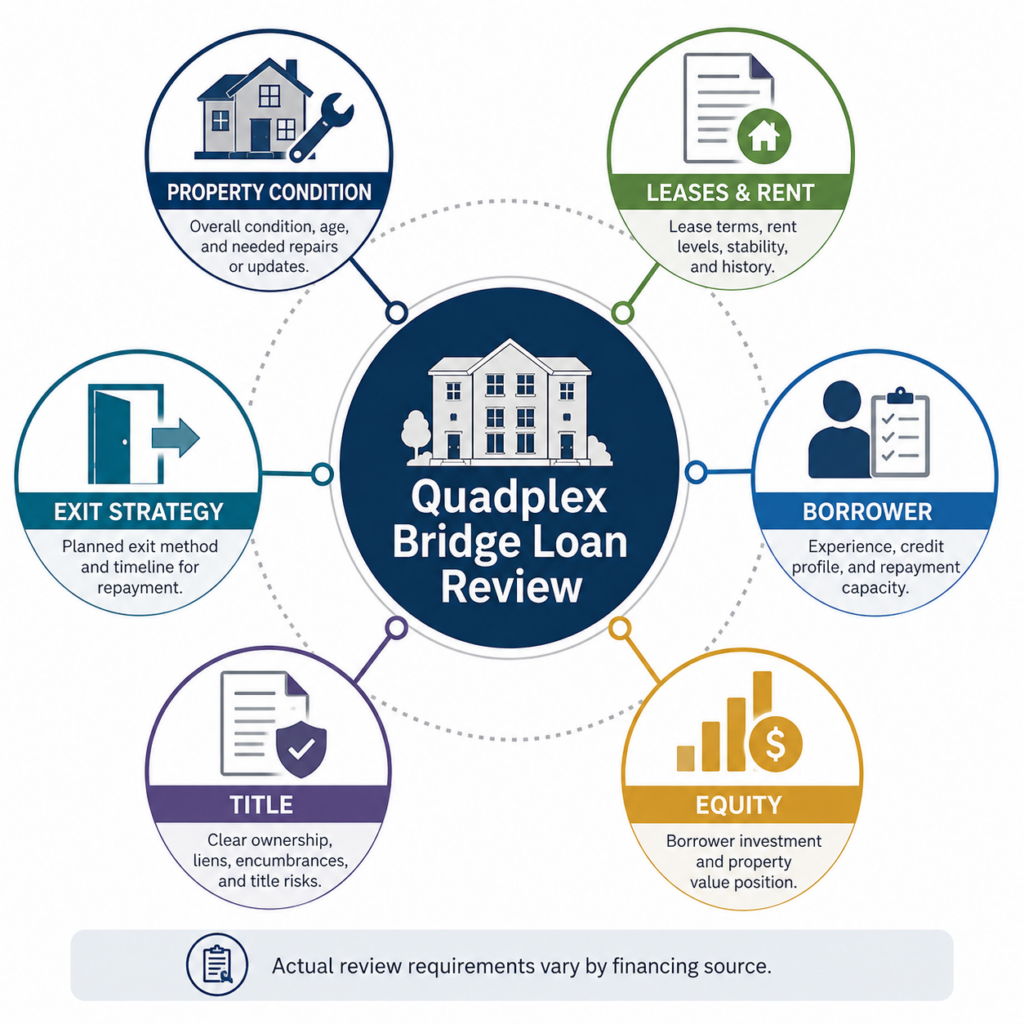
Quadplex bridge financing may be considered when:
- A buyer must close on a four-unit investment property before conventional financing is available.
- An owner needs to refinance maturing, private, or other short-term debt.
- The property requires repairs, unit turns, or deferred-maintenance work.
- Some units are vacant and the borrower has a defined lease-up plan.
- Rental records, title, insurance, permits, or property-condition issues must be resolved.
- The borrower is repositioning the property after a management or ownership change.
- The exit is a documented refinance, sale, or other supportable repayment source.
How Is a Quadplex Different From a Larger Multifamily Property?
A quadplex, also called a fourplex or four-unit property, contains four separate residential units within one property. Its appraisal, insurance, zoning, legal-use, and financing treatment may differ from an apartment building with five or more units.
Review may include the legal unit count, current occupancy, executed leases, rent collections, property condition, utilities, title, borrower qualifications, and exit strategy. For broader five-or-more-unit financing information, review multifamily loan options.
For federal business-purpose guidance involving rental property, review the CFPB Regulation Z business-purpose credit guidance.

Why Must Occupancy and Business Purpose Be Disclosed Accurately?
This page is intended for non-owner-occupied, business-purpose and investment-property financing. Owner occupancy can materially affect legal, regulatory, underwriting, and program treatment. A borrower should disclose who will occupy each unit, the intended use of the property, and the purpose of the loan.
The Consumer Financial Protection Bureau’s Regulation Z guidance addresses business-purpose credit and rental-property transactions. Transaction-specific legal treatment should be reviewed by the responsible financing source and qualified counsel.
What Quadplex Bridge-Loan Scenarios May Be Considered?
Quadplex Acquisition
Quadplex Acquisition
Quadplex Refinance
Quadplex Refinance
Renovation Financing
Renovation Financing
Occupancy Stabilization
Occupancy Stabilization
Maturity Payoff
Maturity Payoff
Property Repositioning
Property Repositioning
How Is a Quadplex Bridge-Loan Request Evaluated?
Property Configuration and Legal Use
The review may confirm:
- Four separate dwelling units
- Legal unit count
- Current zoning
- Certificate-of-occupancy status
- Permitted use
- Unauthorized conversions or additions
- Bedroom and bathroom configuration
- Utility metering
- Parking
- Access
- Building condition
- Health or safety concerns
Occupancy and Rental Performance
Relevant records may include:
- Current rent roll
- Executed leases
- Tenant ledgers
- Security-deposit schedule
- Bank statements showing deposits
- Delinquency report
- Vacancy history
- Concessions
- Utility responsibilities
- Month-to-month tenancy
- Pending evictions or tenant disp
Property Condition
Condition review may cover:
- Roof
- Foundation
- Electrical systems
- Plumbing
- Heating and cooling
- Water intrusion
- Fire or life-safety systems
- Unit interiors
- Exterior condition
- Deferred maintenance
- Environmental concerns
- Code violations
- Open permits
- Habitability
- Insurance-related repairs
Insurance
Insurance review may consider:
- Replacement-cost coverage
- Property condition
- Vacancy
- Renovation activity
- Prior losses
- Building age
- Roof age
- Electrical systems
- Plumbing systems
- Flood exposure
- Wind or catastrophe exposure
- Liability coverage
- Named insured and entity vesting
- Mortgagee requirements
Equity and Cost Basis
The reviewer may compare:
- Purchase price
- Existing debt
- Acquisition costs
- Capital already invested
- Documented improvements
- Requested loan amount
- Current value
- As-complete value, when relevant
- Total project cost
- Borrower cash contribution
- Proposed cash-out
Borrower and Guarantor Review
Depending on the program, the review may consider:
- Credit history
- Real estate ownership experience
- Rental-property experience
- Renovation or construction experience
- Liquidity
- Net worth
- Recent bank activity
- Background information
- Litigation
- Business entity history
Title and Ownership
Title review may identify:
- Existing mortgages
- Judgment liens
- Tax liens
- Mechanic’s liens
- Unreleased deeds of trust
- Ownership discrepancies
- Entity vesting issues
- Probate or estate matters
- Easements
- Restrictions
- Pending litigation
- Municipal liens
- Unrecorded ownership claims
Exit Strategy
A complete exit strategy should identify:
- The intended takeout financing
- Expected property condition at exit
- Required occupancy
- Required documentation
- Expected income support
- Borrower qualification assumptions
- Timeline
- Backup exit
- Risks that could prevent the exit
Which Financial Measurements May Affect Quadplex Bridge Financing?
Loan-to-Value Ratio
Loan-to-value, or LTV, compares the proposed loan amount with the property value accepted for underwriting.
LTV Formula
Proposed Loan Amount ÷ Accepted Property Value = LTV
The accepted value may be based on an appraisal or another approved valuation method.
Loan-to-Cost Ratio
Loan-to-cost, or LTC, compares the proposed loan amount with verified acquisition and renovation costs.
LTC Formula
Proposed Loan Amount ÷ Total Eligible Project Cost = LTC
LTC may apply to purchases, construction, rehabilitation, or major improvements.
Debt-Service Coverage Ratio
DSCR compares underwritten net operating income from the property with annual debt service.
DSCR Formula
Underwritten Net Operating Income ÷ Annual Debt Service = DSCR
The lender determines which income and expenses are included.
Debt Yield
Debt yield compares underwritten net operating income with the proposed loan amount.
Debt Yeild Formula
Underwritten Net Operating Income ÷ Proposed Loan Amount = Debt Yield
Debt yield does not depend directly on the interest rate or amortization schedule.
As-Is and As-Completed Value
As-is value reflects the current property condition. As-completed value assumes specified improvements are finished.
Valuation Note
The appraisal scope and value basis depend on the property condition, renovation plan, and financing request.
Cost Basis and Reserves
Cost basis may include purchase price and verified improvements. Reserves may support interest, taxes, insurance, repairs, and operating shortfalls.
Transaction-Specific Review
Recognized costs and required reserves vary by property, borrower, loan purpose, and financing source.
No maximum LTV, LTC, DSCR, debt-yield threshold, loan amount, rate, fee, or term is represented on this page because those terms require current, transaction-specific verification. Review related loan requirement FAQs and borrower FAQs for additional preparation guidance.
What Documents Should Be Prepared?
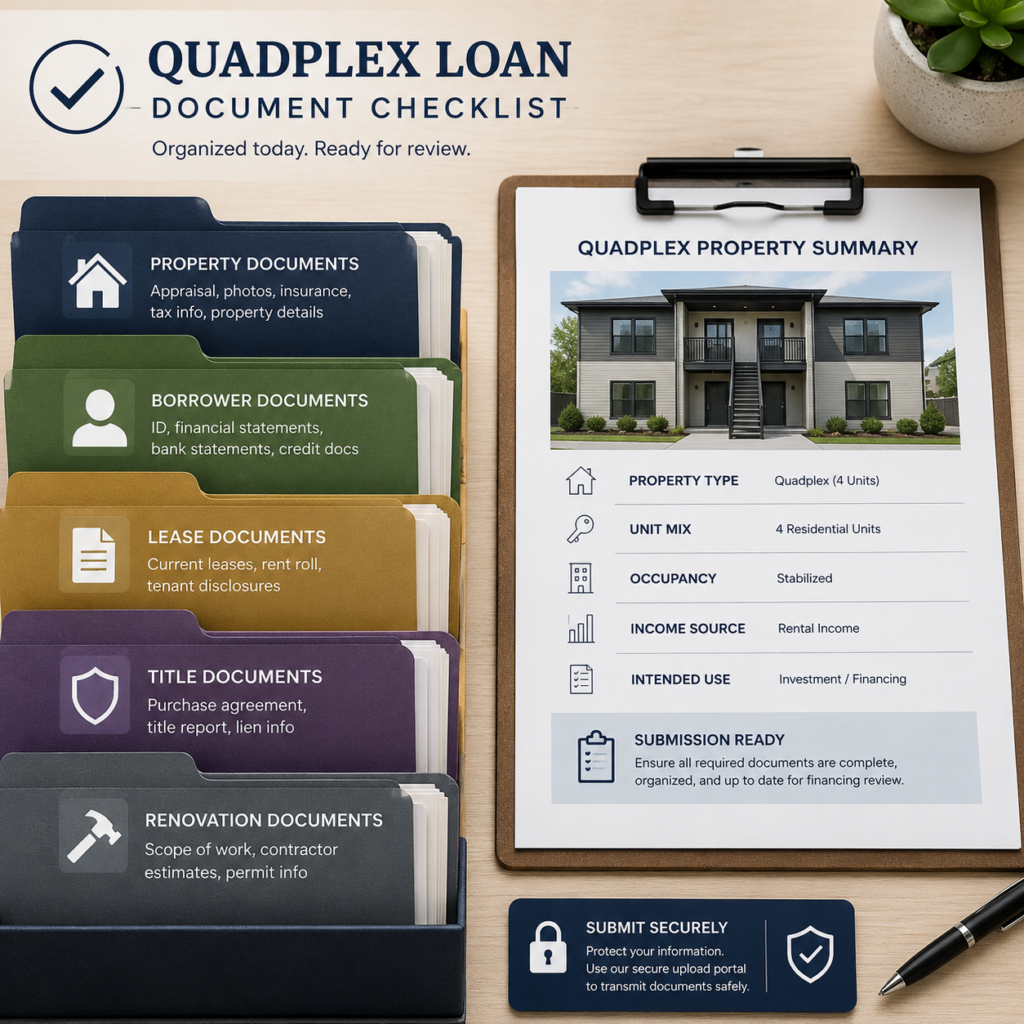
A well-organized submission helps a financing source understand the property, borrower, requested loan purpose, available equity, renovation plan, and proposed exit. Review DPCG’s commercial loan required-documents guide, loan requirement FAQs, and borrower FAQs.
Initial Loan Scenario
- Property address
- Requested loan amount and purpose
- Purchase price or current debt
- Estimated property value
- Current occupancy and monthly rents
- Renovation budget, if applicable
- Requested closing date
- Proposed exit strategy
Property and Rental Documents
- Current rent roll
- Executed leases
- Tenant ledgers and deposit records
- Operating statements
- Property-tax and insurance information
- Photos of all units and exterior
- Appraisal or valuation, if available
- Zoning, permit, or legal-use records
Renovation Documents
- Detailed scope of work
- Line-item budget
- Contractor bids and information
- Permit status
- Project schedule
- Contingency
- Draw schedule
- Current property photos
Borrower and Guarantor Documents
- Credit authorization
- Personal financial statement
- Schedule of real estate owned
- Experience summary
- Liquidity verification
- Bank statements through a secure process
- Background explanations, when applicable
Entity Documents
- Articles of organization or incorporation
- Operating agreement or bylaws
- EIN confirmation
- Certificate of good standing
- Ownership schedule
- Borrowing resolution
- Authorized-signer documents
Acquisition or Refinance Documents
- Executed purchase agreement and amendments
- Earnest-money evidence
- Proof of borrower equity
- Current mortgage statement and payoff demand
- Complete debt schedule
- Requested cash-out and use of proceeds
- Existing lien information
How Does the Quadplex Bridge Loan Process Work?
Initial Scenario Submission
Preliminary Review
Document Collection
Potential Financing-Source Review
Preliminary Terms or Indication
Underwriting and Third-Party Reports
Conditions and Closing Preparation
Closing and Post-Closing Obligations
What Can Delay a Quadplex Bridge Loan?
- Legal unit-count discrepancies: Municipal records do not support four legal units.
- Incomplete rental records: Rent rolls, leases, deposits, and operating statements do not reconcile.
- Unsupported value: The requested loan relies on an estimate not supported by appraisal or market evidence.
- Unclear renovation budget: The scope lacks line items, bids, permits, contingency, or timing.
- Title problems: Unreleased liens, taxes, judgments, ownership discrepancies, or probate issues remain unresolved.
- Insurance problems: Vacancy, claims, old systems, roof condition, or renovation work affects coverage.
- Insufficient equity or liquidity: The borrower lacks funds for closing, repairs, reserves, and unexpected costs.
- Weak exit strategy: The refinance or sale plan depends on unsupported rents, value, occupancy, or timing.
How Can a Borrower Prepare a Stronger Submission?
- Confirm the legal unit count.
- Prepare a unit-by-unit occupancy, rent, lease, and condition summary.
- Reconcile leases, rent rolls, bank deposits, and operating statements.
- Document the complete capital plan, including repairs and reserves.
- Provide a detailed use-of-proceeds breakdown.
- Prepare a realistic renovation scope, budget, and contingency.
- Address title and insurance issues early.
- Explain the exit with measurable milestones.
- Include a backup exit strategy.
- Use an approved secure-upload process for sensitive records.
How Does Direct Private Capital Group, Inc. Assist?
Direct Private Capital Group, Inc. serves as a commercial mortgage broker and private real estate financing resource.
For a qualified quadplex bridge-loan scenario, DPCG may assist by:
- Reviewing the initial request
- Organizing property and borrower information
- Identifying missing documentation
- Clarifying the requested structure and use of proceeds
- Presenting eligible scenarios to possible financing sources
- Communicating questions and conditions
- Helping the borrower understand document requests and next steps
DPCG does not guarantee approval, funding, terms, or closing and is not represented on this page as a direct lender, bank, government agency, debt fund, or owner of committed capital.
Discuss Your Quadplex Bridge-Loan Scenario
Provide the property address, requested loan amount, loan purpose, purchase price or current debt, estimated value, occupancy, rents, renovation budget, borrower experience, requested closing date, and proposed exit strategy. Submitting information does not create an approval, rate lock, commitment to lend, or guarantee of closing.
Quadplex Bridge Loan FAQs
A business-purpose bridge loan may be considered for the acquisition of a non-owner-occupied quadplex when the transaction meets the financing source’s property, borrower, equity, documentation, and exit requirements.
Some financing structures may include approved renovation funds. The borrower may need a detailed scope of work, line-item budget, contractor information, permits, contingency, project schedule, and evidence of funds needed to complete the work.
Vacant units do not automatically prevent review, but the cause of vacancy, unit condition, renovation needs, lease-up plan, market-rent support, liquidity, and reserves may affect the decision and structure.
Current and projected rental income may be relevant, but its importance depends on the program and transaction. Reviewers may also consider collateral value, borrower equity, liquidity, condition, renovation plan, and exit strategy.
This page is limited to verified business-purpose and investment-property financing. Owner occupancy can materially affect legal, regulatory, underwriting, and program treatment and must be reviewed separately.
A quadplex contains four residential units, but its treatment varies by context. Appraisal, lending, zoning, insurance, and regulatory classifications may differ.
Possible exits include refinancing into eligible longer-term rental-property financing, selling the property, or repaying the loan from another documented source.
Closing time depends on file completeness, property condition, title, insurance, appraisal, third-party reports, borrower responsiveness, and satisfaction of closing conditions. No closing timeline is guaranteed.
No. Pricing, leverage, loan amount, term, fees, reserves, recourse, and other conditions depend on current market conditions, the financing source, property, borrower, loan purpose, state, and transaction risk.
Provide the property address, requested amount, loan purpose, purchase price or existing debt, estimated value, occupancy, rents, renovation budget, borrower experience, available funds, requested closing date, and exit strategy.
Compliance Disclaimer
Direct Private Capital Group, Inc. is a commercial mortgage broker and private real estate financing resource. The information on this page is provided for general educational and informational purposes only. It is not a commitment to lend, loan approval, rate lock, guarantee of terms, guarantee of funding, or guarantee of closing.
Any financing is subject to underwriting; borrower and guarantor qualification; verification of business purpose and occupancy; collateral review and valuation; title, insurance, documentation, property condition, third-party reports, state eligibility, financing-source guidelines, market conditions, and applicable law.
Business-purpose and non-owner-occupied investment-property financing only. This page does not offer consumer-purpose residential mortgage financing for personal, family, or household use.
Review the Privacy Policy before submitting personal information. For official business-purpose credit information, review the CFPB Regulation Z resource.