

Home » Land Loans
Finance the acquisition or refinance of eligible raw, vacant, improved, rural, infill, entitled, and development land. Direct Private Capital Group, Inc. assists investors, developers, landowners, business owners, and commercial mortgage brokers with organizing qualified business-purpose land loan scenarios and presenting them to potential financing sources. Each transaction is reviewed individually based on the parcel, access, zoning, utilities, value, borrower strength, equity, intended use, and repayment or exit strategy.
A land loan is financing secured by a parcel that may be vacant, raw, rural, improved, entitled, or intended for future commercial or investment use. Review commonly focuses on the land’s current marketability, legal access, zoning, utilities, physical condition, value, borrower equity, repayment capacity, and a practical plan for development, sale, refinance, or business use. It is one form of commercial real estate financing.
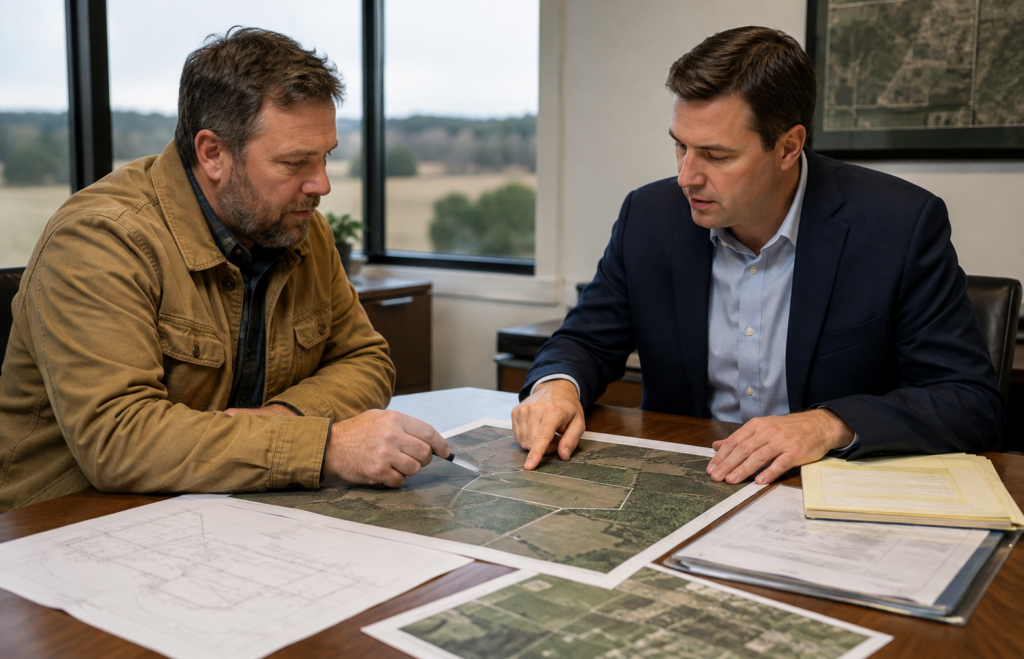
Land financing may be needed when:
Vacant land may produce little or no current income, so underwriting often places greater emphasis on the parcel’s present marketability, legal access, zoning, utilities, environmental conditions, borrower equity, liquidity, carrying costs, and exit strategy.
A transaction may involve raw acreage, public or private road access, easements, wetlands, flood areas, utilities, subdivision approvals, entitlement conditions, development agreements, mineral or water rights, or future construction plans.
Borrowers can review the FEMA Flood Map Service Center for preliminary flood information and the EPA wetland delineation guidance for general environmental information. These resources do not replace property-specific professional review.
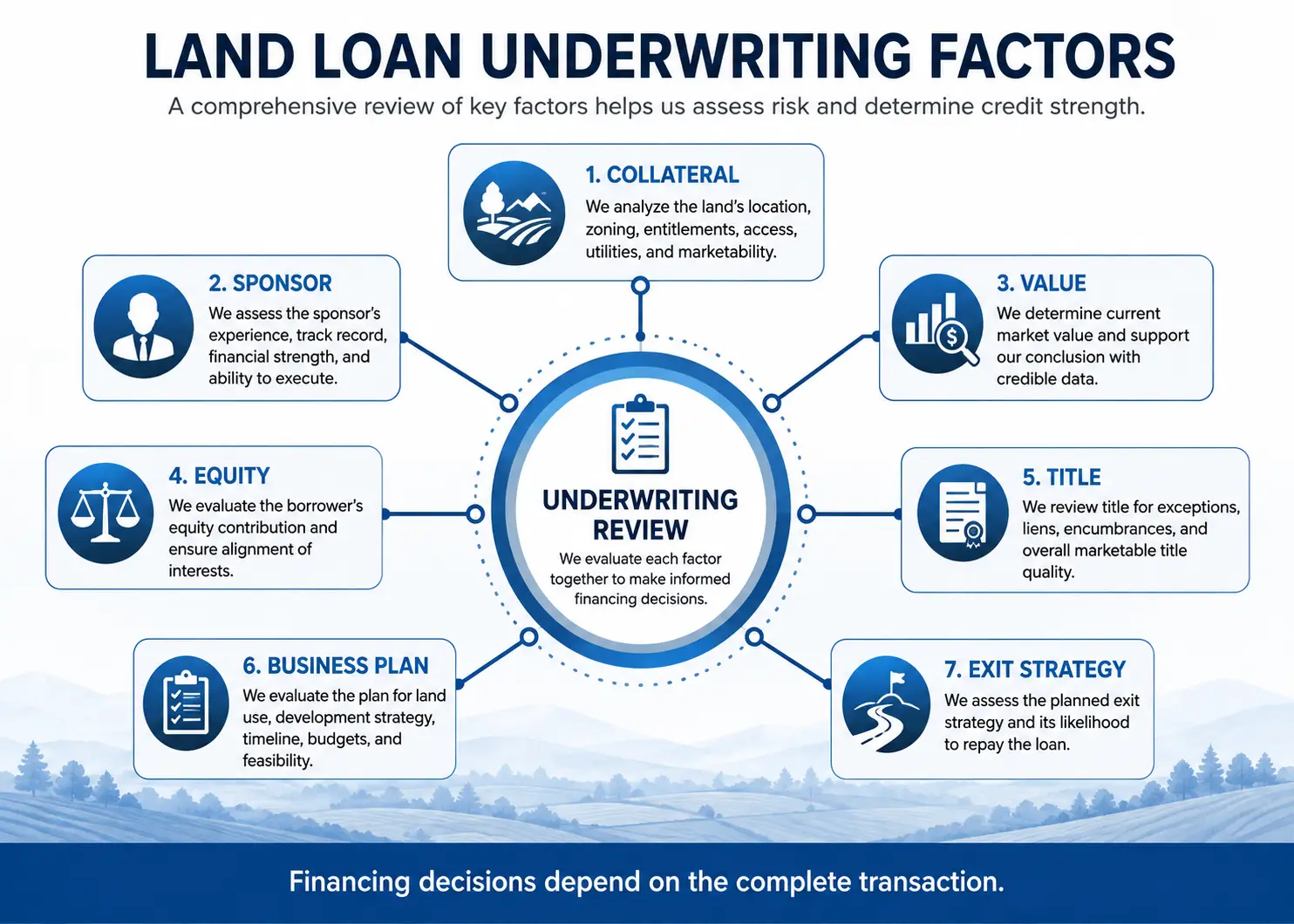
The parcel should be described by its actual current condition rather than only by its proposed future use. Important classifications include raw land, vacant land, improved land, entitled land, infill land, rural land, agricultural land, and commercial development land.
Each category can involve different access, utility, zoning, valuation, environmental, and marketability considerations. The file should clearly separate completed improvements and approvals from work that remains proposed.
Potential uses may include:
Major building projects may require separate ground-up construction financing.
There is no single approval formula for every land loan. Underwriting usually combines property analysis, borrower review, valuation, title, site due diligence, business-plan review, and transaction-specific risk analysis.
Property Location and Marketability
Legal and Physical Access
Zoning and Permitted Use
Utilities and Infrastructure
Topography and Site Condition
Flood and Wetland Conditions
Survey, Easements, and Restrictions
Value, Equity, and Exit Strategy
Title, access, easements, restrictions, environmental conditions, flood areas, wetlands, utility capacity, and incomplete approvals may affect use, transferability, development potential, marketability, and value. These matters should be disclosed early and supported with current documentation.
Loan-to-value, or LTV, compares the proposed loan amount with the current property value accepted for underwriting.
Proposed Loan Amount ÷ Accepted Current Property Value = LTV
The accepted value may be based on an appraisal or another approved valuation method.
Loan-to-cost, or LTC, compares the proposed loan amount with eligible acquisition, site-improvement, or predevelopment costs.
Proposed Loan Amount ÷ Total Eligible Project Cost = LTC
LTC may apply when acquisition and approved site or predevelopment costs are included.
Land carrying costs may include interest, taxes, insurance, maintenance, legal work, engineering, utilities, and extension expenses.
The borrower should explain how carrying costs will be paid throughout the loan term.
As-is value reflects the parcel in its current condition and current approval status as of the valuation date.
Future development potential does not automatically equal current market value.
A prospective value may estimate the property after specified approvals or improvements are completed.
A future value is not the same as present value and should not be presented as though the future condition already exists.
Cost basis may include documented acquisition price and approved capital invested in the parcel. Reserves may support carrying costs and unexpected expenses.
Recognized costs, required equity, reserves, and valuation methods vary by property, borrower, loan purpose, and financing source.
No maximum LTV, LTC, loan amount, rate, term, minimum credit score, reserve requirement, or closing period is represented on this page because those terms require current, transaction-specific verification.
A well-organized submission helps a financing source understand the parcel, borrower, requested loan purpose, current debt, due-diligence status, and proposed exit. Review DPCG’s commercial loan required-documents guide, loan requirement FAQs, and borrower FAQs for additional preparation guidance.
Initial Scenario Review
Preliminary Eligibility Discussion
Document Collection
Financing-Source Review
Preliminary Terms or Indication
Formal Underwriting and Third-Party Reports
Conditions and Final Approval
Closing and Post-Closing Obligations
Direct Private Capital Group, Inc. serves as a commercial mortgage broker and private real estate financing resource.
For a qualified land-loan scenario, DPCG may assist by:
DPCG does not guarantee that a loan will be approved, funded, or closed and should not be described as a direct lender, government agency, bank, debt fund, or owner of committed capital unless current transaction-specific evidence supports that description.

Tell us where the parcel is located, the acreage, land type, current and proposed use, amount requested, estimated value, existing debt, borrower experience, known property issues, and how the financing is expected to be repaid. Submitting information does not obligate you to proceed and does not create a commitment to lend.
Vacant land may qualify when the transaction, collateral, borrower, equity, location, access, value, intended use, and repayment strategy meet a financing source’s requirements. The absence of a completed building generally makes current marketability and the exit strategy especially important.
Raw land generally has limited infrastructure and may lack utilities, grading, roads, drainage, or approvals. Improved land has received some level of site infrastructure or preparation. The exact classification depends on the parcel and completed improvements.
Not for every land loan. Plans may be unnecessary for a simple acquisition or refinance, but they can become important when the request depends on development, entitlement, construction, or a future construction-loan exit.
Potentially. A financing source will generally review ownership, current liens, payment history, property value, loan purpose, requested proceeds, borrower strength, and repayment strategy.
Cash out may be considered when it serves a documented and acceptable business or investment purpose. The amount and structure depend on underwriting, value, lien position, borrower qualification, and the applicable financing source.
Agricultural land may require a financing source that accepts the property’s use and location. Farmers and ranchers may also need to compare private or conventional financing with Farm Credit or USDA agricultural programs.
A financing source must understand whether the property can be legally and practically reached. Informal use of a neighboring road or a visible path does not necessarily establish a recorded access right.
Not automatically. Future or prospective value depends on assumptions and may require approvals, construction, infrastructure, or other work. Financing sources commonly focus on supported current value unless a specific program allows another valuation method.
Many transactions require an appraisal or another approved valuation, but the exact requirement depends on the financing source, loan size, property, and transaction.
There is no universal closing period. Timing depends on the completeness of the submission, appraisal, title, access, survey, environmental review, zoning, borrower documentation, legal work, and satisfaction of closing conditions.
Direct Private Capital Group, Inc. is a commercial mortgage broker and private real estate financing resource.
The information on this page is provided for general educational and informational purposes only. It is not a commitment to lend, loan approval, rate lock, guarantee of terms, guarantee of funding, or guarantee of closing.
Any financing is subject to underwriting; borrower and guarantor qualification; acceptable credit, equity, liquidity, and reserves; collateral review and valuation; confirmation of business purpose; title, survey, legal access, environmental, flood, wetland, insurance, zoning, utility, entitlement, and documentation review; state eligibility; financing-source guidelines; market conditions; and applicable law.
Business-purpose and investment-property financing only. This page does not offer consumer-purpose residential mortgage financing for personal, family, or household use.
Review the Privacy Policy before submitting personal information.