
Shovel-Ready Commercial Land Loans
Financing a commercial site described as shovel-ready requires more than a strong location or an approved concept. Direct Private Capital Group, Inc. helps commercial landowners, buyers, developers, sponsors, and brokers organize qualified business-purpose financing scenarios and present them to potential financing sources. Each request is reviewed individually based on verified approvals, access, utilities, site condition, title, value, budget, sponsor capacity, and the repayment or exit plan.
What Is a Shovel-Ready Commercial Land Loan?
A shovel-ready commercial land loan is business-purpose financing secured by land presented as prepared for near-term development. The phrase “shovel-ready” is not a substitute for underwriting. Financing sources generally examine the actual approvals, site access, utility capacity, environmental status, title, development budget, sponsor resources, and realistic repayment or exit strategy before deciding whether the property and transaction are financeable. It is one type of commercial real estate financing.
When Might Shovel-Ready Commercial Land Financing Be Needed?
Financing may be relevant when:
- A buyer is acquiring a development-ready commercial parcel under a purchase contract.
- An owner needs to refinance maturing or higher-cost land debt.
- A sponsor needs short-term commercial bridge financing before construction or permanent capital is available.
- The property requires remaining engineering, utility, grading, access, permit, or other preconstruction work.
- The owner is carrying the site while completing final conditions, recorded documents, or permits.
- The property is being prepared for a documented sale to a builder, user, or developer.
- The site is moving from land ownership toward a separate ground-up construction loan.
What Does “Shovel-Ready” Mean for a Commercial Site?
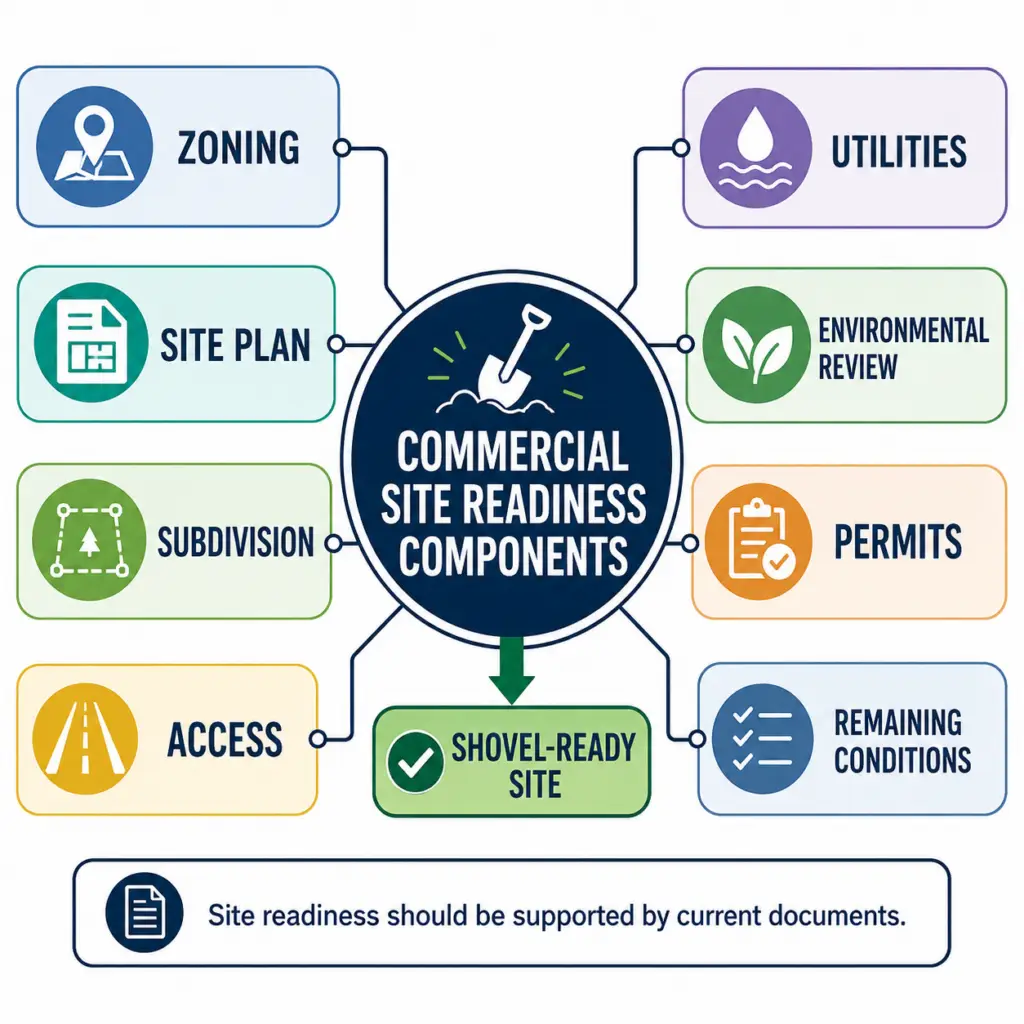
“Shovel-ready” is a practical development-readiness description, not a universal national lending classification. Its meaning depends on the property, jurisdiction, proposed use, approval package, utility status, and work that remains before vertical construction can begin.
A site may be marketed as shovel-ready because it has zoning, land-use approvals, a recorded plat, engineering work, utility commitments, road access, grading, or permits. A financing source will normally want to identify which approvals are final, which are conditional, which can expire, which run with the land, and which require additional work or payment.
For broader context, review entitled commercial land loans and commercial land loans.
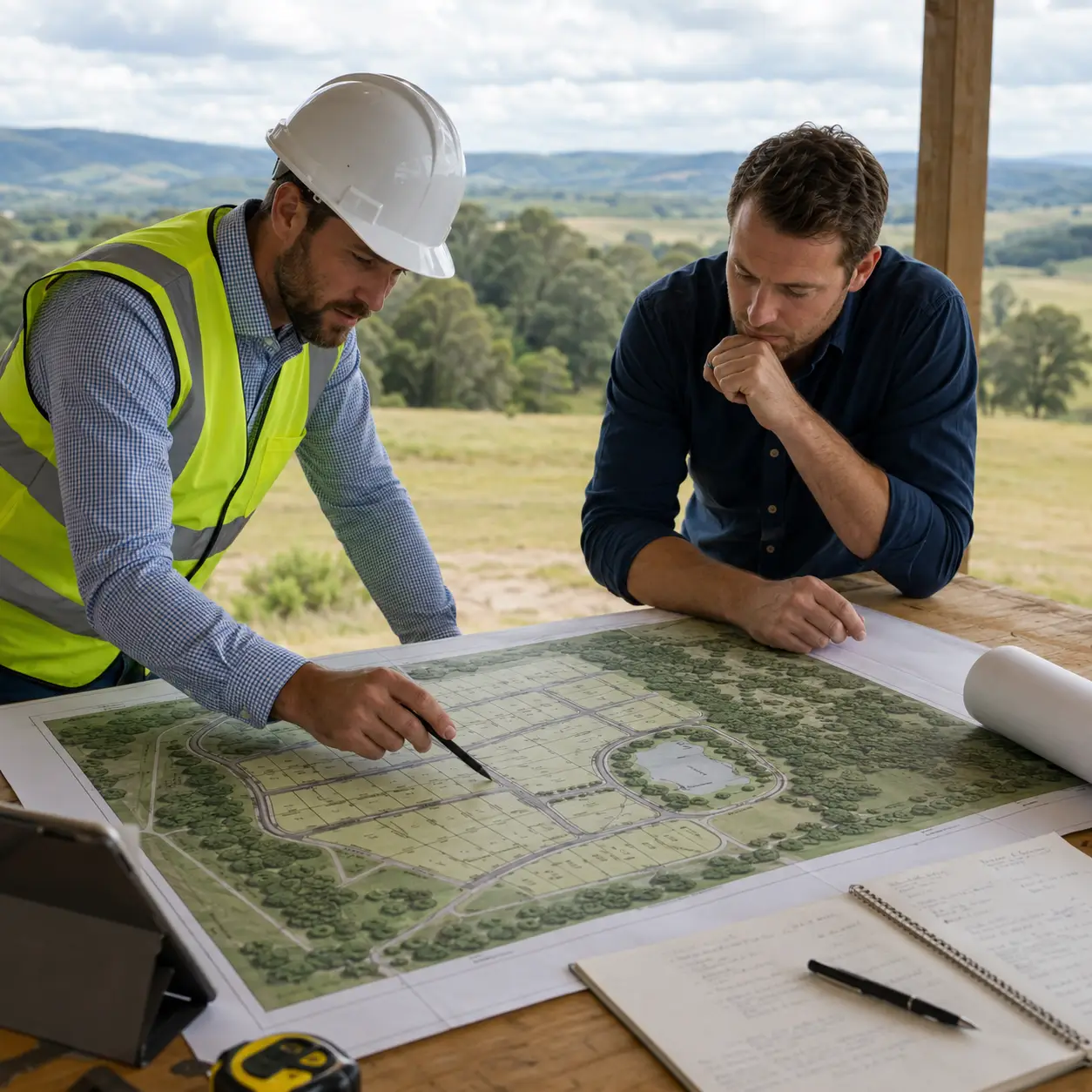
What Site-Readiness Components May Be Reviewed?
Zoning and Land Use
Zoning and Land Use
Site Plan and Subdivision
Site Plan and Subdivision
Access and Transportation
Access and Transportation
Utilities and Capacity
Utilities and Capacity
Environmental and Physical Site
Environmental and Physical Site
Title and Survey
Title and Survey
What Financing Purposes May Be Reviewed?
Acquisition
Purchase financing for a development-ready commercial parcel
- Purchase under an executed contract
- Acquisition of entitled or permitted land
- Purchase of a site with completed access or utility work
- Acquisition before a separate construction closing
- Purchase of land intended for sale to a builder or user
Refinance
Replacing or restructuring existing commercial land debt
- Maturity payoff
- Rate-and-term refinance
- Replacement of seller financing
- Refinance of a bridge loan
- Restructuring after approvals or site work
- Consolidation of eligible real-estate liens
Cash-Out or Capital Recapture
Qualified business-purpose proceeds supported by collateral and underwriting
- Engineering and design costs
- Permit and impact fees
- Utility connectionsor extensions
- Access, grading, drainage, or site work
- Eligible business-debt repayment
- Carrying costs and reserves
- Additional property acquisition
Preconstruction and Site Work
Remaining work needed before vertical construction
- Final engineering
- Grading and earthwork
- Drainage and stormwater improvements
- Utility installation
- Road or access improvements
- Permit completion
- Environmental or site-condition work
Vertical construction may require separate ground-up construction financing.
Bridge or Transitional Uses
Short-term capital for a defined development transition and documented exit
- Pending construction-loan closing
- Completion of final approval conditions
- Sale to a builder, developer, or end user
- Resolution of title or documentation issues
- Temporary financing before permanent debt
- Carrying the site during permit or utility completion
How Is Shovel-Ready Commercial Land Evaluated?
There is no single approval formula for all commercial land loans. Underwriting usually combines collateral analysis, approval verification, site-feasibility review, sponsor review, project-cost analysis, and exit evaluation.
Approvals and Entitlements
Access and Transportation
Utilities and Infrastructure
Environmental and Site Condition
Title and Survey
Value and Cost Basis
Sponsor and Financial Capacity
Exit and Repayment Plan
Official property-specific records should be reviewed directly with the responsible planning, zoning, public works, transportation, and utility agencies. For environmental due diligence, review the U.S. EPA Revitalization-Ready Guide. For flood information, use the FEMA Flood Map Service Center. For wetlands and regulated waters, review U.S. Army Corps of Engineers jurisdictional information.
Which Financial Measurements May Affect Shovel-Ready Land Financing?
Loan-to-Value Ratio
Loan-to-value, or LTV, compares the proposed loan amount with the property value accepted for underwriting.
Formula
Proposed Loan Amount ÷ Accepted Property Value = LTV
The accepted value may be based on an appraisal or another approved valuation method.
Loan-to-Cost Ratio
Loan-to-cost, or LTC, compares the proposed loan amount with eligible acquisition, site-work, or project costs.
Formula
Proposed Loan Amount ÷ Total Eligible Project Cost = LTC
Cost eligibility and treatment vary by financing source.
Cost Basis and Sponsor Equity
Cost basis may include purchase price and verified eligible costs. Sponsor equity is the documented capital remaining at risk.
Review Note
The financing source determines which paid and future costs are recognized and how sponsor equity is calculated.
As-Is and Future Value
As-is value reflects the current condition. As-complete or stabilized value reflects a future condition and is not automatically the current collateral value.
Valuation Note
The appraisal scope depends on the property, approvals, remaining costs, market evidence, and financing request.
Interest, Carry, and Contingency Reserves
Reserves may support interest, taxes, insurance, maintenance, security, site work, and unexpected costs.
Transaction-Specific Review
Reserve requirements vary by property, borrower, loan purpose, risk, timing, and financing source.
Exit Coverage
The proposed construction loan, sale, refinance, or other repayment event must be supported by credible evidence and timing.
No Guaranteed Outcome
A projected future value or exit does not guarantee that the land loan will be approved or repaid.
No maximum LTV, LTC, loan amount, rate, term, minimum credit score, reserve level, or closing time is represented on this page because those terms require current, transaction-specific verification. For survey standards relevant to commercial title and development review, consult the 2026 ALTA/NSPS Land Title Survey Standards.
What Documents Should Be Prepared?
A well-organized submission helps a financing source understand the property, approval status, remaining site work, borrower, requested loan purpose, and proposed exit. Review DPCG’s commercial loan required-documents guide and borrower FAQs for additional preparation guidance.
Initial Loan Scenario
Core facts needed for preliminary review
- Requested loan amount and purpose
- Property address, parcel numbers, and acreage
- Purchase price, current debt, or estimated value
- Proposed commercial use and approval status
- Remaining site work and closing deadline
- Sponsor experience and financial capacity
- Proposed repayment or exit strategy
Property and Approval Documents
Evidence supporting the collateral and development rights
- Deed, legal description, title, tax information, and survey
- Zoning verification, approvals, variances, and conditions
- Approved site plan, recorded plat, and development agreement
- Issued permits and permit-status schedule
- Access, transportation, and utility approvals
Environmental and Site Documents
Reports supporting physical feasibility and risk review
- Phase I and any Phase II environmental reports
- Wetlands, flood, geotechnical, soils, and topographic information
- Drainage, grading, stormwater, and civil-engineering plans
- Utility capacity and connection documentation
- Photographs, aerials, maps, and current site-condition information
Borrower and Entity Documents
Borrower identity, ownership, experience, and financial capacity
- Commercial financing application or scenario summary
- Personal financial statement and real-estate schedule
- Resume or project-experience schedule
- Articles, operating agreement, EIN evidence, good standing, and ownership schedule
- Credit authorization and explanations for material issues
Budget and Capital Documents
Sources, uses, remaining costs, and closing funds
- Sources-and-uses statement
- Detailed remaining site-work budget
- Paid-cost ledger and evidence
- Contractor, engineer, utility, permit, and infrastructure estimates
- Contingency, reserve, equity, and closing-funds evidence
Exit and Repayment Documents
Evidence supporting the proposed repayment event
- Development timeline and milestones
- Construction-loan or takeout plan
- Sale or refinance strategy
- Letters of intent or purchase proposals when genuine
- Tenant commitments or market support when relevant
- Primary and backup exit strategies
What Is Needed for a Shovel-Ready Land Purchase?
A purchase submission may require:
- Executed purchase agreement and amendments
- Escrow and deposit evidence
- Closing deadline and due-diligence period
- Assignment and financing-contingency provisions
- Seller disclosures
- Title, survey, and tax information
- Approval and permit package
- Utility and access documentation
- Site reports and remaining-work budget
- Equity, closing funds, and transition plan
What Is Needed for a Shovel-Ready Land Refinance?
A refinance submission may require:
- Current mortgage statement and payoff demand
- Note, deed of trust or mortgage, and payment history
- Existing loan maturity and lender correspondence
- Other liens, taxes, and insurance status
- Use-of-proceeds breakdown
- Current value support
- Approval and permit status
- Completed-cost and remaining-cost schedules
- Current site-condition information
- Reason for refinancing and repayment or exit plan
How Does the Shovel-Ready Commercial Land Loan Process Work?
Initial Scenario Review
Missing-Item Identification
Document Collection
Financing-Source Review
Preliminary Terms or Indication
Formal Underwriting and Third-Party Reports
Conditions and Final Approval
Closing and Post-Closing Obligations
What Can Delay a Shovel-Ready Commercial Land Loan?
- Unsupported shovel-ready claim: The file uses the term without providing approvals, permits, and site evidence.
- Conditional or expired approvals: Key land-use, site-plan, subdivision, or permit items are incomplete or no longer valid.
- Access or utility uncertainty: Legal access, capacity, connection rights, fees, or extension costs are unresolved.
- Environmental or site concerns: Contamination, wetlands, flood, soils, drainage, slope, fill, or geotechnical issues require further review.
- Title and survey problems: Liens, easements, restrictions, boundary conflicts, or encroachments affect feasibility.
- Unsupported value or budget: Current value, future value, remaining costs, or contingency are not adequately supported.
- Insufficient sponsor support: Liquidity, equity, reserves, experience, or team capacity are unclear.
- Weak exit strategy: The projected construction, sale, or refinance event is not supported by credible evidence.
How Can a Borrower Prepare a Stronger Submission?
- Provide a complete one-page transaction summary.
Include location, acreage, request, use of proceeds, approvals, remaining work, value, budget, timing, sponsor, and exit. - Create an approval matrix.
List each zoning, land-use, subdivision, site-plan, access, utility, and permit item with status and expiration information. - Reconcile the deed, title, survey, site plan, parcel numbers, acreage, and borrowing entity.
- Separate completed costs from future costs.
Support both with invoices, contracts, estimates, and evidence. - Explain all remaining site work.
Identify who will perform it, expected cost, timing, and funding source. - Provide current environmental, flood, wetlands, geotechnical, and other relevant reports.
- Document sponsor equity, liquidity, reserves, experience, and professional team.
- Present a realistic value narrative.
Separate current value from future as-complete or stabilized value. - Provide a primary and backup exit strategy.
- Use an approved secure-upload process for sensitive documents.
How Does Direct Private Capital Group, Inc. Assist?
Direct Private Capital Group, Inc. serves as a commercial mortgage broker and private real estate financing resource.
For a qualified shovel-ready commercial land scenario, DPCG may assist by:
- Reviewing the initial request
- Organizing property, approval, budget, and borrower information
- Identifying missing documentation and unresolved risks
- Clarifying the requested loan structure and use of proceeds
- Presenting eligible scenarios to possible financing sources
- Communicating questions, conditions, and next steps
DPCG does not guarantee that a loan will be approved, funded, or closed and should not be described as a direct lender, bank, debt fund, government agency, or owner of committed capital unless current transaction-specific evidence supports that description.

Start With a Clear Shovel-Ready Commercial Land Scenario
Tell us where the property is located, the acreage, amount requested, use of proceeds, approval status, remaining site work, current debt or purchase price, estimated value, sponsor experience, target closing date, and expected repayment or exit. Submitting information does not obligate you to proceed and does not create a commitment to lend.
Shovel-Ready Commercial Land Loan FAQs
No. The term describes a claimed level of site readiness, but the financing source will independently review the approvals, title, access, utilities, environmental condition, value, budget, sponsor, and exit strategy.
Possibly, depending on the jurisdiction, proposed use, and meaning assigned to the term. The borrower should clearly identify which permits are issued, which are pending, and what conditions remain before construction can begin.
No. Entitlements generally refer to land-use or development rights and approvals. Shovel-ready status may also involve access, utilities, engineering, permits, environmental work, grading, and other site-preparation items.
Not necessarily. Reviewers may request evidence of capacity, connection rights, service points, fees, extension obligations, deposits, and off-site improvements.
Requirements vary by transaction and financing source, but a current environmental assessment is common in commercial real estate due diligence. Additional investigation may be requested when potential concerns are identified.
It can help identify boundaries, easements, access, encroachments, legal-description issues, and other survey matters that may affect title and development feasibility.
Possibly, if the proposed use of proceeds is eligible, fully documented, supported by a budget, and accepted by the financing source. The structure is transaction-specific.
A qualified appraiser may consider the property’s current legal and physical condition, the approvals, comparable sales, market demand, remaining costs, and development risk. Future-condition value is not automatically the same as current collateral value.
The strongest exit is one supported by credible evidence, defined milestones, sufficient time, and backup options. Examples may include a construction-capital closing, an arm’s-length sale, or a refinance, but none is guaranteed.
There is no universal closing period. Timing depends on file completeness, valuation, title, survey, environmental and engineering review, approval verification, insurance, legal review, property complexity, financing-source requirements, and resolution of conditions.
Compliance Disclaimer
Direct Private Capital Group, Inc. is a commercial mortgage broker and private real estate financing resource.
The information on this page is provided for general educational and informational purposes only. It is not a commitment to lend, loan approval, rate lock, valuation, guarantee of terms, guarantee of funding, or guarantee of closing.
Any financing is subject to underwriting; borrower, guarantor, and entity qualification; acceptable credit, equity, liquidity, and reserves; collateral review and valuation; title, survey, access, utilities, environmental, engineering, zoning, permit, insurance, and documentation review; state eligibility; financing-source guidelines; market conditions; and applicable law.
Business-purpose and investment-property financing only. This page does not offer consumer-purpose residential mortgage financing for personal, family, or household use.
Review the Privacy Policy before submitting personal information. For environmental due-diligence information, review the U.S. EPA Revitalization-Ready Guide.