
Entitled Commercial Land Loans
Financing for business-purpose commercial land with documented zoning, subdivision, site-plan, development, or permit approvals. Direct Private Capital Group, Inc. helps commercial landowners, buyers, developers, sponsors, and business-purpose real estate investors organize qualified financing scenarios for review by potential financing sources.
What Is an Entitled Commercial Land Loan?
An entitled commercial land loan is business-purpose financing secured by land that has one or more documented governmental approvals for a proposed development. The exact meaning of “entitled” depends on the jurisdiction and the approvals obtained. Financing review focuses on what is actually approved, whether approvals remain valid and transferable, remaining work and cost, collateral value, sponsor strength, and a realistic repayment or exit strategy. This is a specialized form of commercial land financing.
Why Borrowers Seek Financing on Entitled Commercial Land
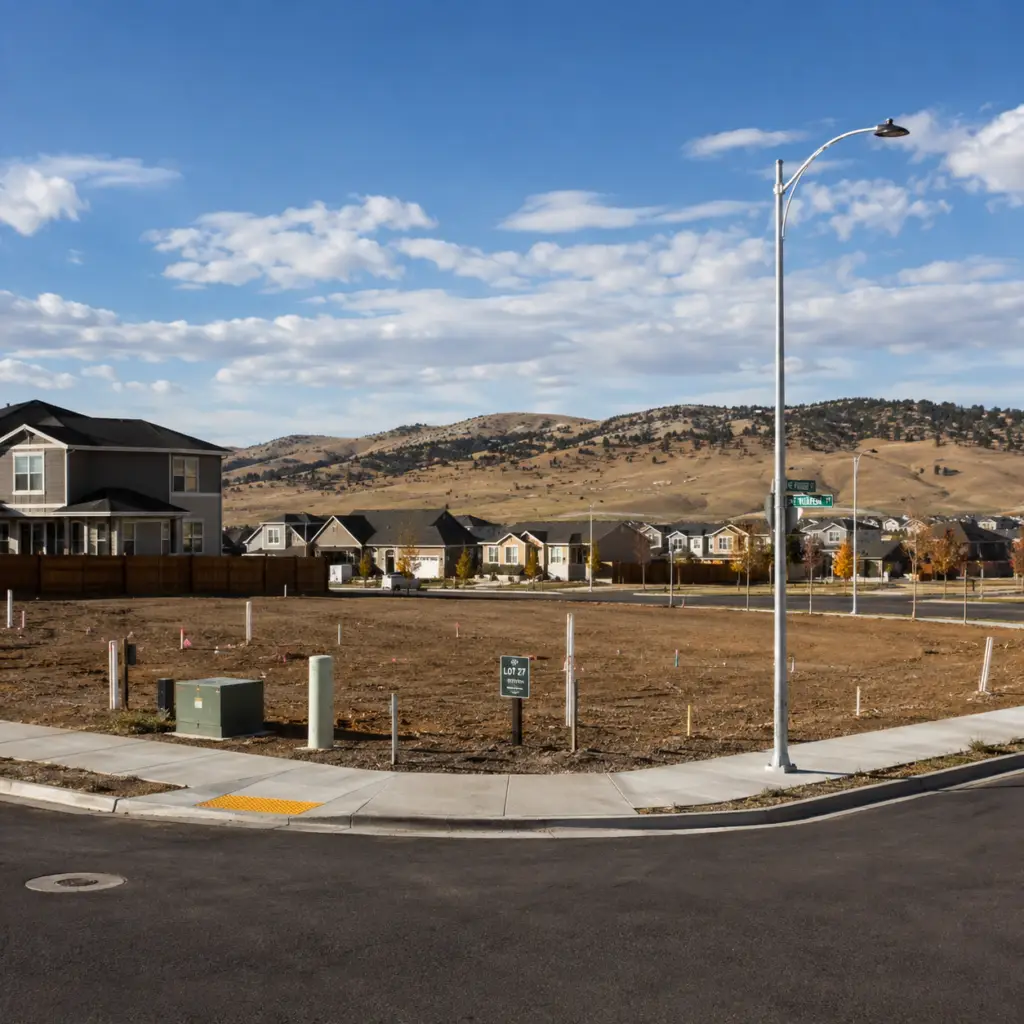
Commercial land may be valuable because of its approved use, but an entitlement does not automatically create liquidity or guarantee that construction can begin. Borrowers may seek financing to:
- Acquire an entitled development parcel under a purchase contract.
- Refinance an existing land loan or upcoming maturity.
- Pay off liens or consolidate business-purpose debt secured by the site.
- Fund eligible engineering, permitting, impact-fee, utility, or site-preparation costs.
- Use commercial bridge financing before a construction loan or sale.
- Carry the site while marketing it to a builder, operator, or end buyer.
- Recapitalize a project after entitlement work has increased development potential.
When vertical construction is imminent, ground-up construction financing may be more appropriate.
What Does “Entitled Land” Actually Mean?
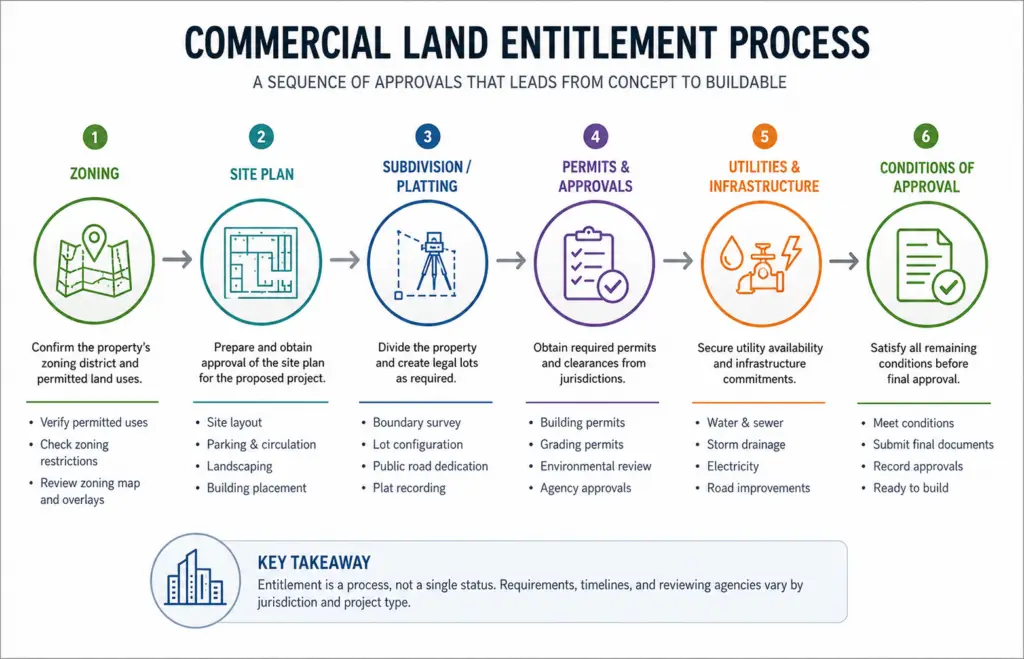
Entitlement is not a single nationwide status. It is a collection of approvals issued or recognized by the government bodies that control land use and development. The borrower should identify every approval, issuing authority, approval date, expiration date, conditions, appeal status, transfer rules, and remaining steps.
A zoning approval, subdivision map, conditional-use permit, site-plan approval, development agreement, building or grading permit, and utility or access commitment may each represent a different stage of readiness. Each must be verified for scope, validity, transferability, remaining conditions, fees, and limitations.
What Risks and Limitations Should Borrowers Understand?
Entitled land remains a higher-execution-risk asset than stabilized income-producing property. Approvals may contain conditions, expire, be challenged, require costly infrastructure, or fail to support the value assumed by the borrower. An entitlement is not the same as a building permit or a guarantee that construction may begin. A financing source may recognize less value than the borrower attributes to approvals or future development. Land may not generate enough cash flow to pay debt service without reserves or outside income. Pre-development costs may not be fully recoverable if the project changes or is not completed. Refinancing can be difficult when milestones, permits, equity, or market conditions do not support a takeout. A sale may take longer or produce lower net proceeds than projected. Default remedies may include foreclosure and loss of invested equity. Legal, tax, zoning, environmental, engineering, and entitlement questions require advice from qualified professionals.
Which Approvals or Items May Establish Entitlement Status?
Zoning or Rezoning
Zoning or Rezoning
Conditional or Special Use
Conditional or Special Use
Site-Plan Approval
Site-Plan Approval
Subdivision or Parcel Map
Subdivision or Parcel Map
Development Agreement
Development Agreement
Permits, Utilities, and Access
Permits, Utilities, and Access
What Property and Transaction Factors Are Reviewed?
Entitlement Quality and Remaining Conditions
- All resolutions, ordinances, permits, maps, development agreements, staff reports, and approval letters
- A current entitlement matrix with remaining conditions, costs, responsible parties, and sequence
- Evidence approvals are effective, unchallenged, transferable, and not expired
- Status of impact fees, exactions, dedications, public improvements, bonds, and other conditions
Location, Access, Utilities, and Physical Feasibility
- Legal and practical public-road access
- Water, sewer, power, gas, telecommunications, and stormwater service
- Utility capacity, connection points, extension costs, easements, fees, and timing
- Topography, drainage, grading, soils, wetlands, flood hazards, parcel configuration, and off-site obligations
Sponsor and Guarantor
- Relevant ownership, entitlement, development, construction, and exit experience
- Capacity to fund closing, carrying costs, overruns, and reserves
- Net worth, contingent liabilities, real estate exposure, litigation, and credit history
- Equity already invested and continuing financial commitment
Value, Basis, and Market Support
- Purchase price or historical cost basis
- Verified entitlement and pre-development expenditures
- Current as-is value through an acceptable valuation process
- Comparable entitled-land sales, absorption, end-user demand, and feasibility
- Sensitivity to approval scope, infrastructure cost, market demand, and exit timing
See the FDIC appraisal and evaluation resources for general valuation information.
Title, Taxes, Insurance, and Legal Structure
- Vesting, legal description, parcel numbers, title exceptions, liens, easements, deed restrictions, and taxes
- Ownership entity, governing documents, authority to borrow, and beneficial ownership
- Consistency among title, survey, plans, and entitlement documents
- Insurance appropriate to current condition and planned activities
- Litigation, appeals, bankruptcy, ownership disputes, or development obligations
How Is an Entitled Commercial Land Site Evaluated?
The review is transaction-specific. No single factor establishes eligibility, value, or approval. Financing sources generally combine approval verification, site feasibility, sponsor review, market support, legal due diligence, collateral valuation, and the primary and backup exit strategies.
Documented Approvals
Remaining Conditions and Costs
Legal and Practical Access
Utilities and Capacity
Zoning and Permitted Use
Environmental, Flood, and Site Conditions
Title, Survey, Easements, and Restrictions
Sponsor Strength, Value Support, and Exit
Environmental and flood review may materially affect feasibility, value, and timing. Review the EPA property due-diligence guide, EPA All Appropriate Inquiries guidance, and the FEMA Flood Map Service Center.
How Are Loan and Financial Metrics Considered?
Loan-to-Value (LTV)
Loan amount divided by the accepted collateral value. It shows the proposed debt relative to current value recognized in underwriting.
Loan-to-Cost (LTC)
Loan amount divided by eligible acquisition or project cost. It helps measure borrower equity and total project exposure.
Cost Basis
Documented acquisition and eligible capitalized costs. It separates actual investment from projected future value.
As-Is Value
Current market value in the property’s present condition and verified approval status.
Prospective Value
Estimated value after identified work or milestones; considered only when assumptions, costs, timing, and completion risk are supportable.
Interest Reserve
Funds set aside for interest during a defined period; potentially relevant when the land does not produce income.
Exit Coverage
The margin between expected exit proceeds and debt due; used to test sale, refinance, or construction-loan takeout support.
Sponsor Equity
Cash and documented cost invested by the sponsor, plus the continuing financial commitment to the project.
Carrying Costs
Taxes, insurance, interest, maintenance, security, and other costs required while the land is held.
Utility and Infrastructure Cost
Connection, extension, off-site, bonding, and public-improvement obligations that affect feasibility and value.
Interest Reserve
Funds set aside to pay loan interest for a defined period
Reserve Relevence
May be relevant when the land does not produce income, subject to structure and underwriting
No program percentage, minimum threshold, rate, term, fee, credit score, or closing timeline is stated on this page because those items vary by transaction and financing source and require current verified support. For general regulatory context, see the FDIC commercial real estate lending resources.
What Documents Are Commonly Needed?
A complete file allows the entitlement status, collateral, borrower, and exit strategy to be evaluated without relying on assumptions. Review DPCG’s commercial loan required-documents guide for broader preparation guidance.
Initial Scenario
- Property address, parcel numbers, acreage, and ownership
- Requested amount and use of proceeds
- Purchase, refinance, cash-out, payoff, or pre-development purpose
- Current debt, maturity, payoff information, and lien position
- Estimated current value and support
- Expected closing date; primary and backup exits
Entitlements and Development Status
- Entitlement summary or approval matrix
- Zoning, permitted-use, site-plan, subdivision, conditional-use, special-use, or development approvals
- Resolutions, ordinances, staff reports, hearing records, and recorded agreements
- Permit log, conditions of approval, and satisfaction evidence
- Development and improvement agreements; public-infrastructure obligations
Property and Third-Party Due Diligence
- Title commitment or preliminary title report
- ALTA/NSPS or other acceptable survey, when required
- Environmental report and follow-up investigation or remediation information
- Flood, drainage, geotechnical, soils, wetlands, traffic, utility, and access reports
- Taxes, assessments, special districts, liens, and development fees
- Appraisal, broker opinion, market study, comparable-sales analysis, and insurance information
Borrower, Guarantor, and Entity
- Entity documents, good standing, ownership chart, and authorized signers
- Identification through an approved secure process
- Personal financial statement, real estate schedule, and liquidity verification
- Credit authorization and background information when required
- Development, entitlement, construction, ownership, and disposition experience
- Litigation, bankruptcy, contingent-liability, and related-party disclosures
Acquisition, Refinance, and Use of Proceeds
- Purchase agreement, amendments, earnest-money evidence, and source of equity
- Existing note, mortgage or deed of trust, payoff demand, and payment history
- Detailed sources-and-uses statement
- Itemized eligible pre-development, site, or infrastructure budget
- Contracts, bids, invoices, and paid-cost evidence
- Explanation and support for cash-out proceeds
Exit Strategy
- Construction-loan plan, lender discussions, or takeout requirements
- Marketing plan, listing agreement, letters of intent, contract, or buyer discussions
- Schedule for entitlement, design, permits, infrastructure, and capitalization
- Updated budget, contingency, carrying costs, taxes, insurance, interest, and reserves
- Backup plan if the primary exit is delayed or unavailable
What Is the Typical Review Process?
Initial Scenario Review
Document and Eligibility Review
Preliminary Discussion or Term Indication
Underwriting
Third-Party Reports
Conditions and Documentation
Closing
Post-Closing Obligations
What Commonly Delays or Prevents a Land Loan?
- “Entitled” is used without copies of actual approvals.
- Approvals are expired, appealed, conditional, nontransferable, or inconsistent with plans.
- Critical conditions are missing from the budget or timeline.
- Utility service, access, drainage, off-site improvements, or capacity is uncertain.
- Title, survey, legal description, parcel configuration, or ownership records do not match.
- Environmental, wetlands, flood, geotechnical, or other site constraints require work.
- Value depends on approvals or density not currently in place.
- Cost basis, equity, liquidity, or use of proceeds is unsupported.
- The exit depends on an uncommitted construction loan, speculative buyer, or unrealistic price.
- Plans, budgets, studies, and schedules are outdated or inconsistent.
How Can a Borrower Prepare a Stronger Submission?
- Create a one-page transaction summary. State the property, acreage, entitlement status, request, use of proceeds, value, equity, timing, and exit.
- Prepare an entitlement matrix. List each approval, agency, date, expiration, conditions, transfer status, and remaining action.
- Organize approvals and plans by category and date.
- Reconcile the legal description, parcel map, survey, title, site plan, and appraisal.
- Support every major budget item with a realistic sources-and-uses statement.
- Show actual cash invested and capacity for carrying costs and overruns.
- Address site issues early, including access, utilities, flood, wetlands, environmental, soils, grading, and off-site work.
- Support the exit with objective evidence and a backup plan.
- Identify weaknesses directly and explain the solution, cost, responsible party, and timeline.
- Use a secure delivery process for sensitive records.
How Direct Private Capital Group, Inc. Assists
Direct Private Capital Group, Inc. is a commercial mortgage broker and private real estate financing resource. DPCG can:
- Review an entitled commercial land scenario
- Identify missing information
- Help organize the submission
- Communicate the transaction to possible financing sources
- Coordinate information during the process
DPCG is not represented on this page as a direct lender, bank, agency lender, debt fund, servicer, or owner of committed capital and does not guarantee approval, terms, funding, or closing.
Have an Entitled Commercial Land Scenario?
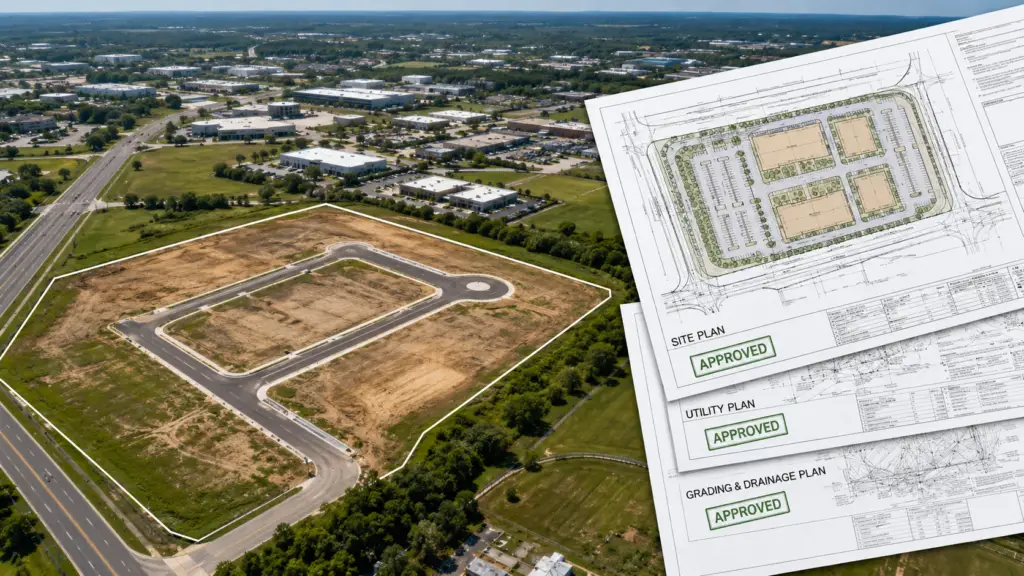
Provide the property location, acreage, entitlement summary, requested loan amount, use of proceeds, current value support, existing debt, sponsor experience, and exit strategy. A focused initial package helps determine what additional information is needed before a financing source can evaluate the request.
Submission does not constitute application approval, a commitment to lend, a rate lock, or a guarantee of financing. You may also contact Direct Private Capital Group or call (800) 664-7505.
Entitled Commercial Land Loan FAQs
Land is commonly described as entitled when a public authority has approved one or more development rights or plans, such as zoning, a conditional use, site plan, subdivision map, development agreement, or permit. The exact status depends on the jurisdiction and documents issued.
No. Entitled land may still require final engineering, permits, utility work, impact fees, bonding, grading, infrastructure, environmental work, or satisfaction of approval conditions.
Acquisition financing may be considered when the property, borrower, equity, contract, entitlement status, value, use of proceeds, and exit meet applicable guidelines.
A refinance may be considered based on current value, lien position, payoff, entitlement status, borrower strength, carrying costs, use of proceeds, and a credible repayment strategy.
A financing source may require an appraisal, evaluation, or other valuation product based on its policies and the transaction. The accepted value may differ from the borrower’s estimate.
Requirements vary. A financing source may require a Phase I or other review. Prospective owners seeking certain federal liability protections should review EPA All Appropriate Inquiries guidance with qualified professionals.
No single document replaces a complete file. A clear entitlement matrix supported by actual approval documents is especially useful because it shows what is approved, what remains, expiration dates, and responsible parties.
Prospective or as-complete value may be considered only when assumptions, approvals, costs, timeline, and completion plan are sufficiently supported. A financing source may rely primarily on current as-is value.
Common exits include sale of the entitled site, a construction-loan closing, refinance after defined milestones, or repayment from another verified business source. Primary and backup exits must be realistic.
Timing depends on file completeness, valuation, title, environmental review, entitlement verification, legal documentation, borrower responsiveness, financing-source requirements, and complexity. No closing time is guaranteed.
Compliance Disclaimer
Direct Private Capital Group, Inc. is a commercial mortgage broker and private real estate financing resource. The information on this page is for general informational and educational purposes and is not a commitment to lend, approval, rate lock, term sheet, legal opinion, appraisal, or guarantee of financing, terms, funding, or closing.
Any financing is subject to complete underwriting; borrower and guarantor qualification; acceptable collateral, valuation, title, insurance, environmental, entitlement, zoning, survey, documentation, and third-party review; state eligibility; lender, investor, or capital-provider guidelines; market conditions; and applicable law. Available structures, rates, leverage, loan amounts, fees, reserves, recourse, credit requirements, eligible uses, and timing vary by transaction and financing source.
Business-purpose and investment-property financing only where applicable. This page is not legal, tax, accounting, environmental, engineering, zoning, investment, or financial advice. Borrowers should consult qualified professionals regarding their property, approvals, obligations, and transaction.