

Commercial Development Parcel Loans
Finance the acquisition, refinance, entitlement, predevelopment, or transition of qualifying commercial development land. Direct Private Capital Group, Inc. assists developers, landowners, investors, sponsors, and brokers with organizing qualified business-purpose financing scenarios and presenting them to potential financing sources. Each transaction is reviewed individually based on the parcel, current approvals, borrower, equity, development plan, requested structure, and repayment strategy.
What Is a Commercial Development Parcel Loan?
A commercial development parcel loan is business-purpose financing secured by land intended for a commercial real estate project. It may support acquisition, refinancing, entitlement work, predevelopment expenses, or a transition to construction financing. Approval depends on the specific property, sponsor, development plan, equity, due diligence, and proposed exit. It is one form of commercial real estate financing.
When Is Commercial Development Parcel Financing Used?
Commercial development parcel financing may be used when:
- A developer is acquiring vacant or underimproved commercial land.
- An owner needs to refinance a maturing land or acquisition loan.
- A borrower needs short-term bridge financing before construction financing is available.
- The project requires zoning, entitlement, engineering, survey, environmental, or permit work.
- A sponsor is assembling multiple adjoining parcels into one development site.
- The parcel is being held while final plans, permits, budgets, or contractor arrangements are completed.
- The owner is preparing the site for sale, recapitalization, or a construction-loan takeout.
How Are Commercial Development Parcel Loans Different From Completed-Property Loans?
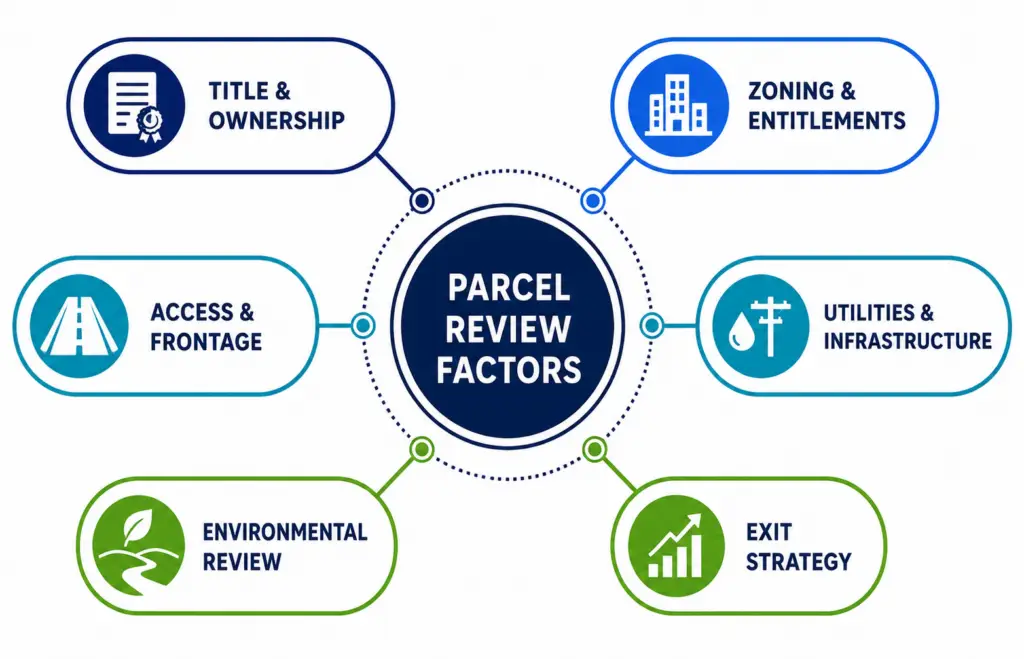
Development parcels often produce little or no current rental income. As a result, the financing review may depend more heavily on the parcel’s present condition, zoning, entitlement status, access, utilities, environmental conditions, title, sponsor strength, equity, liquidity, budget, and exit strategy.
A completed income-producing property may be evaluated substantially through stabilized cash flow. A development parcel instead requires a clear connection between what exists today, what has been approved, what remains to be completed, how much capital is required, and how the loan will be repaid.
Projects that are ready for vertical construction may be better suited to ground-up construction financing.

What Qualifies as a Commercial Development Parcel?
A commercial development parcel is land being held, acquired, or prepared for a commercial or investment-property use. Depending on zoning and approvals, the proposed development may involve multifamily, mixed-use, retail, office, industrial, self-storage, hospitality, medical office, assisted living, student housing, or another permitted business-purpose project.
The intended use does not establish that the parcel is approved or financeable. The file should document current zoning, applicable overlays, land-use restrictions, entitlement status, access, utilities, environmental constraints, approval conditions, and expiration dates.
Which Commercial Development Scenarios May Be Considered?
Raw or Unentitled Land
Raw or Unentitled Land
Entitled Commercial Land
Entitled Commercial Land
Permit-Ready Sites
Permit-Ready Sites
Parcel Assemblage
Parcel Assemblage
Horizontal Development
Horizontal Development
Income-Producing Development Land
Income-Producing Development Land
What Loan Purposes May Be Reviewed?
Acquisition
- Vacant commercial land purchase
- Entitled parcel acquisition
- Permit-ready site purchase
- Multiple-parcel assemblage
- Purchase of a partially improved development site
- Acquisition before construction financing
Refinance
- Maturing land-loan payoff
- Rate-and-term refinance
- Replacement of seller financing
- Refinance after entitlement progress
- Consolidation of eligible parcel debt
- Bridge-loan refinance
Entitlement and Predevelopment
- Zoning and entitlement work
- Architecture and engineering
- Surveys and environmental review
- Geotechnical and utility studies
- Permit and impact fees
- Approved carrying costs and reserves
Horizontal Development
- Grading and drainage
- Roads, curbs, and sidewalks
- Water, sewer, electric, and utility extensions
- Stormwater improvements
- Offsite improvements
- Eligible site-work contingencies
Vertical construction may require separate construction financing.
Bridge or Transitional Uses
- Time to complete final approvals
- Preparation for a construction-loan closing
- Title, access, or documentation resolution
- Sale or recapitalization preparation
- Temporary financing before a documented takeout
- Completion of deferred predevelopment work
How Is a Commercial Development Parcel Evaluated?
There is no single approval formula for all development-land loans. Underwriting generally combines collateral analysis, borrower review, development feasibility, due diligence, equity, liquidity, and exit-strategy analysis.
Current Property Condition
Zoning and Proposed Use
Entitlement Status
Access and Easements
Utilities and Infrastructure
Environmental and Wetlands
Sponsor, Equity, and Liquidity
Budget and Exit Strategy
Preliminary site review may include the USDA Web Soil Survey, but property-specific engineering and geotechnical work may still be necessary. Environmental review may include a Phase I Environmental Site Assessment under the EPA All Appropriate Inquiries framework. Potential wetlands or regulated waters may require review through the U.S. Army Corps of Engineers Regulatory Program. The OCC Commercial Real Estate Lending Handbook also illustrates why acquisition, development, and construction transactions receive detailed collateral, sponsor, feasibility, and repayment analysis.
Which Financial Measurements May Affect Development Parcel Financing?
Loan-to-Value Ratio
Subheading: Compares the proposed loan amount with the accepted current property value. An as-is value should not be confused with a future completed-project value.
Formula
Proposed Loan Amount ÷ Accepted Current Property Value = LTV
The accepted value may be based on an appraisal or another approved valuation method.
Loan-to-Cost Ratio
Subheading: Compares the proposed loan amount with eligible acquisition, entitlement, predevelopment, site-work, or project costs.
Formula
Proposed Loan Amount ÷ Total Eligible Project Cost = LTC
The financing source determines which documented costs are eligible.
Debt-Service Coverage Ratio
Subheading: DSCR may be relevant when the parcel has durable current income, but it may have limited application to vacant land.
Formula
Underwritten Net Operating Income ÷ Annual Debt Service = DSCR
The financing source determines which income and expenses are recognized.
Cost Basis
Subheading: Verified purchase price and eligible capital invested may help establish the borrower’s basis in the property.
Basis Review
Purchase documents, settlement statements, invoices, receipts, and existing debt should reconcile with the sources-and-uses statement.
As-Is, As-Entitled, and As-Complete Value
Subheading: These values reflect different property conditions and assumptions and should not be treated as interchangeable.
Valuation Note
A prospective or as-complete value does not eliminate the approvals, costs, time, construction work, and execution risks required to reach that condition.
Interest and Carrying Reserves
Subheading: Reserves may support eligible interest, taxes, insurance, security, maintenance, and other approved carrying costs.
Transaction-Specific Review
Recognized costs, required reserves, advance controls, and disbursement conditions vary by transaction and financing source.
No maximum LTV, LTC, loan amount, rate, term, minimum credit score, closing time, or state availability is represented on this page because those terms require current, transaction-specific verification. Borrowers should also review DPCG’s commercial loan required-documents guide and loan requirement FAQs.
What Documents Should Be Prepared?
A well-organized submission helps a financing source understand the parcel, borrower, current approvals, requested loan purpose, development plan, equity, and proposed exit. Review DPCG’s commercial loan required-documents guide, loan requirement FAQs, and borrower FAQs for additional preparation guidance. The EPA redevelopment due-diligence guide explains how environmental and broader real estate due diligence can affect a property’s transfer and reuse.
Initial Loan Scenario
- Requested loan amount and purpose
- Property address and parcel numbers
- Parcel size and current condition
- Proposed development
- Purchase price or current payoff
- Estimated current value
- Equity available
- Requested closing date
- Primary and backup exit strategy
Property and Title Documents
- Deed, legal description, parcel map, and survey
- Title commitment and exception documents
- Tax bills and special assessments
- Access, easement, and shared-road agreements
- Current photographs and aerial map
- Existing leases, licenses, or occupancy agreements
- Flood and wetland information
Zoning, Entitlements, and Permits
- Zoning confirmation
- Approved site plan
- Rezoning, variance, or conditional-use approvals
- Development agreement
- Subdivision or plat approvals
- Conditions of approval
- Issued permits and applications
- Expiration dates and agency correspondence
Borrower and Entity Documents
- Commercial loan application
- Personal financial statement
- Schedule of real estate owned
- Sponsor resume and project history
- Liquidity evidence through a secure process
- Articles, operating agreement, EIN, and good standing
- Ownership schedule and borrowing resolutions
Development and Due-Diligence Documents
- Architecture and engineering plans
- Environmental and geotechnical reports
- Utility-capacity letters
- Drainage, traffic, and stormwater studies
- Contractor information and bids
- Detailed development schedule
- Sources and uses, budget, contingency, and cost-to-complete analysis
Financial and Exit Documents
- Existing debt and payoff statements
- Historical operating statements when applicable
- Bank statements through a secure process
- Invoices supporting prior capital invested
- Projected cash flow and carrying costs
- Construction-loan discussion or term indication
- Sale, recapitalization, or takeout support
- Backup repayment plan
What Is Needed for a Commercial Parcel Purchase?
A purchase submission may require:
- Executed purchase and sale agreement
- All amendments and addenda
- Escrow information
- Earnest-money deposit evidence
- Closing deadline and extension rights
- Due-diligence expiration date
- Assignment provisions
- Seller-financing terms, if applicable
- Source-of-funds evidence
- Survey and title
- Zoning and entitlement documents
- Development and transition plan
What Is Needed for a Commercial Parcel Refinance?
A refinance submission may require:
- Current mortgage statement and payoff demand
- Existing note, deed of trust, or mortgage
- Payment history and maturity date
- Existing lender correspondence
- Other liens, judgments, or tax obligations
- Property tax and insurance status
- Itemized use-of-proceeds breakdown
- Current value support
- Verified capital invested
- Current entitlement and development status
- Reason for refinancing
- Repayment and backup exit plan
How Does the Commercial Parcel Loan Process Work?
Initial Scenario Review
Preliminary Financing Discussion
Document Collection
Financing-Source Review
Preliminary Terms or LOI
Formal Underwriting and Third-Party Reports
Conditions and Closing Preparation
Closing and Post-Closing Obligations
What Can Delay a Commercial Development Parcel Loan?
- Incomplete property information: Missing legal descriptions, parcel maps, surveys, photographs, zoning, or intended-use details.
- Unsupported value: The request depends on a future value that is not supported by current approvals or appraisal evidence.
- Unclear zoning or entitlements: The proposed use conflicts with current rules, approvals have expired, or conditions remain unresolved.
- Access or utility problems: Legal access, capacity, connection rights, or extension costs are uncertain.
- Environmental or wetland concerns: Prior use, contamination, wetlands, regulated waters, or remediation require added review.
- Title defects: Unreleased liens, ownership disputes, judgments, easements, restrictions, or conflicting legal descriptions.
- Weak budget or insufficient liquidity: Costs, contingencies, reserves, or equity are not adequately supported.
- Unclear use of proceeds or exit: The requested funds and repayment strategy are not documented.
How Can a Borrower Prepare a Stronger Submission?
- Provide a complete one-page executive summary.
Include the parcel, current condition, proposed development, requested amount, equity, approvals, timing, and exit. - Separate current facts from future plans.
Label existing, approved, proposed, and projected conditions clearly. - Create an entitlement matrix.
List each approval, issuing authority, status, expiration date, remaining conditions, and expected completion date. - Use a detailed sources-and-uses statement.
Reconcile the purchase contract, payoff, budget, invoices, and borrower equity. - Address title, access, utility, environmental, and zoning issues early.
- Document sponsor experience and the project team.
- Support the exit strategy with evidence and a backup plan.
- Use consistent filenames and one controlled document version.
- Protect sensitive information through an approved secure-upload process.
How Does Direct Private Capital Group, Inc. Assist?
Direct Private Capital Group, Inc. serves as a commercial mortgage broker and private real estate financing resource.
For a qualified commercial development parcel scenario, DPCG may assist by:
- Reviewing the initial financing request
- Organizing property, borrower, approval, and development information
- Identifying missing documentation
- Clarifying the requested structure and use of proceeds
- Presenting eligible scenarios to possible financing sources
- Communicating questions, conditions, and next steps
DPCG does not guarantee that a loan will be approved, funded, or closed and should not be described as a direct lender, bank, debt fund, government agency, or owner of committed capital unless current verified evidence supports that description.

Submit Your Commercial Parcel Financing Scenario
Tell us where the parcel is located, its current condition, the financing amount requested, purchase price or payoff, estimated current value, equity, proposed development, entitlement status, requested timing, and expected repayment strategy. Submitting information does not obligate you to proceed and does not create a commitment to lend.
Commercial Development Parcel Loan FAQs
A commercial development parcel loan is business-purpose financing secured by land intended for a commercial real estate project. It may support acquisition, refinance, entitlement work, predevelopment, or a transition to construction financing, subject to the approved use of proceeds.
Potentially, but eligibility depends on the financing source, location, current zoning, collateral value, borrower strength, equity, entitlement strategy, timeline, and exit plan. An unentitled parcel generally presents more execution risk than a parcel with final approvals.
Not automatically. A financing source may focus primarily on the parcel’s current as-is value and verified cost basis. Future or completed values depend on assumptions and do not establish the parcel’s current value.
Experience requirements vary. Relevant experience can strengthen a submission, particularly when entitlement, infrastructure, or construction risks are significant. A financing source may also evaluate equity, liquidity, guarantor strength, contractor, consultants, and the overall project team.
Some financing structures may permit eligible entitlement or predevelopment costs, but the expenses must be documented, accepted by the financing source, and included in an approved use-of-proceeds schedule.
Requirements vary by property and financing source. Commercial real estate transactions commonly undergo environmental review, and a Phase I may be requested. Findings can lead to additional investigation or conditions.
A maturity refinance may be considered when the parcel, borrower, equity, payoff, development progress, and exit strategy support a new transaction. The borrower should begin before maturity and provide the existing loan documents and payoff information.
Cash-out eligibility depends on the financing source, current value, cost basis, existing debt, use of proceeds, borrower qualifications, and exit strategy. An appraisal alone does not guarantee that cash out will be available.
There is no universal closing time. Timing depends on submission completeness, appraisal, title, survey, environmental review, zoning and entitlement verification, borrower responsiveness, legal review, and satisfaction of closing conditions.
A complete, consistent explanation connecting the property’s current condition, proposed development, requested financing, verified equity, development milestones, and repayment strategy is essential. Supporting documents should match the executive summary.
Compliance Disclaimer
Direct Private Capital Group, Inc. is a commercial mortgage broker and private real estate financing resource. The information on this page is provided for general educational and informational purposes only.
Nothing on this page constitutes a commitment to lend, loan approval, rate lock, promise of financing, guarantee of terms, guarantee of funding, or guarantee of closing. Financing is subject to complete underwriting; borrower and guarantor qualification; collateral review; acceptable valuation; title, survey, zoning, environmental, insurance, legal, and documentation review; state eligibility; financing-source guidelines; market conditions; and applicable law.
Loan programs, rates, fees, leverage, terms, recourse requirements, reserves, property eligibility, borrower requirements, and availability vary by transaction and may change without notice. Business-purpose and investment-property financing only. Not for owner-occupied consumer-purpose residential financing.
This page is not legal, tax, accounting, investment, environmental, engineering, zoning, land-use, or financial advice. Review the Privacy Policy before submitting personal information.