
Apartment Debt Financing for Acquisitions, Refinances and Property Business Plans
Apartment debt financing can help qualified owners, buyers, investors and developers acquire, refinance, improve, complete, stabilize or reposition a property with five or more residential units. Direct Private Capital Group, Inc. reviews the property, borrower, operating performance, requested proceeds, business plan and exit strategy. Financing remains subject to underwriting, state eligibility and lender or capital-provider guidelines.
What is apartment debt financing?
Apartment debt financing is a form of commercial real estate financing used for business-purpose transactions involving properties with five or more residential units. It may support an acquisition, refinance, renovation, construction, completion, lease-up, stabilization, partnership transition or another documented property business plan. The appropriate structure depends on the collateral, cash flow, sponsor, equity, requested proceeds and repayment strategy.

When do apartment owners and buyers need debt financing?
Common situations include:
- Purchasing a stabilized apartment property.
- Acquiring an underperforming or value-add property.
- Refinancing a maturing commercial mortgage.
- Replacing bridge, construction, private-money or seller financing.
- Financing unit renovations or major capital improvements.
- Completing a stalled or over-budget construction project.
- Funding ground-up apartment development.
- Providing time and capital for lease-up or stabilization.
- Consolidating eligible property-related debt.
- Buying out a partner or restructuring ownership.
- Obtaining qualified business-purpose cash-out proceeds.
- Borrowers purchasing an apartment property can review our guide to apartment acquisition financing.
The correct financing category depends on what exists today, what work remains, how the property performs and how the requested debt will be repaid.
How does apartment debt financing work?
Apartment debt financing normally involves a lender or capital provider advancing funds to a borrowing entity while the apartment property serves as collateral. The loan documents establish the repayment obligations, maturity, covenants, remedies and any guarantor responsibilities.
The review generally focuses on four connected areas:
- The property and collateral
- The property’s current and projected financial performance
- The borrower, sponsor and guarantors
- The business plan, use of proceeds and exit strategy
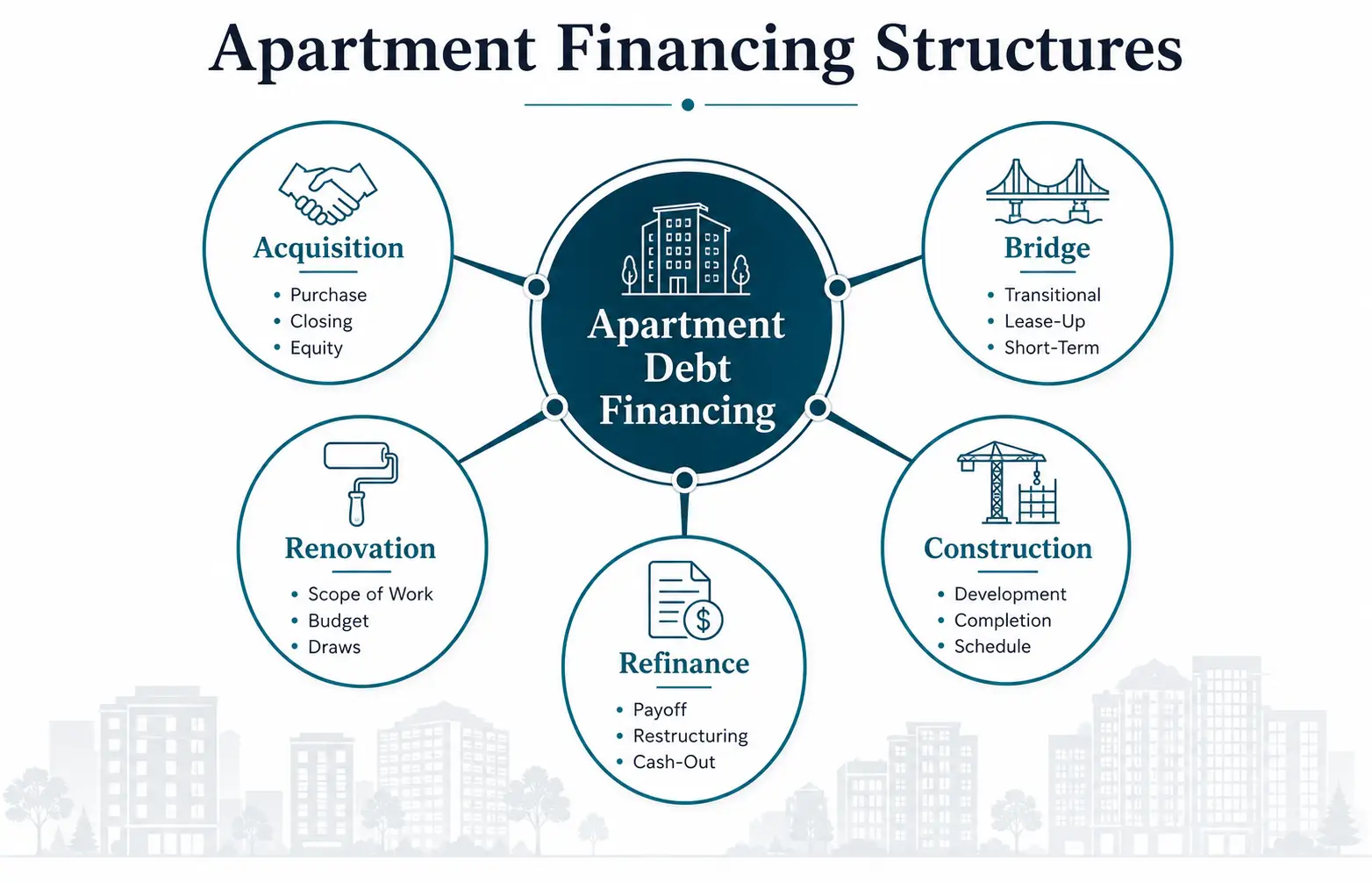
What types of apartment debt financing may be considered?
Apartment Acquisition Financing
Apartment Refinance Financing
Apartment Bridge Financing
Apartment Renovation Financing
Apartment Construction or Completion Financing
Stabilized or Portfolio Financing
What do financing sources review for apartment debt financing?
Review DPCG’s complete commercial loan required-documents guide for additional property, borrower, entity, and financing-document requirements.
Property and Collateral
The review may include:
- Address, legal description and unit count
- Property classification and current use
- Year built and renovation history
- Physical condition and deferred maintenance
- Zoning, legal use and certificate of occupancy
- Parking, utilities and amenities
- Environmental history
- Title and lien status
- Insurance and property taxes
- Marketability, location and comparable properties
Property Operations and Cash Flow
For an operating property, review may include:
- Current rent roll
- Historical rent rolls
- Trailing operating statement
- Year-to-date income and expenses
- Prior-year income and expenses
- Bank deposits
- Tenant ledgers
- Lease files
- Concessions
- Collections
- Delinquencies
- Vacancy
- Bad debt
- Utility reimbursements
- Capital expenditures
Ownership and Entity Review
Entity review may include:
- Articles of organization or incorporation
- Operating agreement
- Bylaws
- Partnership agreement
- EIN confirmation
- Certificate of good standing
- Ownership schedule
- Organizational chart
- Resolutions
- Borrowing authority
- Signatory authority
- Foreign-entity registration
- Beneficial ownership information
- Formation and amendment history
Borrower and Sponsor Review
The lender may evaluate:
- Ownership structure
- Borrowing entity
- Principals and guarantors
- Credit history
- Real estate experience
- Apartment-management experience
- Development or renovation history
- Prior project outcomes
- Liquidity
- Net worth
- Contingent liabilities
- Existing real estate obligations
- Lawsuits
- Bankruptcies
- Foreclosures
- Tnd relevan
Equity and Liquidity Review
The lender may evaluate:
- Amount of cash invested
- Required new equity
- Source of funds
- Seasoning of funds
- Gift or borrowed funds
- Investor contributions
- Partnership capital
- Deposit history
- Post-closing liquidity
- Operating reserves
- Tax and insurance reserves
- Interest reserves
- Renovation contingency
- Construction contingency
Exit Strategy Review
Common exits include:
- Refinance after stabilization
- Refinance after construction completion
- Refinance after increasing occupancy
- Refinance after completing renovations
- Refinance after establishing operating history
- Sale of the property
- Portfolio refinance
- Capital contribution
- Contractual payoff from another documented source.
Owners may review HUD’s Section 223(f) program information for general government-insured multifamily refinance information
Which financial measurements affect apartment debt financing?
Loan-to-Value Ratio
Loan-to-value, or LTV, compares the proposed loan amount with the property value accepted for underwriting.
Formula
Proposed Loan Amount ÷ Accepted Property Value = LTV
The accepted value may be based on an appraisal or another approved valuation method.
Debt-Service Coverage Ratio
Debt-service coverage ratio, or DSCR, compares underwritten net operating income with annual debt service.
Formula
Underwritten Net Operating Income ÷ Annual Debt Service = DSCR
Financing sources may calculate NOI and debt service differently.
Debt Yield
Debt yield compares underwritten net operating income with the proposed loan amount.
Formula
Underwritten Net Operating Income ÷ Proposed Loan Amount = Debt Yield
Debt yield does not directly use the interest rate or amortization schedule.
Loan-to-Cost Ratio
Loan-to-cost, or LTC, compares the proposed loan amount with eligible total project cost for an acquisition, renovation or construction transaction.
Formula
Proposed Loan Amount ÷ Eligible Total Project Cost = LTC
Eligible costs depend on the specific financing program and transaction.
Net Operating Income
Net operating income, or NOI, generally represents property income minus property-level operating expenses before debt service and certain owner-specific items.
Underwriting Adjustment
The underwriter may adjust reported NOI for vacancy, concessions, unsupported income, taxes, insurance, management, reserves and nonrecurring items.
Interest Reserve
An interest reserve is a controlled amount budgeted to pay eligible interest during construction, renovation or lease-up.
Important Limitation
The existence or size of a reserve is transaction-specific and does not eliminate the borrower’s repayment obligations.
These formulas are educational examples only. They do not represent minimum or maximum program thresholds. Each financing source determines its own calculations, adjustments and qualification requirements.
Which documents help support an apartment debt financing request?
A well-organized submission helps the financing source understand the property, borrower, requested proceeds, business plan and exit without repeatedly requesting basic information. Review DPCG’s commercial loan required-documents guide for additional guidance.
Initial Financing Scenario
- Property address and number of units
- Loan purpose and requested amount
- Estimated current value
- Purchase price or existing payoff
- Current occupancy, gross income and NOI
- Borrower experience and credit estimate
- Available equity or cash contribution
- Requested closing date
- Business plan and exit strategy
Property and Operating Documents
- Current rent roll and unit mix
- Trailing and year-to-date operating statements
- Historical property financials
- Lease summary and material leases
- Property tax and insurance information
- Utility information
- Property-management agreement
- Capital-expenditure history and property reports
Entity Documents
- Articles of organization or incorporation
- Operating agreement, bylaws or partnership agreement
- EIN confirmation
- Certificate of good standing when required
- Ownership chart
- Borrowing and signatory resolutions
- Foreign registration or trust documents when applicable
Acquisition or Existing Debt Documents
- Purchase agreement and amendments
- Earnest-money evidence and sources-and-uses schedule
- Current mortgage statement and payoff
- Existing note, mortgage and loan agreement
- Modification or extension agreements
- Payment history and prepayment provisions
- Subordinate debt and recorded lien information
Borrower and Guarantor Documents
- Loan application and personal financial statement
- Schedule of real estate owned
- Liquidity verification
- Experience summary or resume
- Credit authorization
- Tax returns or financial statements when required
- Explanations for material credit, litigation or bankruptcy events
- Identification through an approved secure process
Renovation, Construction and Exit Documents
- Detailed scope of work and line-item budget
- Contractor bids and construction contract
- Plans, permits and project schedule
- Draw schedule and contingency
- Completed-work and remaining-cost evidence
- Lease-up or stabilized operating projection
- Itemized use-of-proceeds schedule
- Primary and backup exit documentation
What is the apartment debt financing process?
Initial Scenario Review
Preliminary Document Review
Financing-Source Identification
Preliminary Terms or Letter of Intent
Formal Underwriting
Valuation and Third-Party Reports
Conditions and Closing Preparation
Closing, Funding and Post-Closing Obligations
What commonly delays apartment debt financing?
- Incomplete or inconsistent financials: The rent roll, operating statements, bank deposits or unit count do not reconcile.
- Unsupported valuation: The expected value is not supported by current income, market evidence or property condition.
- Property classification issues: The actual use differs from the described apartment use.
- Title or lien problems: Unreleased liens, judgments, mechanics’ liens, vesting errors or payoff disputes remain unresolved.
- Insurance or environmental issues: Coverage, property condition or environmental history requires additional review.
- Weak renovation or construction budget: The remaining budget does not cover all work, soft costs, carry and contingency.
- Insufficient equity or liquidity: The financing source requires more cash or post-closing reserves.
- Unclear use of proceeds or exit: Requested dollars or the repayment plan are not adequately documented.
- Late transaction changes: Ownership, proceeds, collateral, guarantors or the business plan changes during review.
How can a borrower prepare a stronger submission?
- Create a one-page executive summary.
Include the property, request, purpose, value, debt, income, occupancy, equity, sponsor, timing and exit. - Use one consistent set of numbers.
Reconcile the application, rent roll, financials, budget and sources and uses. - Explain the business plan in measurable steps.
State what will be completed, the cost, timing and expected operational result. - Document borrower equity and liquidity.
Identify cash already invested, new equity and post-closing reserves. - Itemize renovation or construction costs.
Avoid unsupported lump-sum estimates. - Disclose problems early.
Explain title, credit, litigation, environmental, construction or code issues before submission. - Prepare a primary and backup exit.
Explain how the debt will be repaid if the original timeline changes. - Keep entity information consistent.
Confirm ownership, vesting, agreements and signing authority. - Centralize communication.
Avoid conflicting document versions and last-minute changes. - Protect sensitive records.
Use an approved secure-upload process for confidential documents.
How does Direct Private Capital Group assist with apartment debt financing?
Direct Private Capital Group, Inc. is a commercial mortgage broker and private real estate financing resource.
DPCG may assist by:
- Reviewing the initial scenario
- Organizing the financing request
- Identifying missing information
- Helping the borrower or broker understand document requirements
- Comparing the transaction with possible financing categories
- Presenting qualified submissions to possible lenders, investors, or capital providers
- Coordinating communication during review
- Helping address document and underwriting questions
- Tracking major conditions
- Supporting closing coordination
DPCG does not guarantee approval, terms, funding or closing and should not be described as the direct lender, bank, agency lender, servicer, debt fund or owner of committed capital.

Have an apartment financing scenario to review?
Send the property information, requested financing, current operations, borrower experience, business plan, and exit strategy. A clear initial package helps identify whether additional review is appropriate and what information may still be needed.
Frequently Asked Questions About Apartment Debt Financing
Apartment debt financing is business-purpose financing secured by a property with multiple residential units. It may support an acquisition, refinance, renovation, construction, completion, lease-up, stabilization or another qualifying property business plan.
Yes. Acquisition financing may be considered for a qualifying apartment purchase. Review commonly includes the purchase agreement, property operations, value, borrower equity, sponsor qualifications, closing date and post-closing plan.
A refinance may be considered to replace maturing debt, private financing, bridge debt, construction debt or another eligible obligation. The financing source will generally review the payoff, property value, operating performance, ownership and requested proceeds.
Some financing structures may include approved renovation proceeds. A detailed scope, budget, contractor information, schedule, contingency and draw plan may be required.
Construction-completion financing may be considered when the remaining scope, cost to complete, existing debt, contractor obligations, borrower equity, project status and exit can be documented.
Cash flow is central to many stabilized apartment loans. Transitional, renovation, lease-up and construction financing may place greater emphasis on value, cost basis, sponsor capacity, budget, reserves and a credible exit.
Debt-service coverage ratio compares underwritten net operating income with annual debt service. It is calculated by dividing NOI by annual debt service. Financing sources may calculate both figures differently.
No universal minimum credit score is stated on this page. Requirements vary by financing source, program, property, leverage, liquidity, sponsor experience and transaction risk.
Timing depends on document completeness, property complexity, appraisal, environmental review, title, insurance, legal documentation, third-party reports and closing conditions. No closing period should be guaranteed before full review.
No. A scenario submission is a request for review only. It is not an approval, commitment, rate lock or guarantee of terms, funding or closing.
Compliance Disclaimer
Direct Private Capital Group, Inc. is a commercial mortgage broker and private real estate financing resource. The information on this page is provided for general informational and educational purposes only.
Nothing on this page constitutes an approval, commitment to lend, loan offer, rate lock or guarantee of terms, proceeds, funding or closing. Any financing that may be available is subject to complete underwriting, borrower and guarantor qualification, collateral review, valuation, title, insurance, documentation, third-party reports, state eligibility, lender, investor or capital-provider guidelines, market conditions and applicable law.
Loan structures, requirements, costs, rates, leverage, reserves, recourse, prepayment terms and closing timelines vary by transaction and financing source. Business-purpose and investment-property financing only where applicable.
This page is not legal, tax, accounting, investment or financial advice. Borrowers should consult their own qualified advisers regarding their transaction. Equal-credit-opportunity requirements may apply to business credit. Review the CFPB’s official Regulation B resource.