

Apartment Acquisition Financing
Apartment acquisition financing helps investors, buyers, and sponsors purchase residential rental properties generally containing five or more units. Direct Private Capital Group, Inc. reviews the property, purchase contract, operating performance, borrower equity, sponsor qualifications, valuation, business plan, and exit strategy. Terms, approval, funding, and availability depend on underwriting, state eligibility, and lender or capital-provider guidelines.
What is apartment acquisition financing?
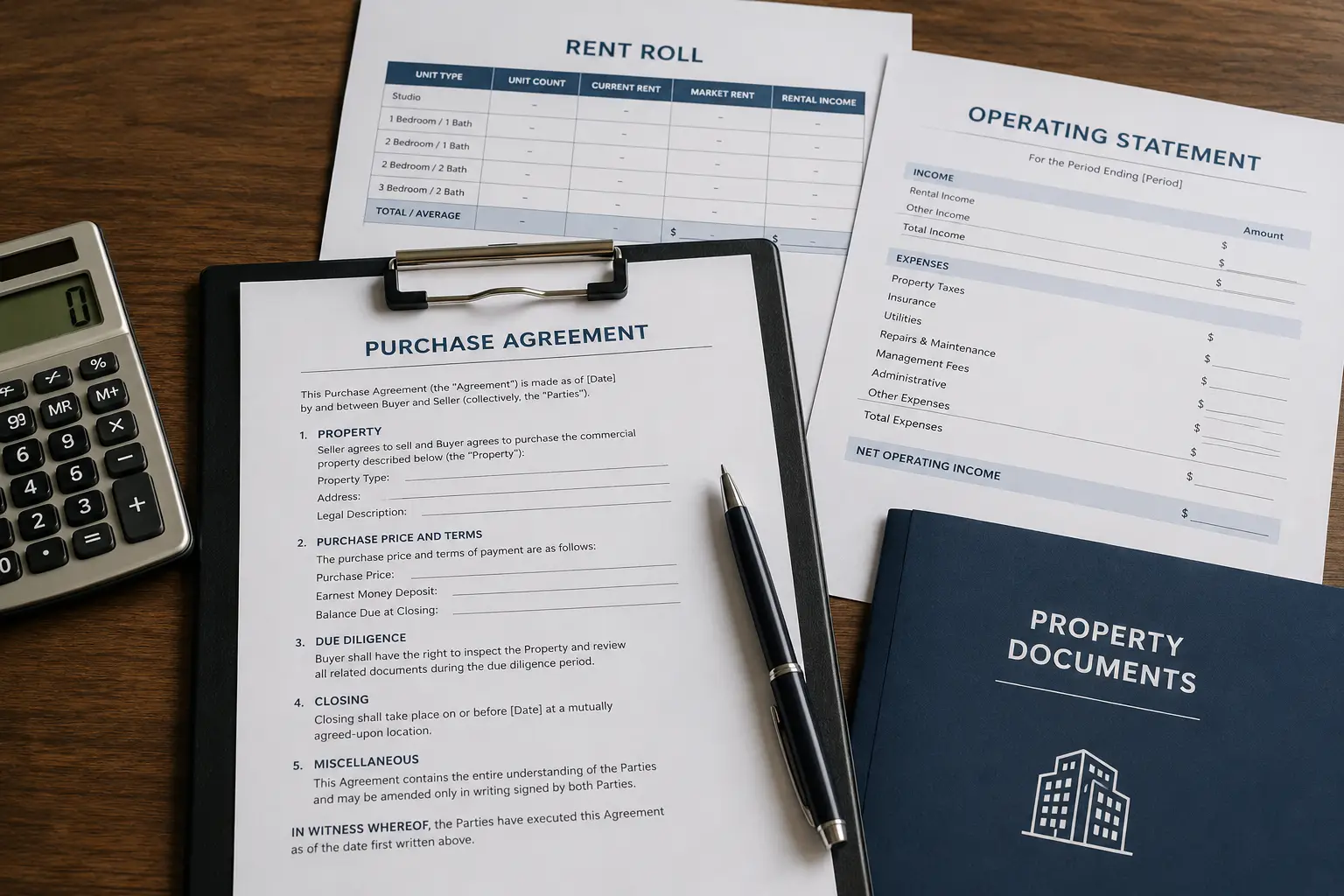
Apartment acquisition financing is one type of commercial real estate financing used to purchase a residential rental property generally containing five or more units. The proposed structure is evaluated using the purchase contract, current property operations, physical condition, valuation, borrower equity, sponsor qualifications, liquidity, and repayment strategy. Available structures vary by the property, business plan, market, borrower, and financing source.
When is apartment acquisition financing needed?
Common purchase situations include:
- Acquiring a stabilized apartment building.
- Buying a property with below-market rents.
- Purchasing a building that needs repairs or capital improvements.
- Acquiring an underperforming property for operational improvement.
- Purchasing a property with current vacancy or collection issues.
- Completing a time-sensitive acquisition.
- Buying through a newly formed property-owning entity.
- Acquiring a property as part of a larger portfolio.
- Buyers facing a short closing deadline, temporary financing gap, or property-condition issue may also review private money financing for investment property.
- Purchasing a mixed-use property in which the apartment component is material.
- Using short-term financing before a planned permanent refinance.
- Buyers comparing apartment financing with other rental-property structures can also review DPCG’s investment property loan options
How does apartment acquisition financing work?
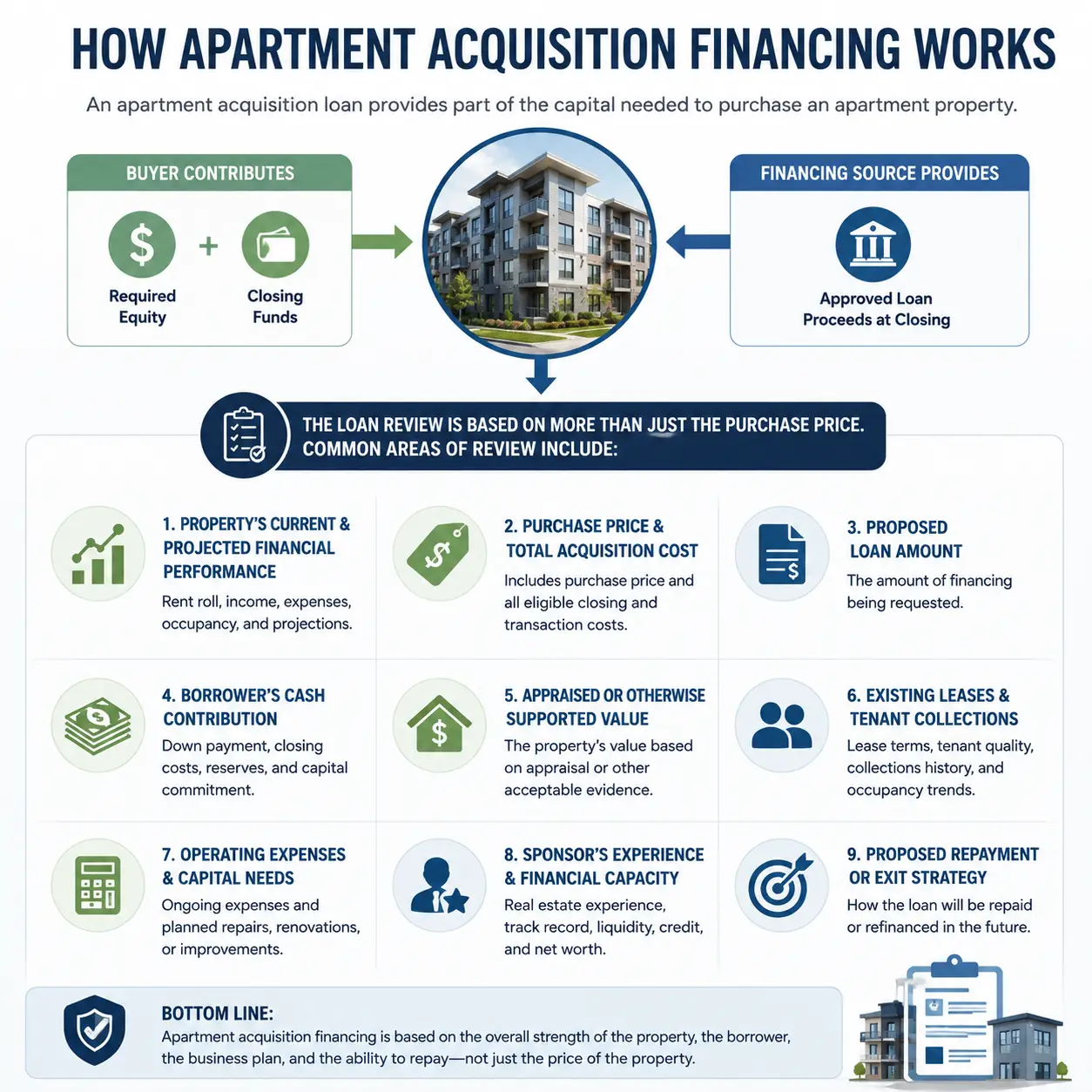
An apartment acquisition loan provides part of the capital needed to purchase an apartment property. The buyer contributes the required equity and closing funds, while the financing source provides the approved loan proceeds at closing.
The requested loan is not evaluated from the purchase price alone. The review commonly includes:
- The property’s current and projected financial performance
- The purchase price and total acquisition cost
- The proposed loan amount
- The borrower’s cash contribution
- The property’s appraised or otherwise supported value
- Existing leases and tenant collections
- Operating expenses and capital needs
- The sponsor’s experience and financial capacity
- The proposed repayment or exit strategy.
The Office of the Comptroller of the Currency identifies acquisition financing and financing for income-producing real estate as forms of commercial real estate lending.
What types of apartment acquisition scenarios may be considered?
Stabilized Apartment Acquisition
Value-Add Apartment Acquisition
Underperforming Property Acquisition
Bridge-to-Permanent Acquisition
Portfolio Apartment Acquisition
What do financing sources review for an apartment purchase?
Property and Collateral
The review may include:
- Property address and legal description
- Number and type of units
- Unit mix
- Year built and renovation history
- Current physical condition
- Deferred maintenance
- Amenities and parking
- Commercial or mixed-use components
- Affordable-housing restrictions
- Regulatory agreements
- Ground leases or leasehold interests
- Zoning and lawful use
- Code or permit issues
- Environmental history
- Flood exposure
- Market position and location
- Comparable property information
Borrower and Sponsor
The borrower and sponsor review may include:
- Ownership structure
- Principal biographies
- Apartment ownership experience
- Renovation or construction experience
- Property-management experience
- Credit history
- Personal financial statements
- Liquidity
- Net worth
- Contingent liabilities
- Existing real estate schedule
- Litigation, bankruptcy, foreclosure, or default history
- Source of equity
- Post-closing reserves
- Guarantor structure
Purchase Contract and Closing Requirements
The purchase agreement helps determine:
- Purchase price
- Earnest-money deposit
- Financing contingency
- Due-diligence deadline
- Closing date
- Extension rights
- Assignment rights
- Seller credits
- Required deposits
- Included personal property
- Assumed contracts
- Prorations
- Default remedies
Equity & Source of Funds
The buyer should be prepared to document the source of:
- Earnest-money deposit
- Required down payment
- Closing costs
- Financing fees
- Third-party report expenses
- Initial repairs
- Operating reserves
- Construction or renovation contingency
- Post-closing liquidity
Equity sources may require additional review when funds come from partners, investors, gifts, loans, equity pledges, sale proceeds, cryptocurrency, foreign accounts, recently transferred funds, or entities other than the borrowing entity.
Renovation Documents
Buyers planning unit renovations, common-area improvements, or other capital work should prepare a detailed scope, budget, contractor information, contingency, and construction schedule. Review DPCG’s apartment renovation financing guide for additional information about renovation budgets, draws, and project preparation
- Detailed scope of work
- Itemized budget
- Contractor bids
- Contractor license and insurance information
- Construction schedule
- Draw schedule
- Permit status
- Plans and specifications
- Engineering reports
- Architect information
- Contingency amount
- Evidence supporting projected rents
Exit Strategy
The exit strategy explains how the acquisition debt is expected to be repaid.
Potential exits include:
- Refinancing into longer-term debt
- Refinancing after renovation
- Refinancing after occupancy improvement
- Refinancing after resolving operational issues
- Selling the property
- Paying down debt with other documented capital
- Repositioning and recapitalizing the ownership structure
The exit must be realistic in relation to the loan term, property condition, renovation timeline, lease-up period, market conditions, and expected future debt capacity. Borrowers researching possible long-term refinancing options can review the official Fannie Mae Multifamily resources and Freddie Mac Multifamily financing options for general program information. Availability at the time of refinance will depend on the property’s actual performance, borrower qualifications, market conditions, and then-current program requirements.
Which financial measurements affect apartment acquisition financing?
Loan-to-Value Ratio
LTV compares the proposed loan amount with the supported value of the property. The value used may depend on the financing structure and applicable underwriting requirements.
Formula
Proposed Loan Amount ÷ Accepted Property Value = LTV
The accepted value may be based on an appraisal or another approved valuation method.
Loan-to-Cost Ratio
For an acquisition, total cost may include the purchase price and approved renovation or project costs. Not every cost is necessarily eligible to be financed.
Formula
Proposed Loan Amount ÷ Total Eligible Project Cost = LTC
Debt-Service Coverage Ratio
DSCR measures the relationship between property income and required debt payments.
Formula
NOI ÷ Annual Debt Service = DSCR
The required calculation method and minimum threshold vary by financing source, loan structure, property condition, and market. No specific ratio should be assumed until the program is verified.
Debt Yield
Debt yield measures the property’s income in relation to the proposed loan balance without relying directly on the interest rate or amortization schedule.
Formula
NOI ÷ Loan Amount = Debt Yield
Net Operating Income
NOI is property income remaining after ordinary operating expenses and before debt service, depreciation, income taxes, and certain capital expenditures.
Formula
Effective Property Income − Operating Expenses = NOI
As-Is, As-Complete, and Stabilized Value
As-is value reflects the property in its current condition. As-complete and stabilized values may reflect approved improvements and supported future operations.
Valuation Note
Future value is not guaranteed and depends on execution, costs, timing, market conditions, property performance, and the final valuation analysis.
Apartment acquisition underwriting commonly evaluates purchase basis, current operations, supported property value, debt-service capacity, borrower equity, and the proposed exit. No specific LTV, LTC, DSCR, debt-yield, or reserve threshold should be assumed until the applicable financing source and program are verified.
Which documents help support an apartment acquisition request?
A well-organized submission allows the financing source to understand the purchase, property, borrower, equity, business plan, and proposed exit without repeatedly requesting basic information. Review DPCG’s complete commercial loan required-documents guide for additional borrower, entity, property, title, and financing-document guidance.
Initial Loan Scenario
- Property address
- Number of units
- Purchase price
- Requested loan amount
- Earnest-money deposit
- Contract closing date
- Current occupancy
- Current property income
- Renovation budget, if applicable
- Borrower equity contribution
- Borrower and guarantor names
- Ownership and apartment experience
- Business plan
- Proposed exit strategy
Purchase and Acquisition Documents
- Fully executed purchase and sale agreement
- All amendments and addenda
- Assignment agreement, when applicable
- Earnest-money receipt
- Escrow instructions
- Seller credits or concessions
- Due-diligence schedule
- Closing statement draft, when available
- Existing survey, if available
- Offering memorandum, if available
- Broker package, if available
Property Financial Documents
- Current rent roll
- Trailing 12-month operating statement
- Current year-to-date operating statement
- Prior-year operating statements
- General ledger, when requested
- Delinquency report
- Concession report
- Occupancy history
- Lease expirations
- Utility reimbursement schedule
- Current property-tax information
- Insurance history or quote
- Capital-expenditure history
- Existing service contracts
Borrower and Guarantor Documents
- Borrower loan application
- Personal financial statement
- Schedule of real estate owned
- Liquidity verification
- Bank or brokerage statements through an approved secure process
- Resume or ownership experience summary
- Track record of completed transactions
- Explanation of material credit, litigation, or bankruptcy events
- Identification through an approved secure process
- Tax returns, when required and transmitted securely
- Current business financial statements, when applicable
Lease and Tenant Information
- Sample residential leases
- Commercial leases for mixed-use properties
- Lease abstracts, when available
- Tenant ledger
- Security-deposit schedule
- Tenant receivables
- Rent-control or affordability restrictions, when applicable
- Regulatory agreements, when applicable
- Housing-assistance contracts, when applicable
Renovation Documents
- Detailed scope of work
- Itemized budget
- Contractor bids
- Contractor license and insurance information
- Construction schedule
- Draw schedule
- Permit status
- Plans and specifications
- Engineering reports
- Architect information
- Contingency amount
- Unit-turn schedule
- Renovation assumptions
- Before-and-after rent analysis
- Evidence supporting projected rents
Secure-Document Notice:
Do not send Social Security numbers, complete bank-account information, tax returns, identification documents, or other highly sensitive records through an unsecured website form or ordinary unencrypted email. Use DPCG’s approved secure-document process after it is provided.
What is the apartment acquisition financing process?
Initial Scenario Review
Document Collection and File Organization
Preliminary Financing Discussion
Financing-Source Review
Term Indication or Letter of Interest
Underwriting
Third-Party Reports
Conditions and Closing Preparation
What commonly delays an apartment acquisition loan?
- Incomplete or inconsistent financial records: A rent roll that does not match the operating statement, leases, bank deposits, or unit count can delay underwriting.
- Unsupported property income: Projected rent, concessions, reimbursements, or occupancy assumptions may be reduced or excluded when they are not supported by leases, collections, comparable properties, or credible market evidence.
- Unverified equity: The borrower may need to document the down payment, closing costs, reserves, repairs, and post-closing liquidity.
- Title or ownership issues: Existing liens, ownership discrepancies, probate matters, assignments, or entity defects may require correction.
- Appraisal or valuation issues: The supported value may not support the purchase price, projected value, or requested loan amount.
- Insurance or property-condition problems: Coverage limitations, deferred maintenance, life-safety issues, or major repairs may affect proceeds or timing.
- Unclear renovation budget: A general budget without quantities, bids, contingency, permits, and timing may be insufficient.
- Weak exit strategy: A refinance exit based only on future appreciation, unsupported rent growth, or unverified future loan terms may not be considered reliable.
- Last-minute transaction changes: Changes to price, ownership, guarantors, scope, loan amount, seller credits, or equity source can require renewed review.
How can a buyer prepare a stronger submission?
- Provide a complete purchase agreement.
Include every amendment, assignment, addendum, extension, and earnest-money receipt. - Reconcile the rent roll and operating statements.
Explain differences in occupancy, income, concessions, delinquencies, and expenses. - Separate historical performance from projections.
Clearly identify what the property earns today and what the buyer expects after executing the business plan. - Document the equity source.
Identify who is contributing funds, where the funds are held, and whether any portion must be repaid. - Prepare an ownership chart.
Show the borrowing entity, principals, ownership percentages, guarantors, investors, and authorized signers. - Explain the business plan in writing.
Address the purchase rationale, property condition, management plan, renovation, rent strategy, operating improvements, timing, and exit. - Use an itemized renovation budget.
Include quantities, costs, contractor support, contingency, permits, and timing. - Address known problems early.
Disclose title issues, violations, deferred maintenance, tenant disputes, environmental matters, prior defaults, credit events, or litigation before they appear in third-party reports. - Use realistic timing.
Compare the contractual closing date with the time needed for underwriting, appraisal, title, insurance, environmental review, legal documentation, and funding conditions. - Maintain a backup plan.
Consider the consequences of lower proceeds, higher expenses, valuation changes, repair requirements, a delayed closing, or an unavailable refinance exit.
How does Direct Private Capital Group assist with apartment acquisition financing?
Direct Private Capital Group, Inc. is a commercial mortgage broker and private real estate financing resource.
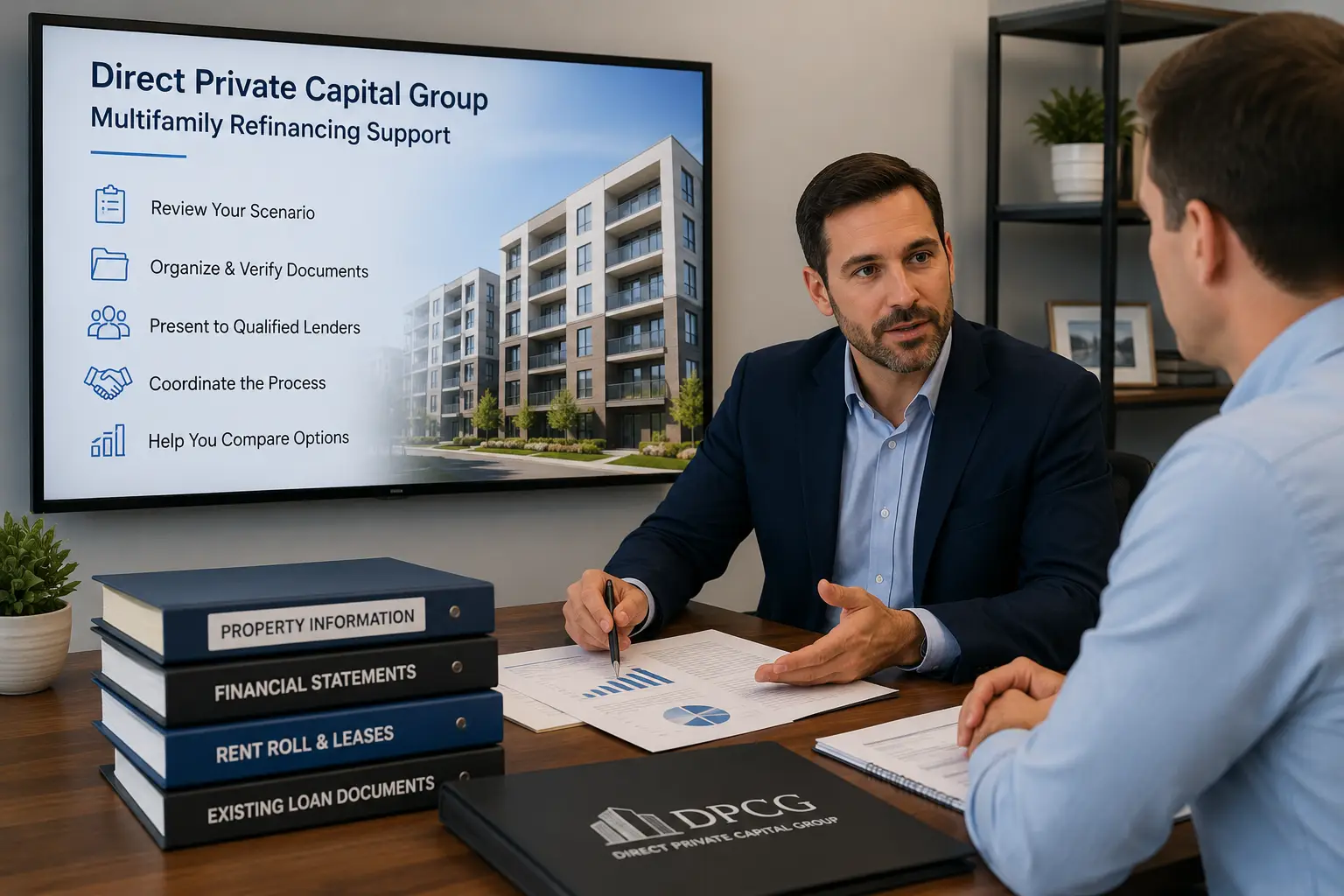
DPCG may assist by:
- Reviewing the initial apartment acquisition scenario
- Identifying incomplete or inconsistent information
- Helping organize the purchase, property, borrower, and entity documents
- Clarifying the requested financing, equity contribution, and business plan
- Presenting eligible transactions to possible financing sources
- Coordinating information requests during the review process
- Helping the borrower compare proposed structures
- Communicating with the borrower, broker, and transaction parties as the file progresses
DPCG does not guarantee approval, terms, funding, or closing and should not be described on this page as the direct lender, bank, agency lender, servicer, debt fund, or owner of committed capital.
Preparing to acquire an apartment property?
Provide the property address, unit count, purchase price, requested loan amount, closing date, current occupancy, property financials, borrower experience, equity contribution, renovation budget, and exit strategy. DPCG can conduct an initial review and identify the next information needed to evaluate the scenario.
Frequently Asked Questions About Apartment Acquisition Financing
Apartment acquisition financing is business-purpose financing used to purchase a residential rental property generally containing five or more units. The proposed structure is evaluated using the purchase contract, property operations, physical condition, valuation, borrower equity, sponsor qualifications, and exit strategy.
A vacant or underperforming property may require a transitional or bridge structure rather than financing based only on stabilized cash flow. Review commonly focuses on purchase basis, property condition, renovation needs, sponsor experience, equity, reserves, lease-up, and exit.
Some financing sources consider first-time apartment buyers, but the structure may depend on related real estate, construction, property-management, business, or investment experience. Liquidity, qualified partners, experienced management, purchase basis, and a detailed business plan may be important.
There is no universal down-payment requirement. Required equity depends on the property, purchase price, supported value, cash flow, condition, renovation plan, borrower qualifications, financing source, and market conditions. Closing costs and reserves may be required in addition.
Certain acquisition structures may include an approved renovation or capital-improvement component. The financing source may require an itemized budget, scope of work, contractor review, permits, contingency, inspections, draw controls, borrower equity, and support for the completed business plan.
Common property records include the current rent roll, trailing operating statements, year-to-date financials, leases, tenant ledgers, delinquency reports, concessions, utility information, tax records, insurance records, service contracts, and capital-expenditure history.
The purchase price is important, but it does not by itself establish the value used for financing. Valuation may consider property income, expenses, occupancy, condition, comparable transactions, market rents, capitalization assumptions, and other property-specific factors.
Projected rents may be considered when supported by market data, comparable properties, renovation plans, unit quality, leasing assumptions, and a credible timeline. Current leases, collections, occupancy, and actual operating history may receive greater weight.
A lower valuation can reduce available proceeds, increase required equity, require a revised structure, or prevent the transaction from proceeding under the proposed terms. The buyer may need to renegotiate, contribute additional funds, or consider another structure.
There is no guaranteed closing period. Timing depends on file completeness, property complexity, financing structure, appraisal, title, insurance, environmental review, property condition, borrower responsiveness, legal documentation, and closing conditions.
Compliance Disclaimer
Direct Private Capital Group, Inc. is a commercial mortgage broker and private real estate financing resource. The information on this page is provided for general informational and educational purposes only.
Nothing on this page constitutes an approval, commitment to lend, loan offer, rate lock, or guarantee of terms, proceeds, funding, or closing. Any financing that may be available is subject to complete underwriting, borrower and guarantor qualification, verification of equity and liquidity, collateral review, valuation, title, insurance, documentation, third-party reports, state eligibility, applicable lender, investor, or capital-provider guidelines, market conditions, and applicable law.
Loan structures, requirements, costs, rates, leverage, reserves, recourse, prepayment terms, and closing timelines vary by transaction and financing source. Business-purpose and investment-property financing only where applicable.
This page is not legal, tax, accounting, investment, or financial advice. Borrowers should consult their own qualified advisers regarding their transaction.
Equal-credit-opportunity requirements can apply to commercial and business credit. Review the Consumer Financial Protection Bureau’s Regulation B resource for official information.