

Apartment Construction Loans for Ground-Up, Rehabilitation Completion Projects
Apartment construction loans are business-purpose commercial real estate loans used to finance qualified ground-up apartment development, substantial rehabilitation, project completion, and related construction needs. Direct Private Capital Group, Inc. reviews the land, plans, permits, budget, developer experience, contractor, equity, market demand, construction timeline, and proposed repayment strategy. Approval, terms, funding, and availability depend on complete underwriting, state eligibility, and lender or capital-provider guidelines.
What is an apartment construction loan?
An apartment construction loan is one type of commercial real estate financing used to acquire eligible land, refinance approved property debt, and fund hard and soft construction costs for an apartment project. Proceeds are commonly advanced in stages as verified work is completed. Underwriting focuses on the borrower’s equity, project feasibility, plans, permits, construction budget, development team, market support, and exit strategy.
When is apartment construction financing needed?
Common situations include:
- Acquiring entitled or partially entitled land for apartment development.
- Starting vertical construction on land already owned by the sponsor.
- Refinancing an existing land or construction loan approaching maturity.
- Completing a partially built or stalled apartment project.
- Moving from bridge financing to a longer-term
- Addressing documented cost overruns or revised construction needs.
- Funding remaining construction, punch-list work, or certificates of occupancy.
- Carrying a completed property through lease-up and stabilization.
- Preparing the project for a permanent refinance or sale.
- Purchasing rather than refinancing? Review multifamily acquisition financing.
How does apartment construction financing work?
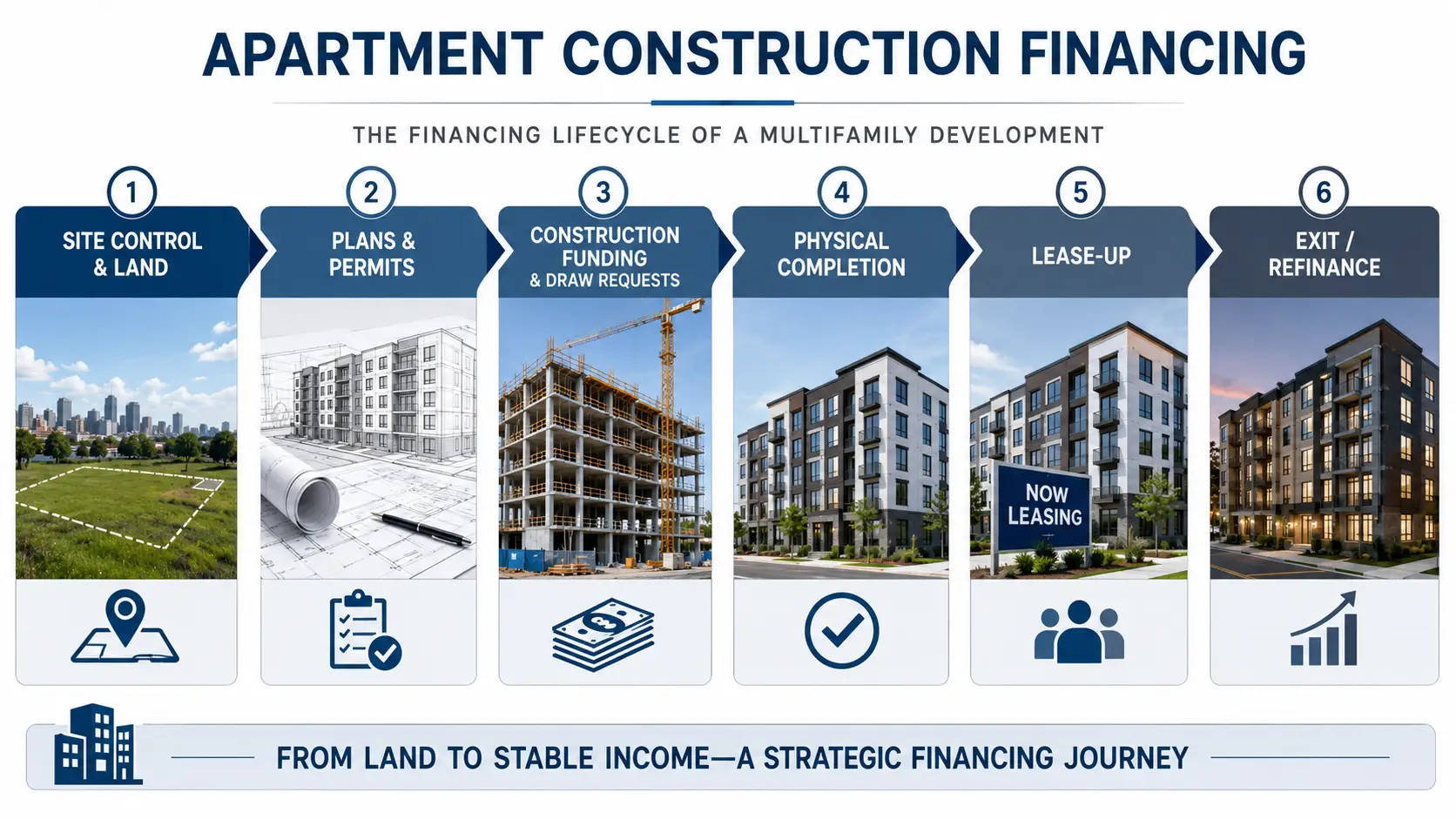
Apartment construction financing is generally structured around an approved project budget and construction schedule. The financing source establishes the maximum facility, identifies eligible costs, confirms the borrower’s required equity, and advances construction proceeds according to documented draw procedures.
The review generally connects five areas:
- The land, zoning, entitlements, plans, permits, and collateral.
- The developer, guarantors, contractor, architect, engineers, and property manager.
- The construction budget, sources and uses, contingency, and cost-to-complete analysis.
- The market, projected rents, lease-up assumptions, and stabilized operations.
- The permanent refinance, sale, or other documented exit strategy.
What types of apartment construction scenarios may be considered?
Ground-Up Apartment Development
Construction on Owned Land
Construction Completion
Substantial Rehabilitation
Adaptive Reuse or Conversion
Lease-Up and Stabilization
Land Acquisition With Future Construction
Mixed-Use Apartment Development
Construction Loan Refinance
What do financing sources review for an apartment construction loan?
Site, Zoning and Permits
The review may include:
- Property address, legal description, acreage, and access
- Topography, utilities, drainage, and flood risk
- Current zoning and approved density
- Entitlements, variances, and development agreements
- Site-plan and subdivision approvals
- Permits issued, pending, or expiring
- Environmental history and site conditions
- Easements, encroachments, and off-site improvements
Developer and Construction Team
The financing source may review:
- Developer and sponsor experience
- Guarantor liquidity and net worth
- General contractor license, insurance, and financial strength
- Comparable projects completed
- Architect and engineering team
- Property-management and lease-up plan
- Current workload and concurrent projects
- Litigation, claims, defaults, or disputes
Budget, Market and Exit
The financial review commonly examines:
- Detailed hard- and soft-cost budget
- Sources and uses
- Contingency and interest reserve
- Borrower equity already invested and still available
- Projected rents, concessions, and absorption
- Stabilized operating expenses and NOI
- As-is, as-complete, and stabilized value
- Permanent refinance, sale, and backup exit
Title and Survey
The financing source may review:
- Ownership
- Legal description
- Easements
- Encroachments
- Access
- Restrictions
- Development agreements
- Tax liens
- Mechanics’ liens
- Judgment liens
- Ground leases
- Utility rights
- Mineral rights
- Recorded covenants
- Pending litigation
- Survey exceptions
Borrower Equity
The financing source may review:
- Cash equity
- Land equity
- Costs already paid
- Deposits
- Development fees
- Reimbursable expenses
- Partner contributions
- Equity commitments
- Source of funds
- Timing of contributions
- Remaining liquidity
Business Plan and Exit Strategy
The financing source may evaluate:
- Construction start, milestones, and completion timing
- Certificate-of-occupancy requirements
- Lease-up schedule and stabilized occupancy
- Projected rents and operating expenses
- Interest and operating reserves
- Permanent-loan requirements
- Expected refinance or sale timing
- Backup plan if completion or lease-up takes longer
Which financial measurements affect apartment construction financing?
Loan-to-Cost
Loan-to-cost, or LTC, compares the proposed loan amount with the total approved project cost.
Formula
Proposed Loan Amount ÷ Approved Total Project Cost = LTC
The financing source determines which land, hard, soft, reserve, contingency, and financing costs are eligible.
Loan-to-Value
Loan-to-value, or LTV, compares the proposed loan amount with the accepted as-is, as-complete, or stabilized value.
Formula
Proposed Loan Amount ÷ Accepted Property Value = LTV
The relevant value depends on the project stage and underwriting approach.
Borrower Equity
Borrower equity may include eligible cash, recognized land equity, and documented project costs already paid.
Formula
Eligible Borrower Equity ÷ Approved Total Project Cost = Equity Percentage
Not every prior expense or increase in land value receives equity credit.
Projected Net Operating Income
Projected NOI represents stabilized property income less underwritten operating expenses before debt service and certain capital items.
Use in Exit Analysis
Projected NOI helps evaluate stabilized value, debt-service coverage, debt yield, and the permanent refinance strategy.
As-Is, As-Complete and Stabilized Value
As-is value reflects the current site or project. As-complete value reflects physical completion. Stabilized value reflects assumed sustainable occupancy, income, and operations.
Valuation Use
The financing source determines which value applies to the loan structure, draw exposure, and exit analysis.
Interest Reserve and Contingency
An interest reserve supports scheduled interest during a defined period. A contingency covers approved unforeseen construction costs.
Important Limitation
Reserves and contingency do not eliminate the borrower’s repayment duties or responsibility for funding shortages and overruns.
Owners researching longer-term multifamily financing may review the Fannie Mae Multifamily financing options, Freddie Mac Multifamily financing options, and HUD multifamily programs for general information. Program requirements are source-specific and do not represent guaranteed DPCG terms.
Which documents help support an apartment construction loan request?
A complete submission helps the financing source understand the property, sponsor, requested structure, business plan and exit. Review DPCG’s commercial loan required-documents guide for additional borrower, entity, property, title and financing-document guidance.
Initial Construction Scenario
- Project address and site acreage
- Proposed unit count and project type
- Current project stage
- Requested loan amount
- Land basis and existing debt
- Total development and hard-cost budget
- Equity invested and remaining equity
- Entitlement and permit status
- Developer and contractor experience
- Construction schedule and proposed exit
Plans, Permits and Budget
- Architectural, civil, structural, MEP, and landscape plans
- Specifications and revision log
- Building, grading, utility, and other permits
- Detailed line-item construction budget
- Sources-and-uses schedule
- Construction schedule and milestones
- Contingency, interest reserve, and lease-up budget
- Appraisal, market study, and rent comparables when available
Entity and Development Team
- Articles, operating agreement, EIN confirmation, and good standing
- Ownership chart and borrowing resolutions
- Developer and sponsor resumes
- General contractor profile, license, insurance, and project list
- Executed construction contract and schedule of values
- Architect, engineer, property manager, and leasing agreements
- Joint-venture and equity documents when applicable
Existing Debt and Active Construction
- Current mortgage statement and payoff
- Note, deed of trust, and loan agreement
- Modification and extension agreements
- Prior draw requests and inspection reports
- Cost-to-complete report
- Open invoices, retainage, and lien releases
- Change-order log and current construction photos
- Mechanics’ liens and subordinate obligations
Borrower and Guarantor Documents
- Loan application
- Personal financial statement
- Schedule of real estate owned
- Liquidity verification
- Bank or brokerage statements through a secure process
- Tax returns when required and transmitted securely
- Credit authorization and identification through a secure process
- Experience summary and contingent liabilities
- Explanations for material credit, litigation, bankruptcy, or foreclosure events
Market, Environmental and Exit Documents
- Phase I Environmental Site Assessment
- Survey, title, geotechnical, soil, and flood reports
- Market study and absorption analysis
- Projected rent roll and stabilized operating statement
- Builder’s-risk and liability insurance information
- Permanent refinance analysis
- Sale or recapitalization plan
- Backup exit and sensitivity analysis
What is the apartment construction loan process?
Initial Project Review
Document Collection and File Organization
Preliminary Financing Discussion
Term Indication or Letter of Intent
Formal Construction Underwriting
Appraisal, Cost Review and Third-Party Reports
Conditions, Loan Documents and Closing
Initial Funding and Construction Draws
What commonly delays an apartment construction loan?
- Incomplete Entitlements or Permits: Unresolved zoning, density, site-plan, utility, or permit matters can prevent final underwriting.
- Incomplete Plans: Conceptual drawings may not provide enough detail for construction-cost and feasibility review.
- Weak or Inconsistent Budget: Missing costs, unsupported estimates, limited contingency, or conflicts with the plans can delay approval.
- Unresolved Funding Gap: Verified loan proceeds and borrower equity must cover the approved development cost.
- Contractor Concerns: Limited comparable experience, financial weakness, excessive workload, claims, or incomplete contracts may require further review.
- Title, Lien, or Environmental Problems: Mechanics’ liens, access issues, easements, contamination, or incomplete reports can delay closing.
- Insurance Problems: Builder’s-risk exclusions, inadequate limits, or unavailable required coverage can prevent closing.
- Late Changes: Changes to ownership, contractor, plans, budget, unit count, or exit can require renewed underwriting.
How can a developer prepare a stronger submission?
- Prepare a clear executive summary.
Explain the project, current stage, financing request, equity, risks, and exit. - Document site control and approvals.
Provide deeds, contracts, zoning, entitlements, permits, and expiration dates. - Use a complete construction budget.
Reconcile the budget with the plans, contractor contract, schedule, contingency, and reserves. - Provide a balanced sources-and-uses schedule.
Total sources should equal total uses. - Document equity and liquidity.
Show costs already paid, remaining equity, and resources for overruns or delays. - Support the development team.
Provide comparable experience for the developer, contractor, architect, engineers, manager, and leasing team. - Address unusual issues early.
Explain liens, cost overruns, contractor changes, litigation, environmental issues, or permit delays. - Use realistic market assumptions.
Support rents, concessions, absorption, expenses, and stabilized value. - Prepare a primary and backup exit.
Explain the planned refinance, sale, extension, or equity solution. - Protect sensitive information.
Use an approved secure-upload process for confidential records.
How does Direct Private Capital Group assist with apartment construction financing?
Direct Private Capital Group, Inc. is a commercial mortgage broker and private real estate financing resource.
DPCG may assist by:
- Reviewing the initial apartment development scenario
- Identifying missing project, construction, borrower, or entity information
- Helping organize plans, permits, budgets, sources and uses, and team documents
- Clarifying the requested loan purpose and construction stage
- Presenting eligible transactions to possible financing sources
- Coordinating information requests and tracking underwriting conditions
- Communicating with borrowers, brokers, lenders, attorneys, title, escrow, contractors, and third-party providers as appropriate
DPCG does not guarantee approval, terms, funding, construction draws, completion, refinancing, sale, or closing and is not described on this page as the direct lender, bank, debt fund, agency lender, servicer, or owner of committed capital.

Have an Apartment Development That Needs Construction Capital?
Send the project address, unit count, current stage, requested loan amount, land basis, construction budget, equity invested, permit status, developer experience, contractor information, completion schedule, and proposed exit for an initial review.
Frequently Asked Questions About Apartment Construction Loans
An apartment construction loan is business-purpose financing used to fund eligible land, hard construction costs, soft costs, reserves, and related expenses for a qualified apartment-development project. Proceeds may be advanced at closing and through later construction draws.
It may include land acquisition when the transaction and financing structure allow it. The financing source will review the purchase agreement, land value, existing debt, entitlements, borrower equity, budget, and construction readiness.
A financing source may recognize some land equity, but the amount and treatment depend on the land basis, current value, existing debt, ownership history, and applicable underwriting guidelines. Land appreciation is not automatically treated the same as cash equity.
Requirements vary. Some financing sources require fully issued construction permits, while others may consider a transaction with limited remaining approvals. Outstanding permits, corrections, conditions, fees, and expiration dates should be disclosed.
Approved soft costs may be included. Examples can include architecture, engineering, permits, legal expenses, insurance, taxes, financing costs, and other documented project expenses. Eligibility varies by financing source.
Construction proceeds are commonly advanced through a draw process. Draw approval may require an inspection, contractor payment application, invoices, lien releases, updated budget, updated schedule, and confirmation that the work matches approved plans and loan conditions.
A partially completed apartment project may be considered for construction-completion financing. The financing source will typically require a current inspection, cost-to-complete analysis, updated budget, lien information, contractor review, permit status, and a credible completion and exit plan.
The borrower may need to fund the shortfall, use approved contingency, revise the scope, or obtain additional approved capital. The loan documents determine how overruns and change orders are handled.
Experience is an important underwriting factor. A borrower without directly comparable development experience may need a stronger contractor, development partner, guarantor, construction manager, additional equity, or other support.
Timing depends on the project stage, file completeness, plans, permits, appraisal, construction-cost review, environmental review, title, insurance, legal documentation, and resolution of underwriting conditions. No closing period should be guaranteed before full review.
Compliance Disclaimer
Direct Private Capital Group, Inc. is a commercial mortgage broker and private real estate financing resource. The information on this page is provided for general informational and educational purposes only.
Nothing on this page constitutes an approval, commitment to lend, loan offer, rate lock, promise of construction draws, or guarantee of rates, proceeds, leverage, terms, funding, completion, refinancing, sale, or closing. Any financing that may be available is subject to complete underwriting, borrower and guarantor qualification, site and collateral review, plans, zoning, entitlements, permits, construction-budget and cost review, appraisal or valuation, title, survey, insurance, environmental review, documentation, third-party reports, state eligibility, lender, investor or capital-provider guidelines, market conditions, and applicable law.
Construction proceeds may be advanced through controlled draws and may be subject to inspections, approved budgets, invoices, lien releases, borrower-equity requirements, change-order approval, permit compliance, construction progress, and other conditions. Loan structures, rates, costs, reserves, equity requirements, recourse, guarantees, retainage, draw procedures, prepayment terms, reporting obligations, and timelines vary by transaction and financing source.
Business-purpose and investment-property financing only where applicable. This page is not legal, tax, accounting, investment, engineering, architectural, environmental, construction-management, or financial advice. Borrowers and developers should consult their own qualified professionals.
Equal-credit-opportunity requirements can apply to commercial and business credit. Review the Consumer Financial Protection Bureau’s Regulation B resource for official information.