

Apartment Bridge Loans for Transitional Properties
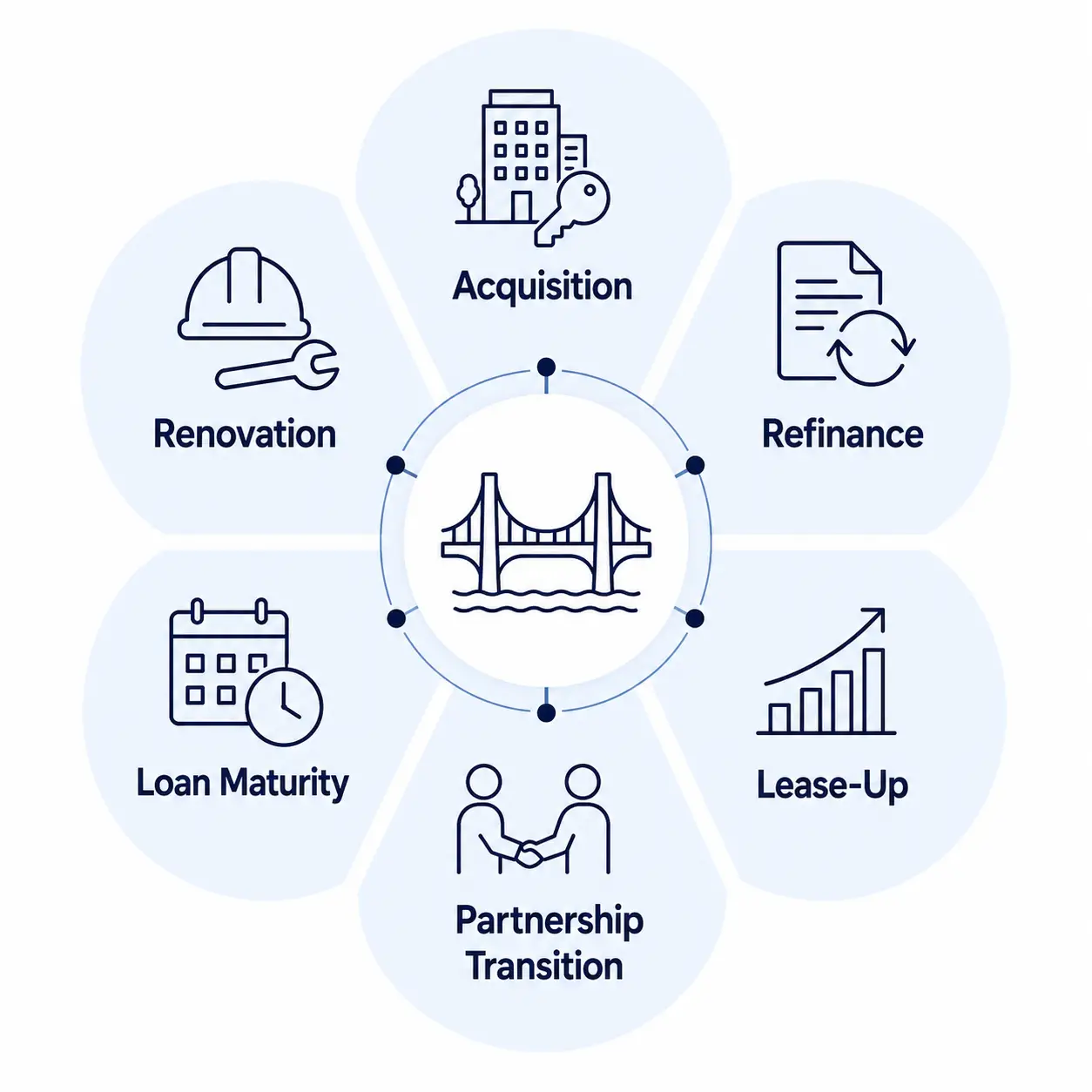
Apartment bridge loans are short-term business-purpose financing structures used when an apartment property or transaction is not yet ready for permanent financing. They may be considered for acquisitions, refinancing, renovations, lease-up, stabilization, loan maturities, partnership transitions, or other time-sensitive business plans. Direct Private Capital Group, Inc. helps organize eligible apartment financing scenarios for review by possible financing sources.
What Is an Apartment Bridge Loan?
An apartment bridge loan is a short-term business-purpose real estate loan intended to address a temporary financing need. It is commonly considered when an apartment property requires renovation, lease-up, operating improvement, debt restructuring, or additional time before a sale or longer-term refinance. Learn more about commercial bridge loans and broader commercial real estate financing.
Why Would an Owner or Buyer Need Bridge Financing?
Apartment transactions do not always meet permanent-loan requirements at the exact time financing is needed. Common transitional situations include:
- Acquiring a property before permanent financing is available.
- Renovating units, common areas, or building systems.
- Completing lease-up or improving rent collections.
- Addressing deferred maintenance or property-condition issues.
- Refinancing an upcoming or matured loan.
- Completing construction or renovation work.
- Restructuring ownership or buying out a partner.
- Preparing the property for sale or a longer-term refinance.
Buyers focused on a purchase transaction may also review apartment acquisition financing.
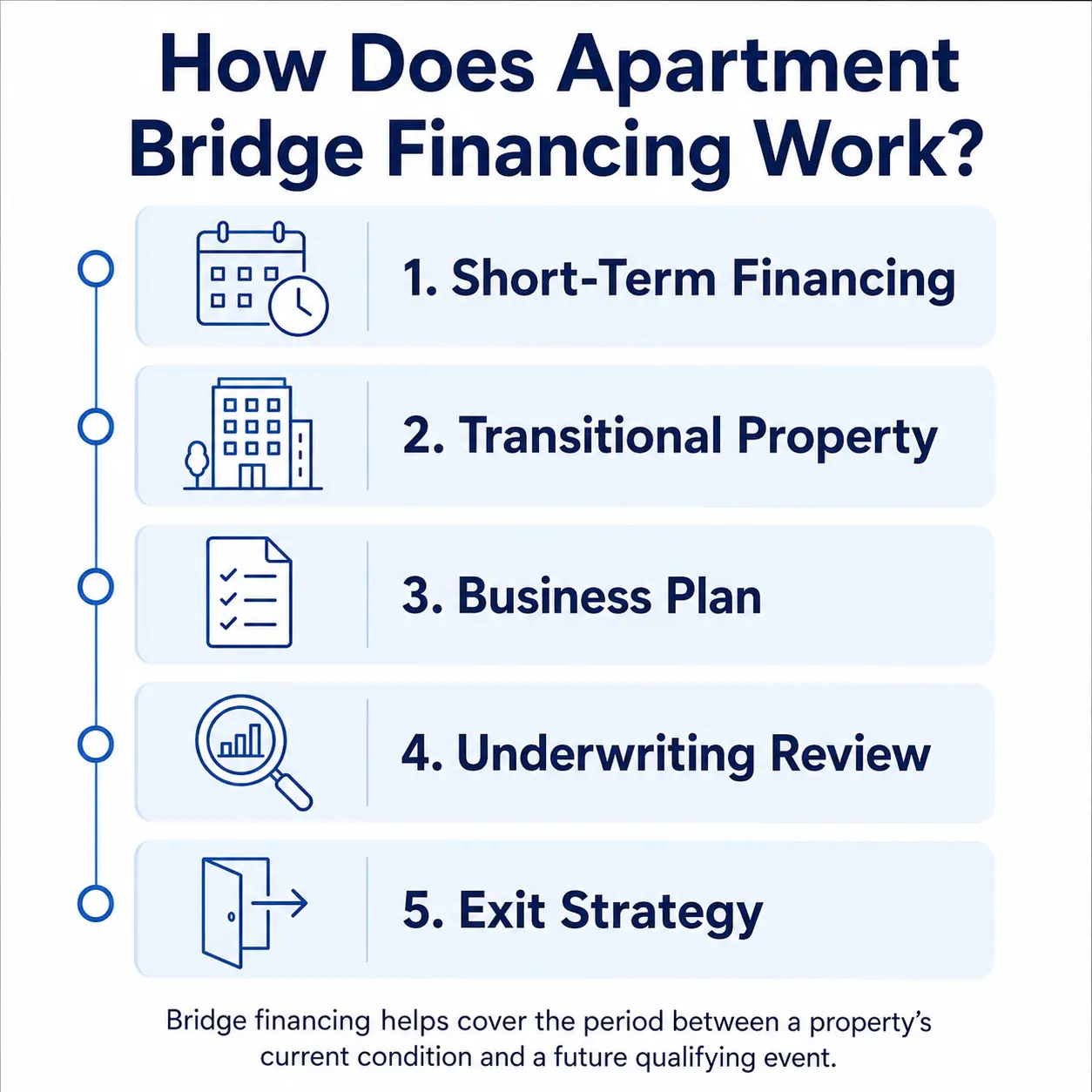
How Does Apartment Bridge Financing Work?
An apartment transaction does not always fit the requirements of a conventional bank, permanent lender, or agency-style financing program at the exact time financing is needed.
A property may have vacancies, deferred maintenance, below-market rents, incomplete renovations, weak historical cash flow, an upcoming loan maturity, unresolved title issues, a new ownership structure, or a business plan that has not yet been completed. A buyer may also be under a purchase contract with a closing deadline that does not allow enough time for a longer permanent-loan process.
Bridge financing is generally designed to address the period between the property’s current condition and a future qualifying event.
What Apartment Bridge Loan Scenarios May Be Considered?
Apartment Acquisition Bridge
Apartment Refinance Bridge
Value-Add Renovation
Lease-Up and Stabilization
Maturity or Completion Financing
Partnership or Ownership Transition
What Do Financing Sources Review for an Apartment Bridge Loan?
Property and Collateral
The review may include:
- Property address and legal unit count
- Current occupancy and unit mix
- Building size, age, and condition
- Deferred maintenance and code issues
- Zoning and certificates of occupancy
- Taxes, insurance, utilities, and management
- Environmental and flood-zone concerns
- Current, as-complete, or stabilized value
Borrower and Sponsor
The review may include:
- Ownership and apartment experience
- Renovation, construction, or lease-up experience
- Credit history
- Liquidity and net worth
- Real estate portfolio
- Contingent liabilities
- Property-management and contractor strength
- Ability to address cost overruns or delays
Property Cash Flow
The financial review may examine:
- Current and historical rent rolls
- Trailing and year-to-date operating statements
- Occupancy, concessions, and collections
- Payroll, utilities, repairs, and management fees
- Taxes, insurance, and reserves
- Current versus stabilized net operating income
- Operating deficits during the bridge period
Existing Debt and Equity
A complete review should identify:
- Current payoff and maturity date
- First, second, and other liens
- Default or extension status
- Purchase deposit or cash invested
- Capital improvements already completed
- Required new equity
- Closing costs and reserve needs
- Requested cash-out or use of proceeds
Business Plan and Exit Strategy
The financing source may evaluate:
- Why bridge financing is needed
- Renovation or completion milestones
- Lease-up and occupancy assumptions
- Budget, contingency, and draw controls
- Primary refinance or sale exit
- Backup exit if the plan is delayed
- Reserves and support during the transition
For general permanent-loan information, review Fannie Mae Multifamily resources and Freddie Mac Multifamily financing options.
Which Financial Metrics Matter in Apartment Bridge Underwriting?
Loan-to-Value Ratio
Current collateral leverage
Loan-to-value, or LTV, compares the requested loan amount with the property value accepted for underwriting.
Formula
Loan Amount ÷ Accepted Property Value = LTV
The accepted value may be based on an appraisal or another approved valuation method.
Loan-to-Cost Ratio
Project-cost leverage
Loan-to-cost, or LTC, compares the loan amount with eligible acquisition, renovation, construction, or completion costs.
Formula
Loan Amount ÷ Eligible Project Cost = LTC
Eligible project cost is not necessarily the same as every dollar shown in a borrower’s budget.
Debt-Service Coverage Ratio
Income compared with debt payments
DSCR compares underwritten net operating income with annual debt service.
Formula
Underwritten NOI ÷ Annual Debt Service = DSCR
A transitional property may have weak current DSCR, so reserves and the stabilization plan may receive additional review.
Debt Yield
Property income compared with loan amount
Debt yield measures underwritten NOI relative to the proposed loan amount.
Formula
Underwritten NOI ÷ Loan Amount = Debt Yield
Debt yield does not directly depend on the interest rate or amortization schedule.
As-Is, As-Complete and Stabilized Value
Value at different business-plan stages
As-is value reflects current condition; as-complete value reflects completed improvements; stabilized value reflects supported operating performance.
Valuation Note
Projected value is not guaranteed and remains subject to appraisal, accepted assumptions, and underwriting review.
Interest Reserve
Temporary payment support
An interest reserve is a controlled amount intended to cover some scheduled interest during the bridge period.
Reserve Note
The amount, control, and use of any reserve are transaction-specific and do not eliminate the borrower’s repayment responsibility.
Projected value, income, and exit assumptions should be supported by current property information and a credible business plan. Owners considering a potential bridge-to-permanent exit may review Fannie Mae Multifamily financing resources and Freddie Mac Multifamily financing options for general program information.
What Documents Are Commonly Requested for an Apartment Bridge Loan?
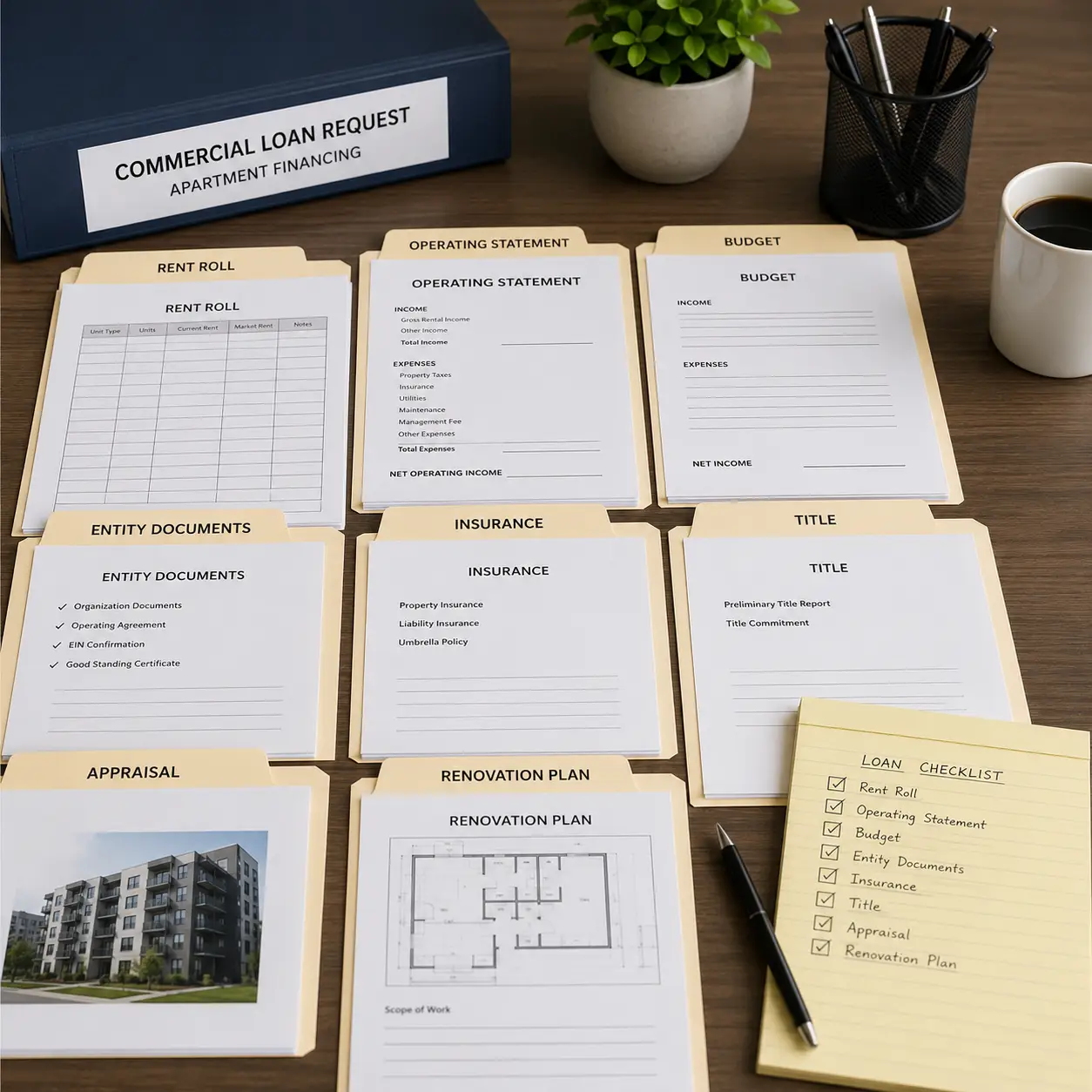
An organized submission helps a financing source understand the property, borrower, business plan, requested structure, and exit. Review DPCG’s commercial loan required-documents guide for additional document guidance.
Initial Loan Scenario
- Property address and unit count
- Loan purpose and requested amount
- Purchase price, current value, and existing debt
- Renovation or completion budget
- Current occupancy and monthly income
- Requested closing date
- Borrower experience
- Primary and backup exit strategies
- Known title, legal, environmental, insurance, or permit issues
Property Documents
- Current and historical rent rolls
- Trailing and year-to-date operating statements
- Unit mix and lease information
- Property photos and condition reports
- Tax, insurance, utility, and management information
- Zoning and certificates of occupancy
- Appraisal, environmental, survey, or engineering reports when available
Entity Documents
- Articles of organization or incorporation
- Operating agreement, partnership agreement, or bylaws
- EIN confirmation
- Certificate of good standing
- Ownership schedule and organizational chart
- Borrowing resolution
- Authorized signer information
- Amendments and foreign registrations when applicable
Acquisition or Refinance Documents
- Purchase agreement and amendments
- Deposit evidence and closing deadline
- Current mortgage statement and payoff demand
- Promissory note and loan agreement
- Modification or extension agreements
- Payment history and default notices
- Current title report and junior-lien information
- Itemized use of proceeds
Borrower and Guarantor Documents
- Loan application
- Personal financial statement
- Schedule of real estate owned
- Experience summary or résumé
- Liquidity verification
- Credit authorization
- Explanations for material credit, litigation, bankruptcy, or default events
- Identification and sensitive financial records through an approved secure process
Renovation and Exit Documents
- Detailed scope of work
- Line-item budget and contingency
- Contractor agreement, license, and insurance
- Plans, permits, schedule, and draw plan
- Completed-work evidence and remaining-cost report
- Lease-up schedule and rent support
- Permanent-financing analysis or sale plan
- Backup exit strategy
What Is the Apartment Bridge Loan Process?
Initial Scenario Review
Property, borrower, loan purpose, and exit
Preliminary Financing Discussion
Clarify structure and missing information
Term Indication
Preliminary and subject to review
Complete Loan Submission
Organized documents and explanations
Formal Underwriting
Borrower, property, business plan, and exit
Third-Party Reports
Valuation, title, environmental, and other reviews
Conditions and Documentation
Resolve closing requirements
Closing and Post-Closing
Funding, reporting, draws, and exit preparation
What Can Delay an Apartment Bridge Loan?
- Incomplete or inconsistent documents: Missing or conflicting rent rolls, operating statements, entity records, budgets, or payoffs can stop a complete review.
- Unsupported property value: The borrower’s estimate may not be supported by an accepted appraisal or current income.
- Weak exit strategy: A future refinance or sale should be supported by realistic milestones and a backup plan.
- Title or lien problems: Unreleased liens, judgments, ownership discrepancies, tax liens, or mechanic’s liens may require correction.
- Insurance or environmental issues: Missing coverage, unacceptable terms, or environmental findings may require additional review.
- Permit, zoning, or occupancy issues: Unauthorized units, open permits, code violations, or missing certificates can affect eligibility.
- Unreliable renovation budget: A budget that is not itemized or excludes contingency, labor, materials, or required work may be questioned.
- Last-minute transaction changes: Changes to ownership, guarantors, proceeds, budget, condition, or exit can require re-underwriting.
Property owners can review the EPA’s environmental due-diligence guidance and the FEMA Flood Map Service Center when relevant to the property.
How Can a Borrower Prepare a Stronger Submission?
- Prepare a one-page executive summary.
State the property, loan purpose, requested amount, business plan, and exit. - Use one consistent set of numbers.
Reconcile the loan request, value, unit count, income, budget, and use of proceeds. - Provide current property financials.
Include a current rent roll and operating statements. - Identify every payoff and lien.
Disclose senior debt, junior debt, judgments, and other obligations. - Document equity and liquidity.
Show the borrower’s investment and capacity to address closing costs or overruns. - Use a detailed renovation budget.
Include a scope, timeline, contingency, and contractor support. - Support projected rents and occupancy.
Separate current results from future assumptions. - Explain the primary and backup exits.
State what happens if stabilization, refinancing, or sale takes longer. - Disclose known problems early.
Address title, permit, condition, insurance, environmental, or legal issues. - Protect sensitive information.
Use an approved secure-upload process for confidential documents.
How Does Direct Private Capital Group Assist with Apartment Bridge Financing?
Direct Private Capital Group, Inc. is a commercial mortgage broker and private real estate financing resource.
DPCG may assist by:
- Reviewing the initial apartment bridge scenario
- Identifying incomplete or inconsistent information
- Helping organize property, borrower, and entity documents
- Clarifying the requested loan purpose and use of proceeds
- Presenting eligible files to possible lenders, investors, or capital providers
- Coordinating information requests during the review process
- Communicating with borrowers, brokers, and transaction parties as the file progresses
DPCG does not guarantee approval, terms, proceeds, funding, or closing and is not represented on this page as the direct lender, bank, agency lender, debt fund, servicer, or owner of committed capital.
Discuss Your Apartment Bridge Financing Scenario
Provide the property address, unit count, requested loan amount, loan purpose, current income, existing debt, renovation needs, borrower experience, and proposed exit strategy. A complete initial scenario helps DPCG identify the next information needed for review.
Submitting a scenario is not an approval, commitment to lend, rate lock, or guarantee of financing.
Frequently Asked Questions About Apartment Bridge Loans
Bridge financing may be considered for business-purpose apartment properties, subject to the financing source’s property, unit-count, location, condition, occupancy, and transaction guidelines. Property eligibility must be confirmed for each scenario.
Yes, acquisition is a common bridge-loan use case. The review generally includes the purchase agreement, closing deadline, required equity, property condition, current operations, renovation plan, borrower experience, and exit strategy.
It may be considered, but maturity alone does not establish eligibility. Provide the payoff, payment history, maturity or default notices, current property performance, requested proceeds, title information, and a credible repayment plan.
Not necessarily. Transitional properties may have vacancy or active lease-up. The financing source may evaluate current occupancy, leasing pace, operating deficits, reserves, market demand, and the stabilization plan.
Some structures may include eligible renovation or capital-improvement costs. A detailed scope, itemized budget, contractor information, timeline, contingency, draw schedule, and evidence supporting the proposed improvements may be required.
Experience requirements vary. The review may consider project complexity, prior ownership and renovation history, the strength of the property manager or contractor, and the borrower’s financial capacity.
The exit should identify a realistic repayment event, milestones required to reach it, supporting financial and market evidence, expected timing, and a backup plan if the primary exit is delayed.
Timing depends on file completeness, underwriting, valuation, title, insurance, environmental review, legal documentation, third-party reports, borrower responsiveness, and satisfaction of conditions. No closing timeline is guaranteed.
State eligibility varies by financing source, transaction type, property, borrower, licensing considerations, and applicable law. Availability must be confirmed for each transaction.
No. A submission is a request for review only. It is not an approval, commitment to lend, rate lock, or guarantee of terms, proceeds, funding, or closing.
Compliance Disclaimer
Direct Private Capital Group, Inc. is a commercial mortgage broker and private real estate financing resource. The information on this page is provided for general informational and educational purposes only.
Nothing on this page constitutes an approval, commitment to lend, loan offer, rate lock, or guarantee of terms, proceeds, funding, or closing. Any financing that may be available is subject to complete underwriting, borrower and guarantor qualification, collateral review, valuation, title, insurance, documentation, third-party reports, state eligibility, applicable lender, investor, or capital-provider guidelines, market conditions, and applicable law.
Program structures, requirements, costs, rates, leverage, reserves, recourse, prepayment terms, extension options, and closing timelines vary by transaction and financing source. Business-purpose and investment-property financing only.
This page is not legal, tax, accounting, insurance, investment, appraisal, or financial advice. Borrowers should consult qualified advisers regarding their transaction.
Equal-credit-opportunity requirements can apply to commercial credit. Review the Consumer Financial Protection Bureau’s Regulation B resource and the official eCFR text for 12 CFR Part 1002.