
Apartment Loan Guide
Learn how apartment building loans work, which financing structures may be considered, what documents borrowers commonly provide, and how to prepare an apartment acquisition, refinance, bridge, renovation, construction, completion, lease-up, or portfolio financing request.
Direct Private Capital Group, Inc. is a commercial mortgage broker and private real estate financing resource. Financing is subject to underwriting, borrower qualification, collateral review, state eligibility, and lender or capital-provider guidelines.
What Is an Apartment Loan?
An apartment loan is business-purpose financing secured by a residential rental property containing multiple units. Depending on the property and transaction, financing may be used for acquisition, refinance, renovation, construction, completion, lease-up, stabilization, or another qualified business purpose.
Apartment financing is one category of commercial real estate financing. Approval and structure depend on the property, borrower, cash flow, collateral value, documentation, and repayment plan.
When Do Apartment Owners and Buyers Need Financing?
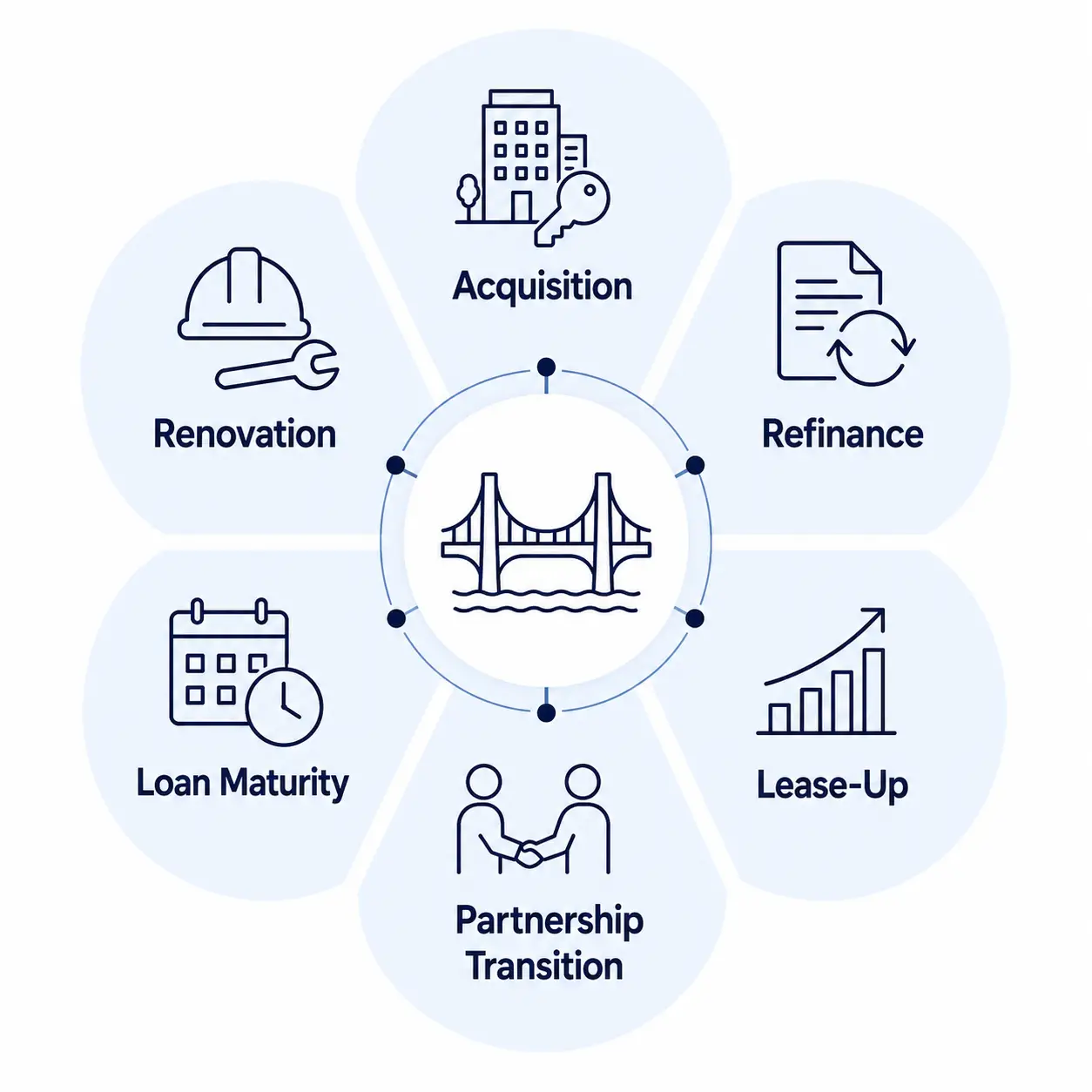
Apartment financing becomes relevant when the property or transaction requires capital for a defined business purpose.
- Purchasing an apartment building under a signed contract.
- Replacing an existing loan that is approaching maturity.
- Refinancing short-term or bridge financing.
- Funding eligible renovations, unit turns, or capital improvements.
- Completing an unfinished construction project.
- Supporting lease-up or stabilization after construction or renovation.
- Consolidating approved property-related debt.
- Evaluating qualifying cash-out proceeds.
- Financing a portfolio containing multiple apartment properties.
- Preparing a transitional property for longer-term financing.
Buyers purchasing an apartment property should also review apartment acquisition financing.
Which Properties Are Considered Apartment Buildings?
For commercial financing discussions, an apartment building generally refers to residential rental real estate containing multiple dwelling units and operated as an income-producing property.
The classification used by a lender or capital provider can depend on:
- Number of legal units
- Current use and occupancy
- Zoning and certificate-of-occupancy records
- Whether units are leased individually
- Whether the property includes commercial space
- Whether units are operated as short-term rentals
- Whether the property functions as student, senior, workforce, affordable, supportive, or conventional housing
- Whether the asset is one property or part of a portfolio
What Types of Apartment Loan Scenarios May Be Considered?
Apartment Acquisition
Apartment Acquisition
Apartment Refinance
Apartment Refinance
Apartment Bridge Financing
Apartment Bridge Financing
Apartment Renovation Financing
Apartment Renovation Financing
Apartment Construction Financing
Apartment Construction Financing
Lease-Up and Portfolio Financing
Lease-Up and Portfolio Financing
How Is an Apartment Loan Evaluated?
Property and Collateral
- Property address, parcel, and legal description
- Legal unit count and property classification
- Zoning, permitted use, and certificate of occupancy
- Year built, construction type, and renovation history
- Current condition and deferred maintenance
- Building systems, parking, amenities, and accessibility
- Code, fire, life-safety, flood, and environmental concerns
- Insurance availability and marketability
- Current and projected occupancy
Borrower and Sponsor
- Borrowing entity, ownership, principals, and guarantors
- Credit and background information
- Apartment ownership and management experience
- Construction or renovation experience
- Liquidity, net worth, and contingent liabilities
- Real estate owned and existing debt
- Capacity to fund equity, reserves, and cost overruns
- Strength of the property manager, contractor, and professional team
Property Income and Expenses
- Current and historical rent rolls
- Executed leases, tenant ledger, and bank deposits
- Collections, delinquencies, concessions, and vacancy
- Other property income and utility reimbursements
- Trailing-12-month and year-to-date operating statements
- Taxes, insurance, payroll, management, repairs, and utilities
- Replacement reserves and recurring operating costs
- Normalized net operating income
Existing Debt and Equity
- Current lender, balance, payment, and maturity
- Extension and prepayment requirements
- Default interest, late charges, and advances
- First, second, and other lien positions
- Judgments, mechanics liens, and municipal claims
- Required equity and earnest-money deposit
- Source of closing funds, reserves, and investor contributions
- Recent transfers and ownership changes
Business Plan and Exit Strategy
- Exact loan purpose and requested use of proceeds
- Remaining construction or renovation work
- Lease-up, occupancy, and collection targets
- Property-management and expense-control plan
- Interest, operating, or replacement reserves
- Expected refinance, sale, or other repayment event
- Future debt-service capacity and valuation support
- Backup plan if the original timeline is missed
Borrowers evaluating applicable government-insured options may review HUD Section 223(f) program information.
Which Financial Measurements Matter in Apartment Financing?
Loan-to-Value Ratio
Value-based leverage
Loan-to-value, or LTV, compares the proposed loan amount with the property value accepted for underwriting.
Formula
Loan Amount ÷ Applicable Property Value = LTV
The applicable value may be as-is, as-complete, or stabilized depending on the transaction.
Debt-Service Coverage Ratio
Income cushion above debt service
Debt-service coverage ratio, or DSCR, compares underwritten net operating income with annual debt service.
Formula
Net Operating Income ÷ Annual Debt Service = DSCR
The required ratio and calculation method depend on the applicable financing source.
Debt Yield
Income relative to the loan balance
Debt yield compares underwritten net operating income with the proposed loan amount.
Formula
Net Operating Income ÷ Loan Amount = Debt Yield
Debt yield does not directly use the loan interest rate or amortization schedule.
Net Operating Income
Property income after operating expenses
NOI generally represents gross operating income less vacancy, collection loss, and applicable operating expenses before debt service and certain non-operating items.
Underwriting Note
The underwriter may normalize income and expenses instead of accepting every reported amount without adjustment.
As-Is, As-Complete, and Stabilized Value
Current, completed, and stabilized conditions
As-is value reflects the current property. As-complete value assumes specified work is completed. Stabilized value assumes supportable stabilized occupancy, income, and expenses.
Valuation Note
A projected future value is not a guarantee that the property will achieve the assumed performance.
Loan-to-Cost and Reserves
Project cost and carrying support
Loan-to-cost compares the loan amount with recognized eligible project cost. Interest and replacement reserves may support approved carrying or future capital needs.
Formula and Limitation
Loan Amount ÷ Eligible Project Cost = LTC
Eligible costs and reserve requirements are transaction-specific and do not eliminate repayment obligations.
Owners researching longer-term apartment financing may review the Fannie Mae Multifamily term sheet library and Freddie Mac Multifamily financing options for general educational information. These links do not imply DPCG approval, agency status, or transaction eligibility.
What Documents Are Commonly Needed for an Apartment Loan?
A complete initial package helps the financing source understand the request without relying on assumptions. Exact requirements depend on the property, loan purpose, size, financing source, and transaction stage. Review DPCG’s commercial loan required-documents guide for additional guidance.
Initial Loan Scenario
- Requested loan amount and loan purpose
- Property address, type, and legal unit count
- Current occupancy and estimated value
- Purchase price or existing debt
- Use of proceeds and desired closing date
- Borrower credit estimate, when available
- Brief business plan and exit strategy
- Borrower and authorized broker contact information
Property Documents
- Current and historical rent rolls
- Trailing-12-month and year-to-date statements
- Prior-year operating statements and current budget
- Tax, insurance, utility, and management information
- Unit mix, photographs, and capital-improvement history
- Survey, zoning, certificate of occupancy, and permits
- Existing appraisal, environmental, or condition reports
Entity Documents
- Articles of organization or incorporation
- Operating agreement, bylaws, or partnership agreement
- Employer Identification Number confirmation
- Certificate of good standing, when required
- Borrowing resolutions and ownership schedule
- Organizational chart and amendments
- Authorized signer information
Acquisition or Refinance Documents
- Purchase agreement and all amendments
- Earnest-money evidence and escrow instructions
- Current mortgage statement and payoff
- Existing note, loan agreement, and modifications
- Maturity, extension, and prepayment information
- Preliminary title report and list of all liens
- Detailed sources-and-uses statement
Borrower and Guarantor Documents
- Personal financial statement
- Schedule of real estate owned
- Resume or experience summary
- Liquidity verification through an approved secure process
- Contingent-liability schedule
- Ownership chart and principal information
- Explanation of material credit or legal issues
Renovation or Construction Documents
- Detailed scope of work and itemized budget
- Contractor bids and executed agreements
- Plans, permits, and project schedule
- Draw schedule and contingency
- Cost-to-date and cost-to-complete reports
- Change-order log and completed-work evidence
- Lease-up, refinance, or sale exit documentation
What Is the Apartment Financing Process?
Initial Scenario Review
Preliminary Document Collection
Financing-Source Review
Preliminary Terms or Indication
Formal Application and Underwriting
Valuation and Third-Party Reports
Conditions and Documentation
Closing and Post-Closing Obligations
What Commonly Delays an Apartment Loan?
- Incomplete or inconsistent financial information: Rent rolls, operating statements, tenant ledgers, and bank deposits do not reconcile.
- Unsupported property value: Expected value is not supported by income, condition, comparable evidence, or accepted valuation.
- Incorrect unit count or classification: Advertising, zoning, leases, and occupancy records describe the property differently.
- Title and lien problems: Undisclosed liens, judgments, ownership discrepancies, or old mortgages affect the requested lien position.
- Insurance problems: Required coverage is unavailable, incorrectly classified, insufficient, or delivered late.
- Environmental or property-condition concerns: Historical uses, hazardous materials, deferred maintenance, or system issues require additional review.
- Weak construction budget or missing permits: The budget omits work, contingency, professional fees, or required approvals.
- Unclear use of proceeds or unverified equity: Funds, investors, deposits, or transfers are not fully documented.
- Weak exit strategy: The repayment plan depends only on appreciation or unsupported future performance.
- Last-minute transaction changes: Changes to ownership, amount, collateral, guarantors, or scope require re-underwriting.
How Can Borrower Prepare a Stronger Submission?
- Start with a clear transaction summary.
State the property, unit count, loan purpose, requested amount, current debt or purchase price, occupancy, equity, use of proceeds, timing, and exit. - Reconcile the numbers.
Confirm that the rent roll, operating statement, bank deposits, tenant ledger, payoff, budget, and requested loan amount reasonably agree. - Organize documents by category.
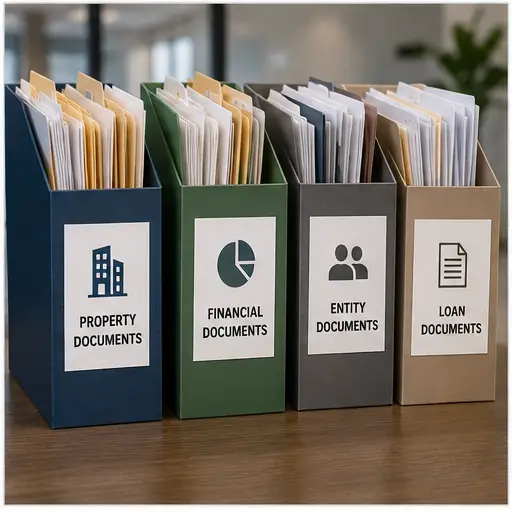
Use clearly named folders for property, borrower, entity, acquisition, refinance, construction, title, insurance, and valuation. - Disclose known problems early.
Explain material credit, tax, title, insurance, environmental, code, contractor, budget, occupancy, or collection issues. - Use a detailed sources-and-uses statement.
Show purchase or payoff, costs, reserves, construction, financing proceeds, equity, and other approved sources. - Prepare a backup exit.
Address slower lease-up, lower rents, higher expenses, cost overruns, delayed sale, or extension needs. - Protect sensitive information.
Use an approved secure-upload process for identification, bank statements, tax returns, and other confidential records.
What Risks Should Apartment Borrowers Consider?
- Interest and carrying costs: Interest, taxes, insurance, utilities, payroll, maintenance, and other costs continue during renovation, construction, vacancy, and lease-up.
- Exit risk: Future financing terms and property values can change, making a projected refinance or sale more difficult.
- Construction and renovation risk: Material costs, labor, hidden conditions, permits, inspections, and change orders can increase the required budget.
- Occupancy and collection risk: Physical occupancy does not guarantee collections, and concessions, delinquencies, turnover, or nonpaying tenants can reduce performance.
Which Loan Terms Require Careful Review?
- Insurance and property requirements: Coverage availability, deductibles, exclusions, repair conditions, and property classification can affect closing and ongoing compliance.
- Recourse and guaranties: A structure may include personal, completion, carry, environmental, repayment, or other guaranties.
- Prepayment and extensions: Review prepayment restrictions, extension conditions, fees, performance tests, and notice requirements.
- Default and maturity: Failure to pay, maintain insurance, pay taxes, complete repairs, satisfy covenants, or repay at maturity can trigger remedies under the loan documents.
Borrowers should review actual loan documents with qualified legal, tax, and financial advisers.
How Does Direct Private Capital Group Assist With Apartment Financing?
Direct Private Capital Group, Inc. is a commercial mortgage broker and private real estate financing resource.
DPCG may assist by:
- Reviewing the initial apartment loan scenario
- Helping organize property and borrower information
- Identifying missing or inconsistent items
- Discussing possible financing categories
- Presenting eligible scenarios to possible financing sources
- Coordinating requests for additional information
- Communicating transaction updates
- Helping the borrower prepare for underwriting and closing conditions
DPCG does not guarantee approval, terms, funding, or closing and is not represented on this page as the direct lender, bank, agency lender, debt fund, servicer, or owner of committed capital.

Prepare Your Apartment Financing Request
Provide the property address, legal unit count, requested loan amount, loan purpose, current occupancy, financial performance, borrower experience, timing, use of proceeds, and exit strategy. A clear and complete submission makes the initial review more efficient.
An inquiry or document submission is not an approval, commitment to lend, rate lock, or guarantee of financing or closing.
Frequently Asked Questions About Apartment Loans
Properties containing five or more residential units are commonly discussed as commercial multifamily properties, but classification depends on the financing source and the property’s legal and actual use. Smaller residential properties, mixed-use buildings, student housing, senior housing, and other specialized assets may be evaluated under different guidelines.
Potentially, but vacancy affects income, carrying costs, property condition, security, insurance, renovation needs, and the exit strategy. A vacant property may require transitional, renovation, construction, or bridge financing rather than stabilized permanent debt.
Potentially. The review may examine current occupancy, collections, completed units, remaining work, lease-up projections, reserves, operating history, and the plan for reaching stabilization. Availability and terms depend on underwriting and the applicable financing source.
Experience requirements vary. A financing source may evaluate the borrower’s ownership, management, renovation, construction, or investment experience and may also consider the strength of the property manager, contractor, and professional team. No universal experience requirement applies to every apartment loan.
A bridge loan is generally used for a transitional property or time-sensitive business plan, while permanent financing is generally intended for a property with supportable ongoing operations. Exact definitions, terms, and eligibility vary by financing source.
Some apartment financing structures may include eligible renovation or capital-improvement costs. The borrower generally needs a detailed scope, itemized budget, project timeline, contractor information, contingency, draw plan, and evidence supporting the completed value and repayment strategy.
Common records include a current rent roll, trailing-12-month operating statement, year-to-date operating statement, prior-year results, tenant ledger, bank deposit information, tax bills, insurance information, and a current property budget. Exact requirements depend on the transaction.
No. Document submission allows the transaction to be reviewed but does not guarantee approval, terms, funding, or closing. Financing remains subject to underwriting and all applicable property, borrower, documentation, valuation, title, insurance, and third-party requirements.
Cash-out refinancing may be considered when supported by the property, value, income, ownership history, existing debt, requested use of proceeds, borrower qualification, and applicable guidelines. Cash out is not automatically available merely because the owner estimates that the property has increased in value.
Possible reasons include unsupported value, inadequate property income, excessive requested leverage, insufficient equity or liquidity, property-condition problems, title defects, insurance issues, environmental concerns, incomplete documentation, weak experience for the proposed project, or an unreliable exit strategy. Each financing source applies its own guidelines.
Compliance Disclaimer
Direct Private Capital Group, Inc. is a commercial mortgage broker and private real estate financing resource. The information on this page is provided for general educational and informational purposes and does not constitute an approval, commitment to lend, loan offer, rate lock, or guarantee of terms, funding, or closing.
Any financing that may be available is subject to complete underwriting; borrower, principal, and guarantor qualification; verification of information; collateral review; appraisal or other valuation; title; insurance; entity documentation; environmental, engineering, property-condition, construction, and other applicable third-party reviews; state eligibility; market conditions; lender, investor, or capital-provider guidelines; and applicable law.
Loan programs, terms, rates, fees, leverage, reserves, recourse requirements, property eligibility, and closing requirements vary by transaction and financing source and may change without notice. Business-purpose and investment-property financing only where applicable. This page is not legal, tax, accounting, investment, or financial advice.
For official equal-credit-opportunity information, review the Consumer Financial Protection Bureau’s Regulation B resource.