

Commercial Apartment Financing
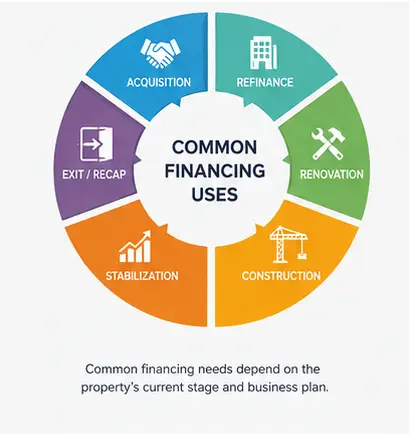
Commercial apartment financing can support the purchase, refinance, renovation, construction, stabilization, or recapitalization of an apartment property. Direct Private Capital Group, Inc. reviews the property, borrower, operating performance, proposed structure, requested proceeds, and exit strategy. Terms, approval, funding, and availability depend on underwriting, state eligibility, and lender or capital-provider guidelines.
What Is Commercial Apartment Financing?
Commercial apartment financing is business-purpose commercial real estate financing secured by an apartment property, commonly a building or project with five or more residential units. It may be used for a purchase, refinance, bridge transaction, renovation, construction project, lease-up, stabilization, partnership change, or another qualified business need. The available structure depends on the property, sponsor, cash flow, requested proceeds, and exit plan.
When Is Commercial Apartment Financing Needed?
Apartment owners, buyers, investors, and developers may seek financing when a transaction cannot be completed entirely with cash or when existing debt no longer fits the business plan.
- Purchasing a stabilized apartment building
- Acquiring an underperforming or value-add property
- Refinancing an existing apartment mortgage
- Replacing maturing or short-term debt
- Funding approved repairs or capital improvements
- Completing construction or renovation work
- Supporting lease-up or stabilization
- Buying out a partner or restructuring ownership
- Obtaining qualified business-purpose cash-out proceeds
- Transitioning from bridge financing to a longer-term structure
- Purchasing rather than refinancing? Review apartment acquisition financing.
What Qualifie as a Commercial Apartment Property?
For commercial underwriting purposes, an apartment property is generally a residential rental property containing multiple dwelling units and operated as an income-producing real estate asset. Properties with five or more units are commonly evaluated under commercial or multifamily underwriting rather than the consumer mortgage standards typically applied to one-to-four-unit residential properties.
Government and agency multifamily programs also commonly distinguish projects with five or more residential units. HUD’s multifamily programs include financing or mortgage-insurance structures for qualifying acquisition, refinancing, construction, rehabilitation, and repair transactions, but eligibility and execution depend on the specific program and approved lender.

What Types of Apartment Financing May Be Considered?
Apartment Acquisition Financing
Apartment Acquisition Financing
Apartment Refinance Financing
Apartment Refinance Financing
Apartment Bridge Financing
Apartment Bridge Financing
Apartment Renovation Financing
Apartment Renovation Financing
Apartment Construction Financing
Apartment Construction Financing
Permanent Apartment Financing
Permanent Apartment Financing
How Is an Apartment Financing Request Evaluated?
Property and Collateral
- Property address, legal description, unit count, and unit mix
- Year built and renovation history
- Current condition and deferred maintenance
- Building systems, life-safety issues, parking, and amenities
- Zoning, legal use, certificates of occupancy, and code issues
- Environmental history and location-related risks
- Current, as-complete, and stabilized value where relevant
Occupancy and Rental Performance
- Current rent roll and lease terms
- Physical and economic occupancy
- Vacancy, down units, and lease-up
- Collections, delinquency, concessions, and bad debt
- Security deposits and lease expirations
- Current and projected market rents
- Affordable or restricted rents where applicable
Property Income and Expenses
- Trailing operating statements and year-to-date results
- Rent and other property income
- Payroll, repairs, utilities, management, taxes, and insurance
- Replacement reserves and capital expenditures
- Nonrecurring income or expenses
- Normalized net operating income
- Current results compared with projected results
Existing Debt, Equity, and Liens
- Current mortgage statements and payoff demands
- First, second, and other lien positions
- Mechanics liens, tax liens, judgments, and UCC filings
- Borrower equity and documented source of funds
- Partner contributions, preferred equity, or subordinate debt
- Prepayment requirements, extension rights, and maturity
- Closing costs, reserves, and itemized uses of proceeds
Borrower, Business Plan, and Exit Strategy
- Ownership and apartment operating experience
- Credit history, liquidity, net worth, and contingent liabilities
- Construction or renovation experience where relevant
- Purpose of financing and use of proceeds
- Renovation, lease-up, or operating milestones
- Refinance, sale, or another documented exit
- Backup plan if stabilization or sale takes longer
Which Financial Metrics Matter in Apartment Financing?
Loan-to-Value Ratio
Loan-to-value, or LTV, compares the proposed loan amount with the property value accepted for underwriting.
Formula and Value Basis
Loan Amount ÷ Accepted Property Value = LTV
The relevant value may be as-is, as-complete, or stabilized, depending on the transaction.
Loan-to-Cost
LTC is especially relevant to acquisitions, renovations, and construction transactions.
Formula and Interpretation
Loan amount ÷ eligible total project cost = LTC
Eligible costs may differ from the borrower’s total expenditure, so the underwriting definition must be confirmed.
Debt-Service Coverage Ratio
DSCR compares underwritten net operating income with annual debt service.
Formula and Interpretation
Underwritten NOI ÷ Annual Debt Service = DSCR
A result above 1.00 indicates that measured NOI exceeds measured debt service, but each financing source applies its own requirements.
Debt Yield
Debt yield measures underwritten property income relative to the proposed loan amount.
Formula and Use
Underwritten NOI ÷ Loan Amount = Debt Yield
It does not directly use the interest rate or amortization schedule.
Net Operating Income
NOI generally equals effective property income minus normal operating expenses before mortgage debt service, income taxes, depreciation, and certain capital items.
Underwriting Adjustment
A financing source may normalize income and expenses when reported figures are incomplete, unsupported, nonrecurring, or inconsistent with leases and market evidence.
As-Is, As-Complete, and Stabilized Value
As-is value reflects current condition. As-complete value assumes defined work is completed. Stabilized value assumes a supported level of occupancy, income, expenses, and operations.
Transaction-Specific Use
These values are not interchangeable, and not every apartment financing request relies on all three.
Interest Reserve
An interest reserve is a controlled amount allocated to eligible loan interest during a construction, renovation, or lease-up period.
Reserve Limitation
An interest reserve does not eliminate interest expense and does not replace the need for a sound completion, operating, and repayment plan.
Where relevant, apartment financing may also be measured through loan-to-cost, cost basis, and loan-to-after-repair or as-completed value. Definitions and eligible costs vary by transaction.
What Documents Are Commonly Requested for Apartment Financing?
A well-organized submission helps a financing source understand the property, borrower, requested proceeds, risks, and proposed exit. Review DPCG’s commercial loan required-documents guide for broader borrower, entity, title, and financing-document guidance.
Initial Apartment Loan Scenario
- Property address, unit count, and unit mix
- Loan purpose and requested loan amount
- Purchase price or existing debt
- Current estimated value
- Current occupancy and gross income
- Estimated operating expenses
- Renovation or construction budget, when applicable
- Borrower credit summary and sponsor experience
- Available liquidity and target closing date
- Known title, insurance, environmental, or legal issues
- Intended exit strategy
Property and Operating Documents
- Current rent roll and lease summary
- Trailing 12-month and year-to-date operating statements
- Prior-year financial statements and current budget
- Unit mix, property photographs, and capital-expenditure history
- Tax bills, insurance information, and utility expenses
- Property-management agreement and service contracts
- Certificates of occupancy, zoning, code, and violation information
- Survey, appraisal, valuation, or property-condition reports when available
Entity Documents
- Articles of organization or incorporation
- Operating agreement, bylaws, or partnership agreement
- EIN confirmation and certificate of good standing
- Ownership schedule and organizational chart
- Borrowing resolution and authorized signer information
- Foreign registration, trust, or estate documents when applicable
Purchase or Refinance Documents
- Executed purchase and sale agreement and amendments
- Earnest-money and source-of-funds evidence
- Current mortgage statements and payoff demands
- Promissory notes, loan agreements, and recorded security instruments
- Subordinate-debt documents and payment history
- Preliminary title report and itemized use of proceeds
- Closing statement or estimated settlement statement
Borrower and Guarantor Documents
- Completed loan application
- Personal financial statement and real-estate-owned schedule
- Resume, sponsor biography, and prior-project list
- Liquidity verification through an approved secure process
- Credit authorization and explanations of material credit events
- Tax returns or financial statements when required and submitted securely
- Litigation, bankruptcy, or contingent-liability information when applicable
Renovation, Construction, and Exit Documents
- Detailed scope of work and itemized budget
- Contractor agreement, license, insurance, plans, and permits
- Draw schedule, cost-to-complete report, change-order log, and contingency
- Inspection reports, paid invoices, lien waivers, and current photographs
- Refinance assumptions, stabilized projections, sale support, and backup exit
Secure-document notice: Do not send Social Security numbers, government identification, complete bank statements, or full tax returns through an unsecured form or ordinary email.
What Is the Commercial Apartment Financing Process?
Initial Scenario Review
Property, borrower, purpose, proceeds, and timing are reviewed.
Preliminary Financing Discussion
Possible financing categories, missing information, and major risks are discussed.
Term Indication or Letter of Interest
A preliminary indication may be issued for review.
Full Underwriting
Property, financial, borrower, entity, and transaction documents are analyzed.
Third-Party Reports
Appraisal, environmental, title, insurance, and other reports may be ordered.
Conditions and Documentation
Outstanding underwriting, legal, title, insurance, and property items are resolved.
Closing
Documents, settlement figures, contributions, and funds flow are finalized.
Post-Closing Obligations
Payments, reporting, repairs, draws, reserves, and covenants continue.
What Commonly Delays Apartment Financing?
- Incomplete or inconsistent financials: Rent rolls, leases, deposits, and operating statements do not reconcile.
- Unsupported valuation: Projected rent, occupancy, or value assumptions lack support.
- Missing equity documentation: Required funds or transfer history cannot be verified.
- Title and lien issues: Ownership disputes, liens, judgments, taxes, or legal-description problems remain unresolved.
- Insurance problems: Coverage, limits, deductibles, exclusions, or property information do not satisfy requirements.
- Environmental or property-condition concerns: Additional investigation, repair, or remediation is needed.
- Weak renovation or construction budget: Scope, quantities, contingency, permits, or contractor support are incomplete.
- Unclear use of proceeds or exit: The request does not show where funds will go or how the loan will be repaid.
- Late changes: Ownership, budget, collateral, requested proceeds, contractor, or closing date changes require renewed review.
How Can a Borrower Prepare a Stronger Submission?
- Present one consistent transaction summary.
Use the same address, unit count, price, loan amount, value, debt, occupancy, and budget throughout the file. - Reconcile the rent roll and financial statements.
Explain vacancy, delinquency, concessions, employee units, and unusual expenses. - Use a detailed sources-and-uses statement.
List payoff, purchase price, closing costs, renovation, reserves, fees, equity, and cash-out. - Disclose problems early.
Address title, environmental, property-condition, credit, litigation, budget, insurance, or occupancy issues directly. - Provide a specific business plan.
State responsible parties, milestones, costs, permits, leasing plans, and contingencies. - Prepare the exit before accepting temporary financing.
Understand future occupancy, income, seasoning, value, and takeout requirements. - Protect sensitive documents.
Use an approved secure-upload process for confidential borrower information.
How Does Direct Private Capital Group Assist?
Direct Private Capital Group, Inc. is a commercial mortgage broker and private real estate financing resource.
DPCG may assist by:
- Reviewing the initial apartment financing scenario
- Organizing transaction information
- Identifying missing or inconsistent items
- Helping explain requested documents
- Presenting eligible scenarios to possible financing sources
- Coordinating questions and information during the review
- Tracking major conditions and milestones
- Maintaining communication among relevant parties
DPCG does not guarantee that a financing source will issue terms, approve a transaction, fund a loan, accept a valuation, approve a borrower, or close by a requested date.

Start With a Clear Apartment Financing Scenario
Share the property address, unit count, loan purpose, requested proceeds, current occupancy, operating information, borrower experience, and target closing date. DPCG will review the available information and identify the next items needed for a meaningful financing discussion.
An initial review is not an approval, commitment to lend, rate lock, or guarantee of terms, financing, or closing.
Commercial Apartment Financing FAQs
An apartment property with five or more residential units is commonly evaluated as commercial or multifamily real estate for financing purposes. The final classification depends on the property’s unit count, use, zoning, lease structure, income sources, and applicable financing guidelines.
Yes. Commercial apartment financing may be considered for an acquisition, rate-and-term refinance, maturing-debt refinance, qualified cash-out request, renovation, construction, completion, or stabilization need. The requirements depend on the specific transaction.
Not always. Some financing structures are intended for stabilized properties, while others may consider vacancy, lease-up, renovation, or operational transition. The request should explain current occupancy, the cause of vacancy, the improvement plan, required funds, and the expected exit.
Review commonly begins with the rent roll, leases, historical operating statements, current collections, vacancy, concessions, bad debt, other income, and operating expenses. The financing source may normalize or adjust figures when calculating underwritten net operating income.
Requirements vary. Experience may receive greater emphasis for construction, major renovation, lease-up, distressed, or operationally complex transactions. A stabilized property without construction may present a different experience requirement.
Some structures may include approved renovation proceeds. The request generally needs a detailed scope, itemized budget, contractor information, schedule, contingency, permits, draw plan, and supported completion or stabilized value.
Bridge financing is generally temporary and used during a defined transition, such as renovation, lease-up, maturity resolution, or stabilization. Permanent financing is generally intended for longer-term ownership of a property with supportable operations.
Depending on the transaction, reports may include an appraisal, environmental assessment, property-condition assessment, survey, zoning report, engineering review, seismic report, market study, construction review, title report, and insurance review.
A qualified business-purpose cash-out refinance may be considered by some financing sources. Review typically includes property value, existing debt, cash flow, seasoning, payment history, requested proceeds, use of funds, borrower strength, and the resulting structure.
There is no universal closing time. Timing depends on file completeness, financing type, underwriting, valuation, title, insurance, environmental work, property condition, legal documentation, borrower responsiveness, and third-party report completion.
Compliance Disclaimer
Direct Private Capital Group, Inc. is a commercial mortgage broker and private real estate financing resource. The information on this page is provided for general educational and informational purposes only.
Nothing on this page constitutes a commitment to lend, loan approval, rate lock, financing offer, guarantee of terms, guarantee of funding, or guarantee of closing. Any financing discussed or arranged is subject to underwriting; borrower, sponsor, and guarantor qualification; credit review; verification of information; collateral review; acceptable valuation; title; insurance; documentation; property condition; environmental and other third-party review; state eligibility; financing-source guidelines; market conditions; and applicable law.
Commercial and business-purpose financing only. This page is not intended for consumer-purpose financing or an owner-occupied one-to-four-unit primary residence.
DPCG is not acting through this page as a legal, tax, accounting, investment, environmental, engineering, insurance, or financial adviser.
For official information about equal-credit-opportunity requirements, review the Consumer Financial Protection Bureau’s Regulation B resource. For environmental due-diligence information, review the EPA’s All Appropriate Inquiries guidance.