

Pennsylvania Proof of Funds for Real Estate Transactions
A proof-of-funds package helps demonstrate that a buyer or sponsor has access to the cash, equity, reserves, or other verified liquidity needed for a Pennsylvania investment-property or commercial real estate transaction. Direct Private Capital Group, Inc. can review your business-purpose real estate scenario, identify missing information, and help organize the financing request for presentation to potential funding sources.
Business-purpose and investment-property transactions only. A proof-of-funds document is not loan approval, a commitment to lend, or a guarantee of closing.
What Is Proof of Funds for a Pennsylvania Real Estate Transaction?
Proof of funds is documentation showing that a buyer, borrower, sponsor, or purchasing entity has access to money needed for a real estate transaction. It may support an offer, demonstrate available equity or cash to close, or help a financing source verify liquidity. The exact document and verification standard depend on the transaction, recipient, source of funds, and financing structure.
Why Might a Pennsylvania Buyer Be Asked for Proof of Funds?

A property seller, listing broker, lender, capital provider, title professional, attorney, or transaction representative may request evidence that the proposed buyer can complete the transaction.
- Submitting a purchase offer
- Making a cash-purchase representation
- Demonstrating required equity or a down payment
- Showing cash to close and reserves
- Supporting a bridge, fix-and-flip, or construction request
- Purchasing through a limited liability company or partnership
- Using funds held across multiple accounts or entities
- Relying on sale, refinance, or partner-contribution proceeds
What Does a Proof-of-Funds Usually Show?
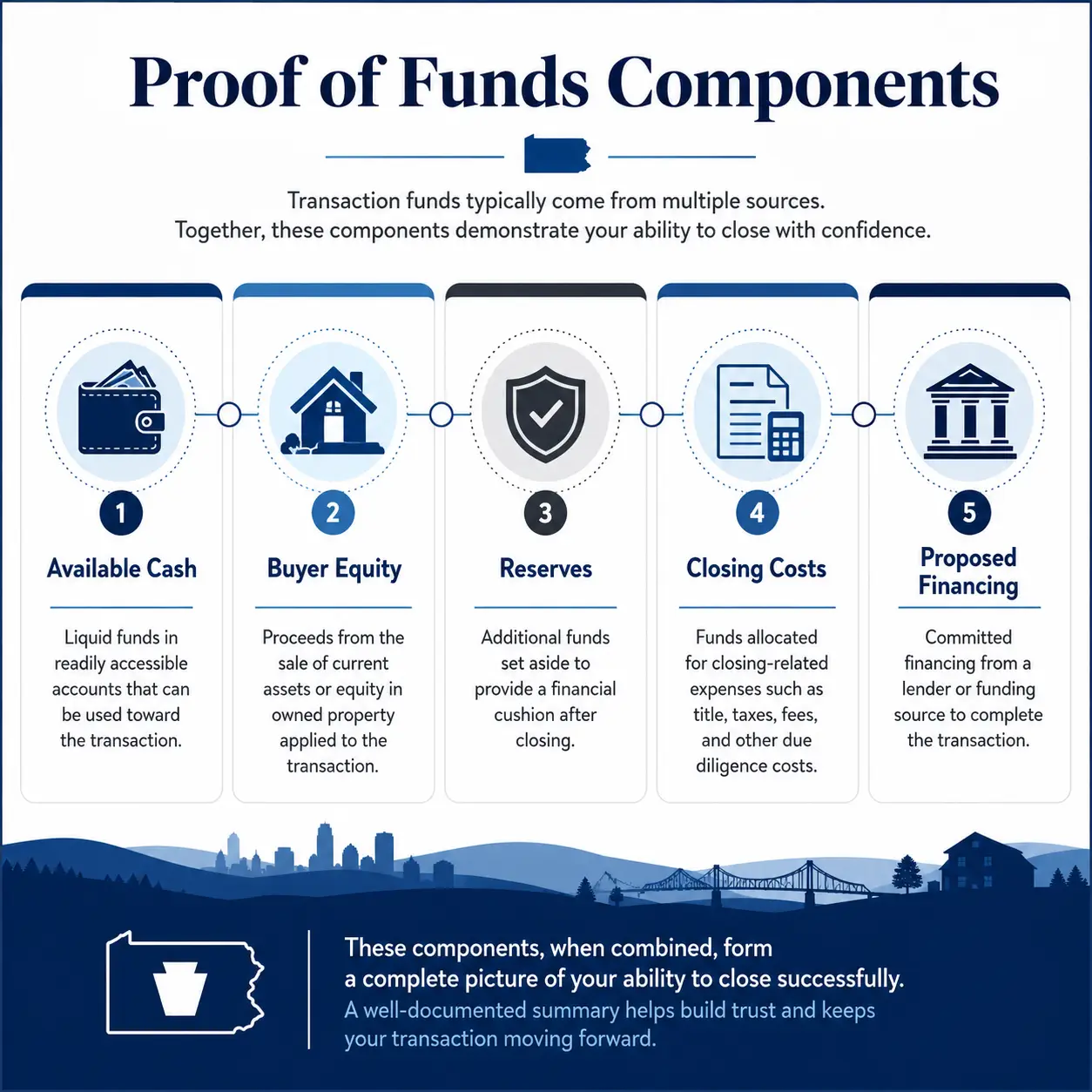
A useful proof-of-funds package normally helps answer four questions: Who controls the funds? How much verified liquidity is available? Where are the funds held? Can the funds be used for the proposed transaction?
Proof of available cash, proof of liquidity, proof of cash to close, proof of buyer equity, and a financing preapproval are related but different concepts. A preapproval or financing letter addresses potential financing and should not be presented as cash already held by the buyer.
Review the Consumer Financial Protection Bureau explanation of prequalification and preapproval.
Proof of Funds Is Not a Financing Approval
A proof-of-funds document may show available money or liquidity as of a stated date, but it does not establish final loan approval, acceptable collateral, clear title, an approved valuation, or guaranteed closing. A financing source may still require complete underwriting, borrower qualification, property review, valuation, title, insurance, and other conditions.
What Types of Documents May Be Used as Proof of Funds?
Bank Account Statements
Bank Account Statements
Bank Verification Letters
Bank Verification Letters
Brokerage and Investment Accounts
Brokerage and Investment Accounts
Entity-Owned Funds
Entity-Owned Funds
Sale or Refinance Proceeds
Sale or Refinance Proceeds
Partner or Investor Contributions
Partner or Investor Contributions
When Is Proof of Funds Commonly Relevant in Pennsylvania?
Commercial Property Acquisition
- Multifamily
- Retail
- Office
- Industrial
- Mixed-use
- Hospitality
Investment-Property Purchase
- Down payment or equity
- Closing costs
- Rehabilitation funds
- Operating reserves
- Contingency funds
Cash Purchase
- Immediately available funds
- Account ownership
- Current balance
- Closing timeline
- Transfer restrictions
Bridge or Private Financing
- Buyer contribution
- Closing costs
- Interest reserve
- Operating reserve
- Renovation contribution
Review related bridge loan information.
Construction or Renovation
- Land or acquisition equity
- Predevelopment costs
- Cost overruns
- Interest reserves
- Borrower-funded work
How Is a Proof-of-Funds Submission Reviewed?
There is no single universal acceptance standard. The requesting party determines what documentation is acceptable for the transaction.
Account Ownership
Available Balance
Source of Funds
Availability
Document Date
Restrictions
Transaction Match
Authenticity and Privacy
Large or recent deposits may require an explanation and supporting records. Review the Consumer Financial Protection Bureau guidance on documenting funds and large deposits.
How Should a Buyer Estimate Cash to Close?
Purchase Price
Begin with the total contracted purchase price.
Minus Proposed Financing
Subtract only financing proceeds reasonably expected to be available at closing.
Plus Closing Costs
Include title, legal, appraisal, environmental, insurance, transfer, and settlement costs.
Plus Required Reserves
Include operating, interest, tax, insurance, repair, and contingency reserves when applicable.
Plus Project Contribution
Add renovation, construction, or other borrower-funded costs.
Estimated Cash Requirement
The result is a preliminary estimate, not a final settlement figure.
Verify the Final Amount
Use the applicable loan documents and closing statement.
Expect Adjustments
Prorations, fees, reserves, and third-party costs may change.
Keep Funds Available
Avoid moving or spending verified funds without documenting the change.
Document Transfers
Preserve records showing movement between accounts.
Protect Sensitive Data
Use an approved secure-upload process.
Confirm Wire Instructions
Independently verify closing instructions before sending funds.
Planning formula: Purchase Price − Proposed Loan Proceeds + Closing Costs + Required Reserves + Renovation or Construction Contribution + Other Transaction Costs = Estimated Buyer Cash Requirement.
What Should Be Included in a Complete Pennsylvania Proof-of-Funds Request?
A well-organized submission helps the seller, broker, financing source, and closing team understand the transaction. Review DPCG’s commercial loan required-documents guide, loan requirement FAQs, and borrower FAQs.
Initial Transaction Summary
- Property address
- Pennsylvania county and municipality
- Property type
- Purchase price
- Requested loan amount
- Loan purpose
- Contract closing date
- Earnest-money deposit
- Required equity
- Estimated closing costs
- Renovation or construction budget, when applicable
- Exit strategy
Buyer and Entity Information
- Full legal name
- Purchasing entity
- Guarantor names
- Contact information
- Ownership percentages
- Authorized signer
- Brief real estate experience summary, when relevant
Proof-of-Funds Documents
- Most recent acceptable account statement
- Bank or financial-institution letter, when available
- Brokerage or custodian statement, when applicable
- Evidence of pending sale or refinance proceeds
- Partner contribution documentation
- Explanation of recent large deposits
- Evidence of transfer between accounts
- Documentation showing the buyer’s authority to use entity funds
Acquisition Documents
- Executed purchase agreement
- Amendments
- Escrow or deposit instructions
- Evidence of earnest-money deposit
- Closing schedule
- Seller or listing-agent proof-of-funds requirements
Financing Information
- Proposed loan amount
- Financing structure
- Preliminary term indication, when available
- Estimated borrower contribution
- Required reserves
- Third-party report requirements
- Conditions that could change the cash requirement
Privacy-Safe Preparation
Before sending a statement:
- Mask most digits of the account number unless full details are specifically required through a secure process
- Keep the account holder’s name visible
- Keep the financial institution’s name visible
- Keep the statement date visible
- Keep the current or available balance visible
- Do not alter the balance or transaction history
- Do not submit a fabricated or edited financial document
- Use an approved secure-upload method for sensitive information
What Should Be Visible on the Document?
- Account holder or asset owner
- Financial institution or custodian
- Statement or verification date
- Current or available balance
- Enough identifying detail to verify authenticity
- Any material restriction affecting use of funds
What Should Be Protected or Submitted Securely?
- Full account numbers
- Social Security numbers
- Government identification
- Tax returns
- Complete bank statements with unrelated activity
- Wire instructions
- Login credentials
- Highly sensitive personal or financial records
How Does the Pennsylvania Proof-of-Funds Review Process Work?
Prepare the Transaction Summary
Confirm the Recipient’s Requirements
Collect Current Financial Documents
Explain Deposits, Transfers, and Contributions
Submit Sensitive Documents Securely
Complete Preliminary Scenario Review
Address Financing and Transaction Conditions
Verify Final Closing Instructions Directly
What Can Delay Proof-of-Funds Acceptance?
- Outdated documents: The statement or letter is older than the recipient permits.
- Ownership mismatch: The account owner does not match the buyer or documented contributing party.
- Insufficient verified funds: Closing costs, reserves, or project contributions were omitted.
- Unexplained deposits: Recent large deposits or transfers are not supported.
- Restricted assets: Funds are pledged, held, margined, or difficult to liquidate.
- Incomplete screenshots: The document lacks the institution, date, owner, or full balance context.
- Transaction changes: Purchase price, loan amount, or closing date changed.
- Security concerns: Sensitive documents were sent through an unapproved channel.
How Can a Buyer Prepare a Stronger Submission?
- Match the financial documents to the buyer or contributing party.
- Calculate the full cash requirement, not only the down payment.
- Explain unusual deposits and transfers before they are questioned.
- Use current documents that meet the recipient’s standards.
- Keep the property, buyer, price, financing, equity, and closing date consistent.
- Use a secure process for sensitive records.
- Do not overstate a proof-of-funds letter as financing approval.
- Independently verify wire instructions before sending funds.
How Can Direct Private Capital Group, Inc. Assist?
Direct Private Capital Group, Inc. serves as a commercial mortgage broker and private real estate financing resource.
For an eligible Pennsylvania business-purpose real estate scenario, DPCG may assist by:
- Reviewing the initial transaction summary
- Identifying missing borrower, property, and funding information
- Reviewing the stated source of equity and cash to close
- Organizing the financing request
- Presenting an eligible file to possible lenders, investors, or capital providers
- Coordinating follow-up information during the financing process
DPCG does not guarantee that a proof-of-funds document will be accepted or that financing will be approved, funded, or closed.

Submit Your Pennsylvania Real Estate Scenario
Send the property address, purchase price, requested financing, closing date, and available proof-of-funds information. DPCG can review the business-purpose scenario and identify the next information needed. Initial review is not a loan approval, commitment to lend, proof-of-funds guarantee, rate lock, or assurance of closing.
Pennsylvania Proof of Funds FAQs
No single universal proof-of-funds document applies to every Pennsylvania transaction. A seller, broker, lender, attorney, title company, auction provider, or contract may establish transaction-specific requirements.
Proof of funds generally shows money or liquidity already available to the buyer or contributing party. A preapproval letter addresses a lender’s preliminary willingness to provide financing, subject to assumptions, underwriting, and conditions.
A current bank statement may be acceptable when it clearly shows the account owner, financial institution, statement date, and sufficient available funds. The recipient decides whether additional verification is required.
Many recipients permit most account digits to be masked while leaving the account holder, institution, date, and balance visible. Confirm the recipient’s requirements before redacting the document.
They may be considered, but the recipient may evaluate market volatility, liquidation timing, taxes, margin obligations, and account restrictions.
Potentially, but the submission should explain the relationship, ownership, contribution amount, authorization, and transfer timing.
No. It reflects information reviewed as of a stated date and does not guarantee that funds will remain available, financing will be approved, transaction conditions will be satisfied, or closing will occur.
The acceptable age depends on the requesting party and the transaction. Obtain the requirement directly from the recipient.
Sensitive documents should be transmitted through an approved secure process. Do not send full account numbers, identification, tax returns, or complete financial records through an unsecured initial inquiry form.
Availability and form of any document depend on verified transaction facts, the proposed financing structure, DPCG’s role, and applicable funding-source procedures. Submitting a scenario does not guarantee issuance, approval, funding, or closing.
Compliance Disclaimer
Direct Private Capital Group, Inc. is a commercial mortgage broker and private real estate financing resource. This page provides general information concerning proof of funds and business-purpose real estate transactions in Pennsylvania. It is not a commitment to lend, loan approval, proof-of-funds guarantee, financing commitment, rate lock, or assurance of terms, funding, or closing.
Any financing is subject to complete underwriting; borrower, entity, and guarantor qualification; verification of information; acceptable collateral; valuation; title; insurance; documentation; liquidity; source-of-funds review; state eligibility; lender, investor, or capital-provider guidelines; market conditions; third-party reports; and applicable law.
Proof-of-funds requirements vary by transaction and recipient. DPCG does not guarantee that any particular document will be accepted. Business-purpose and investment-property transactions only. This page is not legal, tax, accounting, investment, valuation, title, cybersecurity, or financial advice.
Review the Privacy Policy before submitting personal information. For wire-fraud precautions, review the Federal Trade Commission guidance on wiring money and FinCEN’s real estate business-email-compromise analysis.