
Minnesota Proof of Funds for Real Estate Investors
A proof-of-funds document can help show that a buyer has access to funds or a potential financing source for a proposed Minnesota investment-property or commercial real estate transaction. Direct Private Capital Group, Inc. reviews business-purpose scenarios and supporting information to determine whether a proof-of-funds request can be considered through an appropriate financing source.
Proof of funds is not a loan approval, commitment to lend, funding guarantee, or assurance that a seller or other recipient will accept the document.
What Is a Minnesota Proof of Funds Document?
A Minnesota proof-of-funds document is written evidence intended to show that a buyer has access to funds or a potential financing source for a proposed real estate purchase. Its form and acceptance depend on the transaction, the requesting party, the source of funds, and the information verified. It does not replace underwriting, closing funds, or a binding financing commitment.
Why Might a Minnesota Seller or Broker Request Proof of Funds?
Proof of funds may be requested before a seller or transaction professional will accept an offer, release due-diligence materials, confirm a closing timeline, or treat a buyer as financially prepared.
- The purchase is presented as an all-cash transaction.
- The buyer plans to use private, bridge, hard-money, or other business-purpose financing.
- The seller wants evidence of required equity or cash to close.
- The purchase agreement has a short due-diligence or closing period.
- The property is sold through an auction, receiver, estate, bank-owned, or competitive process.
- The buyer is purchasing through an LLC, corporation, partnership, or other entity.
Proof of funds is not the same as earnest money. Minnesota transaction guidance explains that earnest money is handled according to the purchase agreement and applicable trust-account procedures. Review Minnesota real estate information.
What Does Proof of Funds Mean in a Real Estate Transaction?
Proof of Funds Letter: Written evidence from a financial institution, lender, capital provider, or other qualified source. It may identify the buyer, amount, property, expiration date, and conditions.
Proof of Liquidity: Evidence of funds available for equity, deposits, closing costs, reserves, or other required contributions.
Preliminary Financing Indication: A preliminary statement that a scenario may be reviewable. It is not final approval.
Commitment to Lend: A separate, more formal document that generally follows underwriting and stated conditions.
Cash to Close: The amount required at settlement after financing proceeds, deposits, prorations, title charges, taxes, insurance, and other costs. The CFPB Loan Estimate explainer explains cash-to-close and source-of-funds documentation.

When May Minnesota Proof of Funds Be Useful?
Proof of funds may be useful for non-owner-occupied residential investment purchases, apartment and multifamily acquisitions, commercial real estate, mixed-use property, land and development transactions, auction purchases, and bridge or private financing scenarios. The recipient may impose its own format, verification, amount, timing, and expiration requirements.
For broader financing information, review commercial real estate loans.
What Common Minnesota Transactions May Require Proof of Funds?
Investment-Property Purchases
Investment-Property Purchases
Commercial Real Estate Acquisitions
Commercial Real Estate Acquisitions
Multifamily and Apartment Purchases
Multifamily and Apartment Purchases
Land and Development Transactions
Land and Development Transactions
Auction or Time-Sensitive Purchases
Auction or Time-Sensitive Purchases
Bridge or Private Financing
Bridge or Private Financing
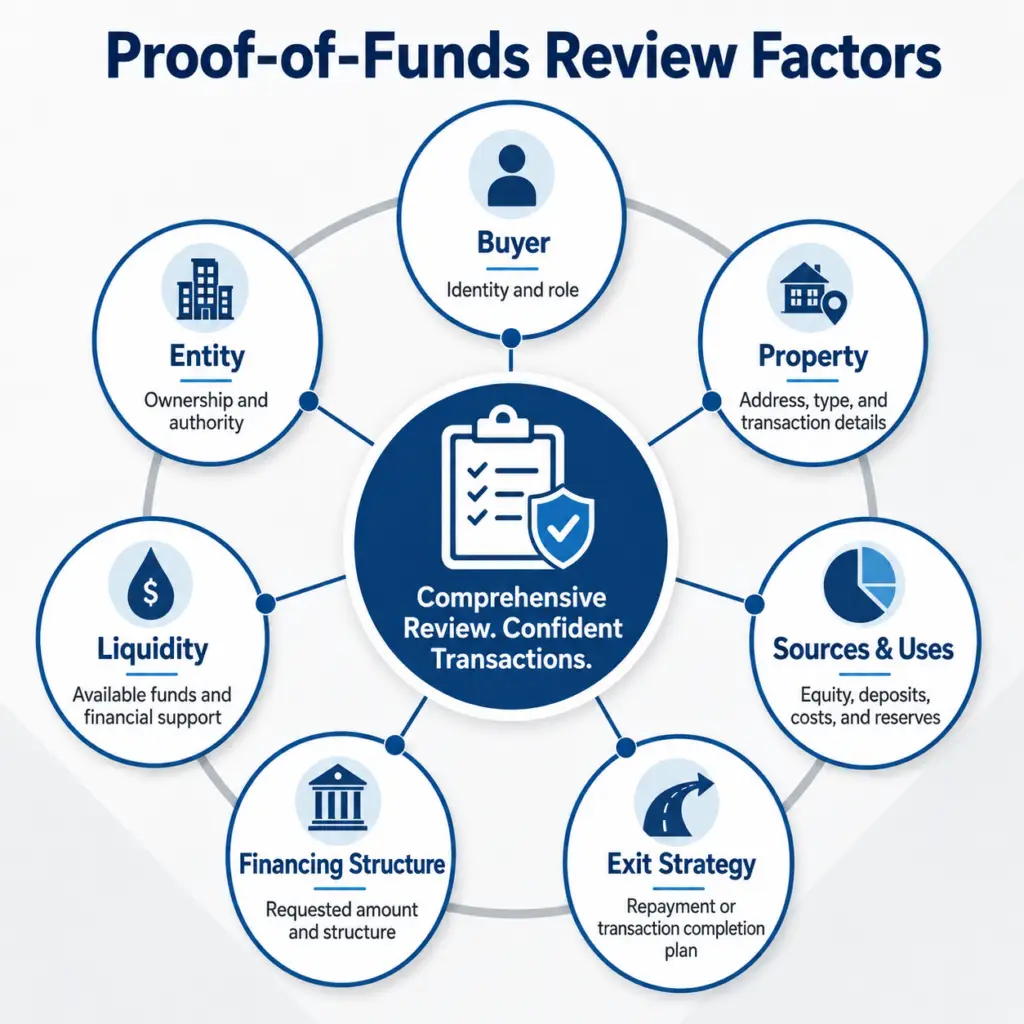
What Information May Be Reviewed?
Buyer and Borrowing Entity
Subheading: Identity, authority, and business purpose
- Legal name of buyer
- Purchasing or borrowing entity
- Authorized signer
- Guarantor information when applicable
- Business-purpose or investment-property confirmation
Property and Transaction
Subheading: The property, price, timing, and purchase terms
- Property address and type
- Purchase price and closing date
- Purchase agreement, LOI, or auction terms
- Current occupancy and income
- Business plan and intended use
Sources and Uses
Subheading: How the transaction will be funded
- Requested loan amount
- Buyer equity and deposit
- Closing costs
- Renovation or construction funds
- Reserves and total project cost
Liquidity and Financial Capacity
Subheading: Evidence supporting available funds
- Current bank or brokerage statements
- Verified account balances
- Entity or guarantor liquidity
- Personal financial statement
- Schedule of real estate owned
- Partner contribution documentation
Financing Structure and Exit
Subheading: Proposed financing and repayment plan
- Loan purpose and requested amount
- Estimated property value
- Purchase price or cost basis
- Renovation or construction budget
- Requested term
- Sale, refinance, stabilization, or other documented exit
What Factors Can Affect a Proof-of-Funds Review?
There is no single format accepted by every seller or transaction participant. Review normally combines buyer, entity, property, liquidity, financing, and transaction-specific verification.
Buyer Legal Name
Purchasing Entity
Requested Amount
Property and Purchase Price
Liquidity and Equity
Source of Funds
Recipient Requirements
Closing Date and Expiration
The requested proof-of-funds amount should be consistent with the purchase price, buyer equity, deposits, closing costs, reserves, improvement funds, and proposed financing. The seller or recipient determines whether the document satisfies its requirements.
Which Financial Measurements May Affect the Review?
Loan-to-Value Ratio
Loan-to-value, or LTV, compares the proposed loan amount with the property value accepted for underwriting.
Formula
Proposed Loan Amount ÷ Accepted Property Value = LTV
No maximum is represented without current program documentation.
Loan-to-Cost Ratio
Loan-to-cost, or LTC, compares the proposed loan amount with eligible acquisition and project costs.
Formula
Proposed Loan Amount ÷ Total Eligible Project Cost = LTC
Eligible costs vary by financing source.
Debt-Service Coverage Ratio
DSCR compares underwritten net operating income with annual debt service when reliable cash flow exists.
Formula
Underwritten NOI ÷ Annual Debt Service = DSCR
The financing source determines eligible income and expenses.
Debt Yield
Debt yield compares underwritten net operating income with the proposed loan amount.
Formula
Underwritten NOI ÷ Proposed Loan Amount = Debt Yield
Cost Basis and Value
Cost basis, as-is value, as-complete value, and stabilized value may affect the proposed financing structure.
Valuation Note
The required valuation method depends on the property and transaction.
Cash to Close and Reserves
The buyer may need funds for equity, deposits, closing costs, repairs, operating reserves, taxes, and insurance.
Transaction-Specific Review
Recognized funds and required reserves vary by transaction and financing source.
No rate, loan amount, LTV, LTC, DSCR, debt-yield threshold, term, or funding timeline is represented on this page because those items require current, transaction-specific verification.
What Documents Should Be Prepared?
A complete submission helps the reviewing party understand the buyer, property, requested amount, source of funds, financing plan, and closing requirements. Review DPCG’s commercial loan required-documents guide, loan requirement FAQs, and borrower FAQs.
Initial Scenario Information
Subheading: Core facts needed for initial review
- Property address and type
- Purchase price
- Requested proof-of-funds amount
- Requested loan amount
- Required equity
- Closing date
- Recipient and required wording
- Business plan and exit strategy
Acquisition Documents
Subheading: Contract and transaction requirements
- Executed purchase agreement
- Letter of intent or auction instructions
- Amendments and addenda
- Earnest-money requirements
- Due-diligence deadline
- Closing date
- Title or escrow contact
Buyer and Entity Documents
Subheading: Identity, ownership, and authority
- Buyer legal name
- Entity formation documents
- Operating agreement or bylaws
- EIN confirmation
- Good standing when requested
- Authorized signer
- Ownership schedule
Liquidity Documents
Subheading: Current evidence of available funds
- Recent bank statements
- Recent brokerage statements
- Escrow verification
- Partner contribution evidence
- Personal financial statement
- Schedule of real estate owned
Property Documents
Subheading: Property, income, value, and due diligence
- Offering memorandum
- Rent roll
- Trailing operating statement
- Leases
- Property condition information
- Valuation support
- Title, insurance, environmental, zoning, and permit records when relevant
Renovation or Construction Documents
Subheading: Project scope, budget, and completion plan
- Scope of work
- Detailed budget
- Contractor information
- Plans and specifications
- Permit status
- Construction schedule
- Draw schedule
- Contingency
- As-complete projections
What Should Be Included in a Purchase Request?
- Purchase agreement and amendments
- Buyer and entity name
- Property address and type
- Purchase price
- Deposit and closing deadline
- Requested proof-of-funds amount
- Required equity and cash to close
- Financing structure
- Recipient instructions
- Business plan and exit strategy
What Should Be Included in a Financing-Based Request?
- Requested loan amount
- Estimated property value
- Purchase price or cost basis
- Existing debt, when applicable
- Renovation or construction budget
- Buyer equity and reserves
- Current financial statements
- Proposed financing term
- Closing date
- Repayment or exit plan
How Does the Minnesota Proof of Funds Review Process Work?
Submit Transaction Details
Provide Recipient Requirements
Document Collection
DPCG Initial Review
Financing-Source Verification
Document Preparation
Recipient Review
Continue Underwriting and Closing
What Can Delay or Prevent a Proof-of-Funds Request?
- The requested amount is not supported by liquidity or the proposed financing structure.
- The buyer name does not match the purchasing entity or purchase agreement.
- Property, price, or closing-date information is incomplete or inconsistent.
- The requested wording would incorrectly imply final approval or unconditional funding.
- Financial records are outdated, incomplete, altered, or difficult to verify.
- Partner funds lack documented ownership or contribution authority.
- The seller or auction rules require a different form of evidence.
- Material transaction terms change after the document is prepared.
How Can a Buyer Prepare a Stronger Request?
- Obtain the recipient’s exact requirements.
- Use the same buyer and entity names shown in the purchase agreement.
- Provide a clear one-page transaction summary.
- State the requested amount and how it relates to the purchase price.
- Separate equity, loan proceeds, deposits, reserves, and improvement funds.
- Provide current, legible financial records through a secure channel.
- Explain the source of funds and partner contributions.
- Disclose material contingencies and changes.
- Provide realistic timing.
- Keep the request consistent with the purchase agreement, title, valuation, and business plan.
How Does Direct Private Capital Group, Inc. Assist?
Direct Private Capital Group, Inc. is a commercial mortgage broker and private real estate financing resource.
DPCG can review a business-purpose real estate scenario, organize the information provided, identify missing items, and present an eligible file to possible lenders, investors, or capital providers.
- Reviewing the initial request
- Organizing buyer, property, and transaction information
- Identifying missing documentation
- Clarifying the requested amount and financing structure
- Presenting eligible scenarios to possible financing sources
- Communicating questions, requirements, and next steps
DPCG does not guarantee that a proof-of-funds request will be approved, accepted, funded, or closed.

Prepare Your Minnesota Proof-of-Funds Request
Provide the property address, purchase price, requested amount, closing date, buyer or entity name, and the recipient’s requirements. A complete submission helps DPCG determine whether the request can be reviewed through an appropriate business-purpose financing source.
Submission does not create an approval, commitment, rate lock, or obligation to issue a proof-of-funds document.
Minnesota Proof of Funds FAQs
No. Requirements depend on the seller, listing broker, auction company, purchase agreement, property, financing structure, and transaction process.
No. A proof-of-funds letter has a limited evidentiary purpose. A loan approval or commitment generally requires more complete underwriting.
Only when the wording is accurate and acceptable to the requesting party. Financing-dependent funds should not be described as unconditional cash.
The reviewing party determines acceptable recency. Current records are generally more useful, and direct verification may be required.
Potentially, but ownership, availability, authority, and permitted use may need to be documented.
The requested amount should be evaluated against the full transaction need, including equity, deposits, closing costs, reserves, and improvement funds.
No. The seller or other recipient decides whether the document is acceptable.
No. Financing remains subject to underwriting, qualification, collateral review, valuation, title, insurance, documentation, third-party reports, state eligibility, market conditions, and applicable law.
Prepare a transaction summary, purchase agreement or seller instructions, buyer and entity information, requested amount, proof of liquidity, and closing deadline, then call (800) 664-7505.
Compliance Disclaimer
Direct Private Capital Group, Inc. is a commercial mortgage broker and private real estate financing resource. This page is provided for general informational purposes and does not constitute a commitment to lend, loan approval, proof that funds are presently available, a rate lock, or a guarantee of terms, funding, acceptance, or closing.
Any proof-of-funds document or financing opportunity is subject to independent review, verification, borrower and guarantor qualification, collateral and valuation review, title, insurance, documentation, applicable third-party reports, state eligibility, market conditions, lender, investor, or capital-provider guidelines, and applicable law.
This page is intended for qualified business-purpose and investment-property transactions and is not legal, tax, accounting, investment, or financial advice. Review the Privacy Policy before submitting information.
For Minnesota transaction information, review the Minnesota Department of Commerce real estate information, Minnesota Statutes § 82.75, and the CFPB Loan Estimate explainer.