

Apartment Bridge Capital for Transitional Properties
Apartment bridge capital is short-term, business-purpose financing for apartment properties that are moving through an acquisition, refinance, renovation, lease-up, stabilization, maturity payoff, or other defined transition. Direct Private Capital Group, Inc. reviews the property, sponsor, operating performance, requested proceeds, business plan, and exit strategy. Approval, terms, funding, and availability depend on underwriting, state eligibility, and lender or capital-provider guidelines.
What is apartment bridge capital?
Apartment bridge capital is temporary commercial real estate financing intended to help an apartment property move from its current condition to a defined next stage. That stage may be a sale, permanent refinance, completed renovation, improved occupancy, stabilized operations, resolved maturity, or another documented exit. The financing structure depends on the property, sponsor, financial condition, business plan, and proposed repayment strategy.

When does an apartment property need bridge capital?
Common situations include:
- Purchasing an apartment property with a short contractual closing period.
- Paying off a maturing or defaulting loan.
- Refinancing an existing private or construction loan.
- Completing renovations, unit turns, or capital improvements.
- Improving occupancy, collections, and property operations.
- Replacing ineffective property management.
- Funding lease-up after construction or renovation.
- Resolving title, ownership, partnership, or lien matters.
- Repositioning an underperforming apartment asset.
- Preparing for permanent bank, agency, institutional, or other takeout financing.
- Consolidating eligible property-related obligations into a clearer debt structure.
- Financing a property with temporary operational or documentation issues.
- Projects that require temporary capital before construction completion or permanent financing may also qualify for a commercial bridge loan structure.
How does apartment bridge financing work?
Apartment bridge financing is generally secured by the apartment property and structured around a defined business plan. The capital provider reviews the property’s current condition, the borrower’s basis and equity, the requested proceeds, the sponsor’s ability to execute the plan, and the proposed repayment strategy.
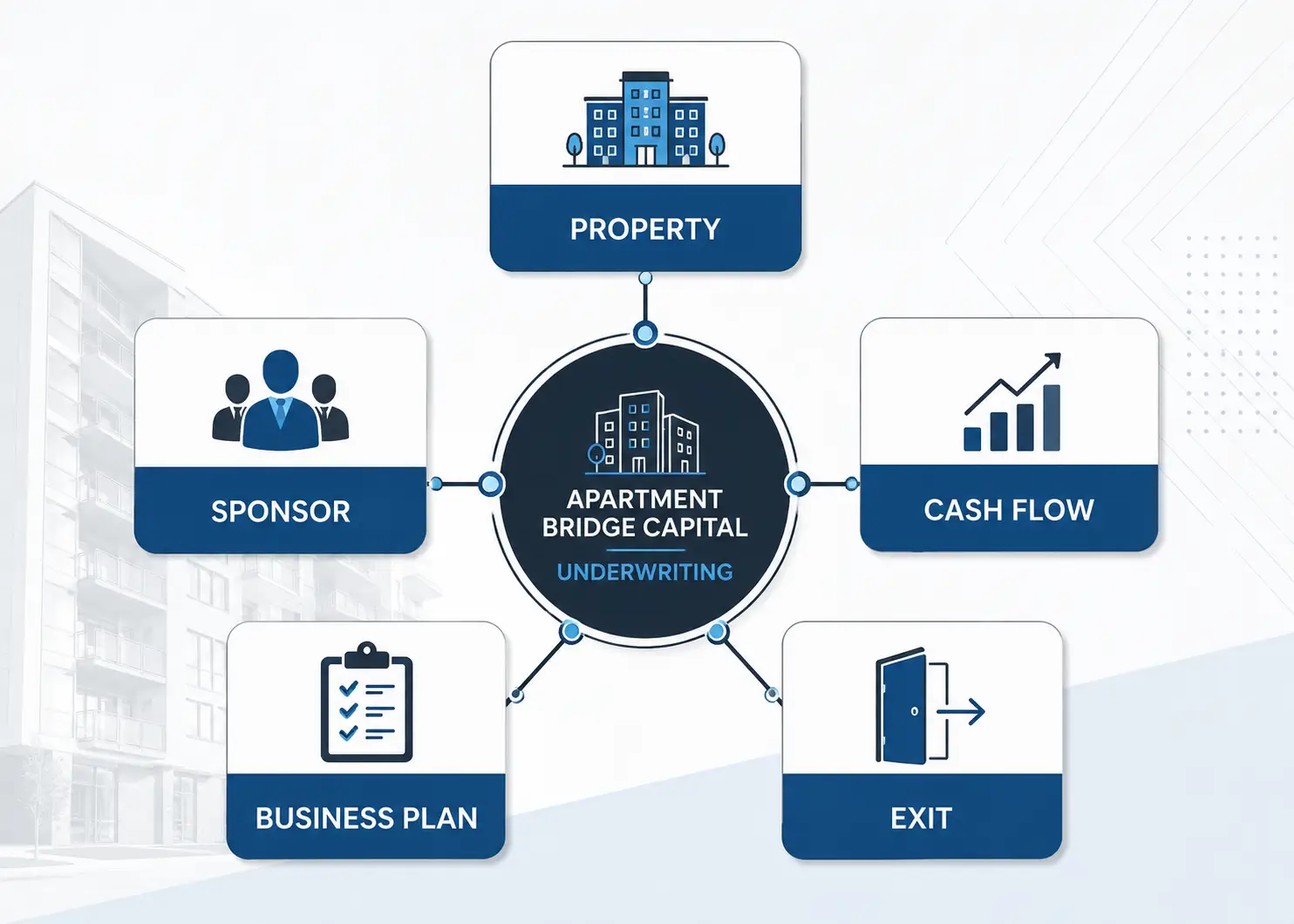
The review generally focuses on four connected areas:
- The real estate securing the loan
- The property’s current and projected financial performance
- The borrower, sponsor, and guarantor
- The business plan, use of proceeds, and exit strategy
What apartment bridge-capital scenarios may be considered?
Apartment Acquisition Bridge
Maturing-Loan Refinance
Renovation and Value-Add
Lease-Up and Stabilization
Partnership Buyout or Recapitalization
Construction Completion
What do capital providers review for apartment bridge capital?
Property and Location
The review may include:
- Property address and legal description
- Number of units and unit mix
- Year built and renovation history
- Current property condition
- Deferred maintenance and code matters
- Parking and amenities
- Zoning and legal use
- Neighborhood and submarket
- Comparable apartment properties
- Local rent and vacancy information
- Flood, environmental, and other location risks
- Current and proposed collateral
Current Operations
The financing source may review:
- Current rent roll
- Physical and economic occupancy
- Collections and delinquency
- Concessions and bad debt
- Lease expirations
- Down or offline units
- Asking and collected rents
- Other property income
- Historical leasing performance
- Property-management performance
- Current operating deficit
- Lease-up assumptions
Borrower and Sponsor
The review commonly examines:
- Borrowing entity and ownership
- Guarantors
- Credit and background
- Apartment ownership experience
- Renovation or development experience
- Liquidity and net worth
- Existing real estate portfolio
- Contingent liabilities
- Management capability
- Source of borrower equity
- Ability to cover cost overruns
- Ability to carry the property during the bridge period
Business Plan and Exit Strategy
The financing source may evaluate:
- What is wrong or incomplete today
- How the requested proceeds will be used
- Renovation, construction, or lease-up milestones
- Budget and contingency
- Expected rents, occupancy, and operating results
- Management and execution plan
- Borrower capital contribution
- Interest or operating reserves
- Primary refinance or sale exit
Existing Debt and Liens
A complete review should identify:
- Current lender and unpaid balance
- Mortgage statements and payoff demand
- Maturity and default status
- Accrued interest and late charges
- Extension rights and fees
- First, second, and other lien positions
- Mechanics’ liens
- Tax or judgment liens
- Preferred equity or mezzanine debt
- Ground leases or regulatory agreements
- Other claims affecting the property or ownership interests
Title, Survey and Legal Matters
Potential concerns include:
- Incorrect ownership
- Entity-name inconsistencies
- Unreleased liens
- Boundary disputes
- Easements
- Encroachments
- Access problems
- Unrecorded agreements
- Litigation
- Pending foreclosure
- Bankruptcy
- Probate or trust issues
- Partnership disputes
- Ground-lease restrictions
- Transfer limitations
- Zoning nonconformity
- Open permits
- Code-enforcement matters
Insurance
Insurance issues can arise from:
- Vacancy
- Renovation work
- Older electrical, plumbing, roof, or building systems
- Prior losses
- Coastal or catastrophe exposure
- Flood-zone location
- Student, senior, supportive, or other specialized occupancy
- Unprotected construction
- Insufficient replacement-cost information
- Incorrect property classification
- Coverage exclusions
- Inability to satisfy lender requirements
Environmental and Physical Condition
Depending on the transaction, third-party review may include:
- Phase I Environmental Site Assessment
- Phase II investigation, when warranted
- Property-condition assessment
- Engineering report
- Roof inspection
- Structural inspection
- Seismic review
- Mold or moisture assessment
- Lead-based-paint review
- Asbestos review
- Radon review
- Flood determination
- Zoning report
- Accessibility review
- Utility or infrastructure analysis
Which financial measurements affect apartment bridge capital?
Loan-to-Value Ratio
Loan-to-value, or LTV, compares the proposed loan amount with the applicable property value used for underwriting.
Formula
Proposed Loan Amount ÷ Applicable Property Value = LTV
The applicable value may be the current as-is, as-complete, or stabilized value, depending on the transaction.
Loan-to-Cost Ratio
Loan-to-cost, or LTC, compares the proposed loan amount with the total eligible project cost.
Formula
Proposed Loan Amount ÷ Total Eligible Project Cost = LTC
Eligible project cost may include purchase price, approved renovation, construction, soft costs, reserves, and contingency.
Debt-Service Coverage Ratio
Debt-service coverage ratio, or DSCR, compares underwritten net operating income with required annual debt service.
Formula
Underwritten Net Operating Income ÷ Annual Debt Service = DSCR
A transitional property may have weak current coverage, making the business plan and exit especially important.
Debt Yield
Debt yield compares underwritten net operating income with the proposed loan amount.
Formula
Underwritten Net Operating Income ÷ Proposed Loan Amount = Debt Yield
Debt yield does not depend directly on the loan’s interest rate or amortization schedule.
As-Is, As-Complete and Stabilized Value
As-is value reflects the property today. As-complete value reflects completion of a defined scope. Stabilized value reflects assumed sustainable occupancy, income, and operations.
Value Review
These values are not interchangeable. The valuation assignment should match the proposed financing and business plan.
Cost Basis
Cost basis helps the capital provider understand how much has been invested in the property compared with the requested financing and current value.
Cost Summary
The borrower should clearly show Original purchase price, Capital improvements, Soft costs, Carrying costs, Financing costs, Prior cash-out proceeds, Current debt, Additional equity invested
Net Operating Income
NOI is generally calculated from property revenue less ordinary operating expenses before debt service, depreciation, income taxes, and certain capital items.
NOI Analysis
A credible NOI analysis should distinguish, Actual collected revenue, Contractual rent Market rent, Concessions, Vacancy, Bad debt, One-time income, Ordinary operating expenses, Capital expenditures, Sponsor projections
Financial metrics are evaluated together with the property, sponsor, business plan, cost basis, requested proceeds, and exit strategy. No single formula guarantees approval or determines the final structure.
After construction and lease-up, the borrower may evaluate multifamily refinancing, stabilized investment property financing, or a sale of the completed property.
Which documents help support an apartment bridge-capital request?
A well-organized submission allows a financing source to understand the property, borrower, requested proceeds, business plan, and exit without repeatedly requesting basic information. Review DPCG’s complete commercial loan required-documents guide for additional borrower, entity, property, title, and financing-document guidance.
Initial Loan Scenario
- Property address
- Property type and unit count
- Loan purpose
- Requested loan amount
- Purchase price or current basis
- Current estimated value
- Existing debt
- Requested cash out
- Renovation or completion budget
- Current occupancy and income
- Desired closing date
- Borrower experience
- Available liquidity
- Proposed exit strategy
Property Documents
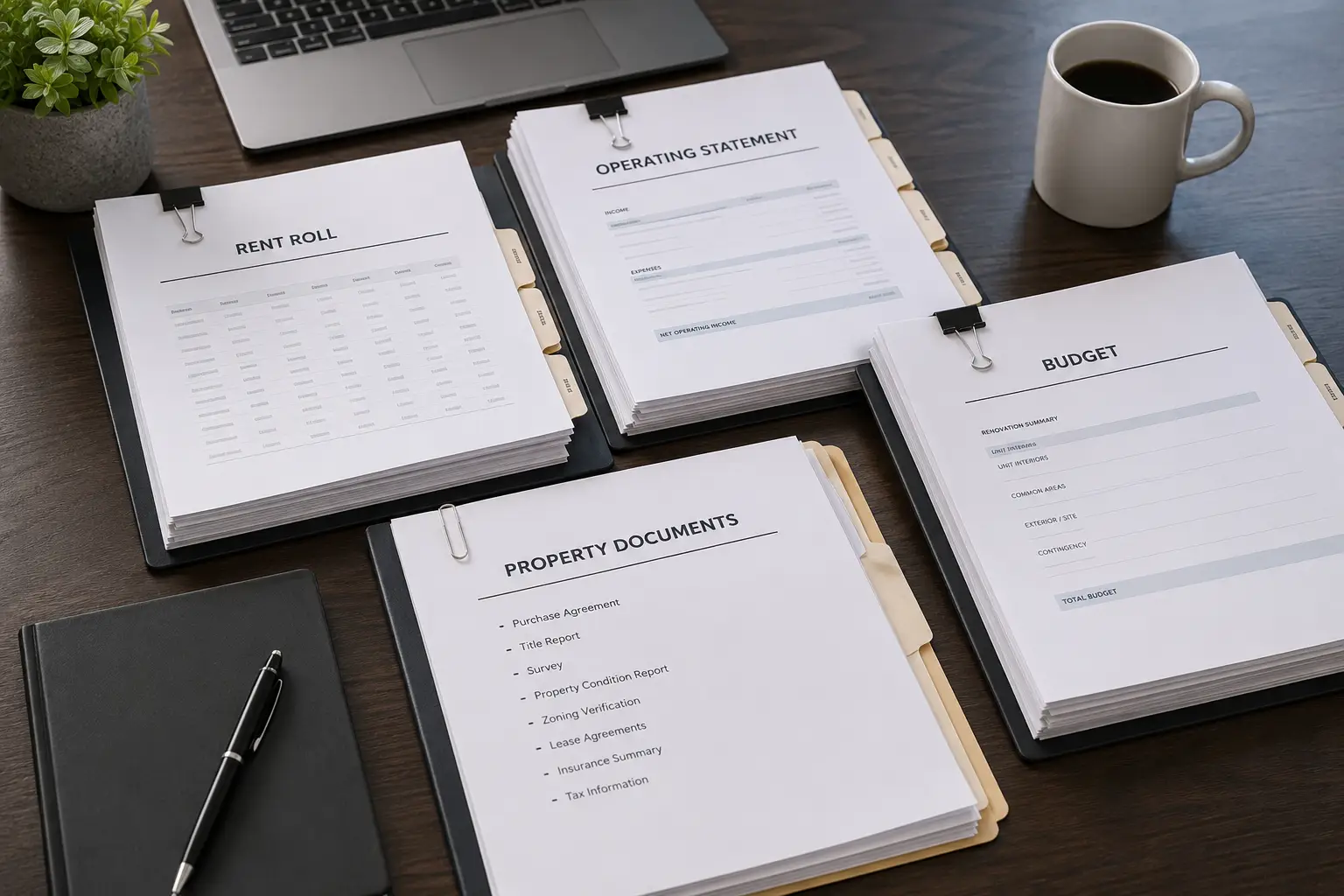
- Current rent roll
- Trailing 12-month operating statement
- Year-to-date operating statement
- Historical property financials
- Recent property bank statements
- Unit mix and lease summary
- Delinquency and concession reports
- Property-tax bills
- Insurance information
- Service contracts
- Management agreement
- Capital-expenditure history
Property and Third-Party Reports
- Appraisal
- Broker price opinion
- Phase I Environmental Site Assessment
- Property-condition assessment
- Survey
- Zoning report
- Flood determination
- Title commitment
- Exception documents
- Insurance quote or policy
- Engineering reports
- Structural reports
- Seismic reports
- Market study
- Rent-comparable analysis
- Construction inspection reports
Entity Documents
- Articles of organization or incorporation
- Operating agreement, bylaws, or partnership agreement
- Employer Identification Number confirmation
- Certificate of good standing, when required
- Ownership schedule and organizational chart
- Borrowing resolution
- Manager or member consent
- Foreign qualification, when applicable
- Trust or joint-venture documents, when applicable
- Existing amendments
Refinance Documents
- Current mortgage statement
- Current payoff demand, when available
- Original loan documents
- Maturity information
- Payment history
- Explanation of any delinquency or default
- Existing-lien schedule
- Prior closing statement
- Default or extension correspondence
- Subordinate debt documents
- Preferred-equity or mezzanine documents
- Recorded lien information
Owners planning to replace construction debt after completion should also review DPCG’s multifamily refinancing guidance.
Borrower and Guarantor Documents
- Loan application
- Government-issued identification through an approved secure process
- Borrowers may also review DPCG’s commercial loan requirement FAQs for general preparation guidance.
- Credit authorization
- Personal financial statement
- Schedule of real estate owned
- Resume or sponsor biography
- Transaction history
- Liquidity evidence
- Bank or brokerage statements through an approved secure process
- Explanations for material credit events
- Litigation or bankruptcy disclosure
- Contingent-liability schedule
Renovation or Construction
- Detailed scope of work
- Line-item budget
- Cost-to-complete statement
- Draw schedule
- Construction timeline
- Contractor agreement
- Contractor qualifications
- Contractor license and insurance, where applicable
- Plans and specifications
- Permits
- Architect or engineer information
- Prior draw history
- Remaining contingency
- Paid invoices
- Lien releases
- Construction photos
- Unit-turn schedule
- Lease-up schedule
- Evidence supporting projected rent premiums
Exit Documentation
- Refinance analysis
- Permanent-loan discussion or preliminary feedback
- Stabilized operating projection
- Lease-up schedule
- Comparable rents
- Sale analysis
- Broker opinion of value
- Proposed listing strategy
- Equity-raise evidence
- Paydown plan
- Backup exit
- Timeline with reasonable contingencies
What is the apartment bridge-capital PROCESS?
Initial Scenario Review
Document Collection and File Organization
Preliminary Financing Discussion
Term Review or Letter of Intent
Formal Underwriting
Valuation and Third-Party Reports
Conditions and Closing Preparation
Closing and Post-Closing Obligations
What commonly delays an apartment bridge closing?
- Incomplete or Inconsistent Financial Information: A rent roll that does not match operating statements, leases, or bank deposits creates underwriting questions.
- Unsupported Property Value: A borrower estimate is not the same as an independent valuation, and projected values must be supported.
- Unclear Use of Proceeds: Working capital or improvements without an itemized breakdown may be insufficient.
- Missing Payoff Information: Expired payoff statements, default interest, or undisclosed liens can change the required loan amount.
- Title or Ownership Problems: Unreleased liens, incorrect entity names, judgments, partnership disputes, or ground-lease restrictions can delay closing.
- Insurance or Environmental Issues: Vacancy, active construction, older systems, catastrophe exposure, contamination concerns, or incomplete reports may require more review.
- Weak Construction Documentation: A budget without detail, contractor support, permits, contingency, or a realistic timeline may be questioned.
- Unverified Borrower Equity: Financing sources may require clear evidence showing the source and availability of required funds.
- Late Transaction Changes: Changes to ownership, requested proceeds, contractor, property condition, or exit plan can restart parts of underwriting.
- Unrealistic Exit Timing: A refinance or sale may take longer than expected and should include reasonable contingencies.
How can a borrower prepare a stronger submission?
- Provide a one-page executive summary.
Explain the property, request, current problem, business plan, and exit in chronological order. - Show the requested amount clearly.
Include a complete sources-and-uses schedule and current payoff information. - Reconcile the property financials.
Confirm that the rent roll, operating statements, leases, and bank deposits reasonably support one another. - Explain inconsistencies before submission.
Address vacancy, declining income, deferred maintenance, title issues, credit events, or cost overruns. - Provide a detailed scope and budget.
Include contractor support, contingency, permits, timeline, draw schedule, and cost-to-complete information. - Document experience and liquidity.
Show relevant apartment, renovation, construction, and ownership experience together with required equity. - Support projected rents and values.
Use objective market evidence and clearly separate current results from projections. - Define the primary and backup exits.
Explain what happens if stabilization, refinancing, or sale takes longer than expected. - Organize the file by category.
Use clear filenames and centralize communication. - Protect sensitive information.
Use an approved secure-upload process for identification, tax returns, bank statements, and confidential records.
How does Direct Private Capital Group assist with apartment bridge capital?
Direct Private Capital Group, Inc. is a commercial mortgage broker and private real estate financing resource.
DPCG may assist by:
- Reviewing the initial apartment financing scenario
- Identifying missing or inconsistent information
- Helping organize the submission
- Reviewing sources and uses
- Clarifying the property’s business plan and exit
- Presenting eligible transactions to possible financing sources
- Coordinating requests for additional documents
- Communicating financing-source feedback
- Helping the borrower or broker track open items
- Supporting the transaction through the applicable review and closing process
DPCG does not guarantee that a financing source will approve, close, or fund a transaction and should not be described as the direct lender, bank, agency lender, servicer, debt fund, or owner of committed capital.
Have an apartment property that needs a bridge?
Provide the property address, unit count, requested loan amount, current value, existing debt, occupancy, renovation or completion needs, borrower experience, and proposed exit. DPCG can conduct an initial review and identify the next information needed to evaluate the scenario.
Frequently Asked Questions About Apartment Bridge Capital
Apartment bridge capital is temporary business-purpose financing intended to help an apartment property move from its current condition to a defined next stage, such as sale, permanent refinance, completed renovation, lease-up, or stabilized operations.
It may be considered for an apartment acquisition when the transaction, borrower, collateral, equity, business plan, and exit meet the financing source’s guidelines.
It may be used to refinance a maturing obligation, subject to the property’s value, current payoff, financial performance, borrower qualifications, title, and a credible repayment strategy.
Renovation proceeds may be included when supported by an acceptable scope of work, budget, contractor information, timeline, contingency, and completed-value analysis. Some proceeds may be advanced through a draw process.
Not necessarily. Bridge financing is often considered for transitional properties, including assets undergoing lease-up or stabilization. Current occupancy, leasing history, operating deficit, business plan, and exit remain important.
Requirements vary. A financing source may consider temporary cash-flow weakness, but the borrower should explain the cause, correction plan, available resources, and repayment strategy.
The exit should be specific and supported. A refinance exit should explain how the property will qualify for future financing, while a sale exit should be grounded in credible timing and market evidence.
Timing varies by transaction and should not be guaranteed. It depends on file completeness, underwriting, valuation, title, insurance, environmental review, legal documentation, borrower cooperation, and resolution of material issues.
Requirements vary by financing source and transaction. Environmental review is common in commercial real estate financing, and additional investigation may be needed when potential concerns are identified.
No. A complete file allows the transaction to be evaluated, but it does not guarantee approval, terms, funding, or closing.
Compliance Disclaimer
Direct Private Capital Group, Inc. is a commercial mortgage broker and private real estate financing resource. The information on this page is provided for general informational and educational purposes only.
Nothing on this page constitutes an approval, commitment to lend, loan offer, rate lock, or guarantee of terms, proceeds, funding, or closing. Any financing that may be available is subject to complete underwriting, borrower and guarantor qualification, collateral review, valuation, title, insurance, documentation, third-party reports, state eligibility, applicable lender, investor, or capital-provider guidelines, market conditions, and applicable law.
Loan structures, requirements, costs, rates, leverage, reserves, recourse, prepayment terms, draw procedures, and closing timelines vary by transaction and financing source. Business-purpose and investment-property financing only where applicable.
qual-credit-opportunity requirements may apply to commercial and business credit. Review the Consumer Financial Protection Bureau’s Regulation B resource for official information.