
Urban Retail Condo Bridge Loans
Urban retail condo bridge loans are short-term, business-purpose financing secured by separately deeded commercial condominium units. They may support an acquisition, refinance, renovation, tenant transition, lease-up, or stabilization plan while the borrower prepares for a sale, permanent loan, business occupancy, or another documented exit.
What is an urban retail condo bridge loan?
An urban retail condo bridge loan is a form of commercial bridge financing for a separately deeded storefront, restaurant, service, showroom, or similar commercial condominium unit. It may be used for acquisition, refinance, renovation, lease-up, stabilization, or another eligible business-purpose transition, subject to underwriting and financing-source requirements.
When can bridge financing help with an urban retail condominium?

Urban retail condominium transactions may require short-term financing when a conventional commercial mortgage does not fit the property’s current condition, occupancy, documentation, or timing. Common situations include:
- Purchasing a vacant retail condominium.
- Acquiring a unit with a short-term or below-market lease.
- Replacing maturing or short-term debt.
- Completing tenant improvements or storefront renovations.
- Repositioning an outdated or underused commercial unit.
- Resolving title, association, insurance, or documentation issues.
- Stabilizing occupancy before seeking permanent financing.
- Preparing an owner-user unit for business occupancy.
- Financing a newly created or converted commercial condominium.
- Completing code, accessibility, mechanical, or life-safety work.
A stabilized property may be better suited to longer-term commercial real estate financing.
How does urban retail condo bridge financing work?
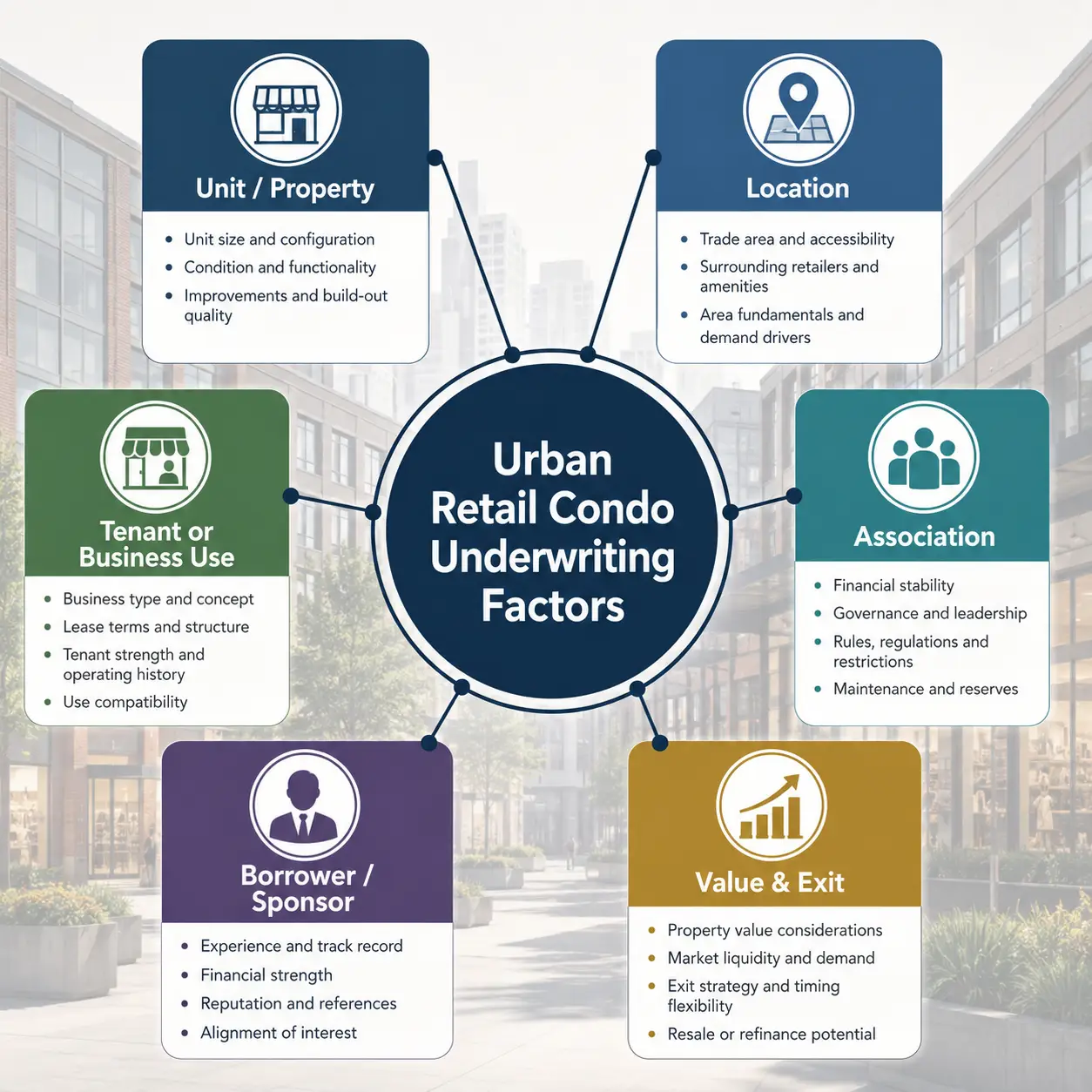
The loan is secured by the individual commercial condominium unit, but underwriting may also examine the larger condominium project. The review generally focuses on:
- The retail unit, location, permitted use, and current condition.
- The condominium declaration, association finances, insurance, restrictions, and shared building systems.
- The borrower, guarantor, equity, liquidity, credit, and experience.
- The tenant, owner-user business, income, renovation plan, and exit strategy.
What types of urban retail condo bridge scenarios may be considered?
Vacant Retail Condo Acquisition
Vacant Retail Condo Acquisition
Retail Condo With Existing Tenant
Retail Condo With Existing Tenant
Owner-User Acquisition
Owner-User Acquisition
Maturing Debt Refinance
Maturing Debt Refinance
Renovation and Lease-Up
Renovation and Lease-Up
Cash-Out or Ownership Transition
Cash-Out or Ownership Transition
What do financing sources review for an urban retail condo bridge loan?
Retail Unit and Location
The review may include:
- Street visibility and frontage
- Pedestrian and vehicle access
- Parking and loading
- Public transportation
- Floor plan and ceiling height
- Utility capacity
- Ventilation and exhaust rights
- Grease-trap availability
- Restroom and accessibility features
- Storage and basement rights
- Signage rights
- Zoning and permitted use
- Certificate of occupancy
- Condition of storefront and building systems
Condominium Project and Association
The financing source may review:
- Recorded declaration and bylaws
- Unit boundaries and common elements
- Commercial-use restrictions
- Association budget and reserves
- Delinquent or special assessments
- Pending litigation
- Master insurance and deductibles
- Engineering or reserve studies
- Owner concentration
- Alteration, leasing, signage, and transfer restrictions
- Structural or deferred-maintenance concerns
Tenant, Lease, or Owner-User Business
The review commonly examines:
- Tenant identity and financial strength
- Lease term, rent, and options
- Security deposit and guarantees
- Concessions and tenant improvements
- Expense reimbursements
- Assignment and termination rights
- Delinquencies
- Business operating history
- Revenue, profitability, licenses, and working capital
- Business-interruption and occupancy risk
Borrower, Guarantor, and Capital Structure
A complete review may identify:
- Ownership and borrowing entity
- Real estate and retail experience
- Credit history
- Liquidity and net worth
- Source of equity
- Post-closing reserves
- Existing and contingent liabilities
- Current mortgages and other liens
- Purchase price or cost basis
- Requested loan and use of proceeds
Business Plan and Exit Strategy
The financing source may evaluate:
- Reason bridge financing is needed
- Renovation or tenant-improvement scope
- Lease-up and rent assumptions
- Carrying costs and reserves
- Permits and contractor readiness
- Expected refinance or sale timing
- Permanent-financing assumptions
- Backup exit plan
- Ability to support the property if the plan takes longer than expected
General commercial real estate risk-management principles are discussed in the OCC Commercial Real Estate Lending Handbook.
Which financial measurements may affect an urban retail condo bridge loan?
Loan-to-Value Ratio
Loan-to-value, or LTV, compares the proposed loan amount with the property value accepted for underwriting.
Formula
Proposed Loan Amount ÷ Accepted Property Value = LTV
The accepted value may be based on an appraisal or another approved valuation method.
Loan-to-Cost Ratio
Loan-to-cost, or LTC, compares the proposed loan amount with eligible acquisition, renovation, closing, and project costs.
Formula
Proposed Loan Amount ÷ Eligible Project Cost = LTC
Eligible costs vary by transaction and financing source.
Debt-Service Coverage Ratio
DSCR compares underwritten net operating income with annual debt service when the unit is leased and income-producing.
Formula
Underwritten Net Operating Income ÷ Annual Debt Service = DSCR
Projected income is not the same as current cash flow.
Net Operating Income
NOI generally reflects property income after operating expenses but before debt service, depreciation, income taxes, and certain capital expenditures.
Review Note
Association assessments, taxes, insurance, utilities, repairs, management, leasing costs, and reserves can materially affect NOI.
As-Is, As-Complete, and Stabilized Value
As-is value reflects current condition. As-complete and stabilized values depend on supported renovation, occupancy, rent, and operating assumptions.
Review Note
Not every transaction relies on all three values. The applicable value depends on the property, loan purpose, and financing source.
Debt Yield
Debt yield compares property-level income with the proposed loan amount without relying on the interest rate or amortization schedule.
Formula
Net operating income ÷ loan amount = debt yield
Borrowers should distinguish current income, projected income, current value, renovation assumptions, and expected stabilized performance. No specific leverage or minimum financial threshold should be assumed before the complete transaction is reviewed.
Which documents help support an urban retail condo bridge-loan request?
A well-organized submission helps the financing source evaluate the unit, association, borrower, transaction, and exit. Review DPCG’s commercial loan required-documents guide for additional guidance.
Initial Loan Scenario
- Property address
- Requested loan amount
- Loan purpose
- Purchase price or current debt
- Estimated value
- Current occupancy
- Use of proceeds
- Target closing or maturity date
- Borrower and guarantor names
- Experience and credit summary
- Proposed exit strategy
Retail Unit and Property Documents
- Current leases and amendments
- Rent roll and operating statements
- Property tax and insurance information
- Floor plans and photographs
- Zoning and certificate of occupancy
- Property-condition and environmental reports
- Repair estimates and contractor bids
- Permits and code information
Condominium Documents
- Recorded declaration and amendments
- Bylaws and rules
- Condominium map or plat
- Association budget and financial statements
- Reserve and assessment information
- Meeting minutes
- Master insurance policy
- Litigation disclosure
- Engineering or reserve study
- Alteration, use, leasing, signage, parking, and storage rules
Purchase or Refinance Documents
- Purchase and sale agreement and amendments
- Deposit and settlement information
- Current mortgage statement
- Note and mortgage or deed of trust
- Payoff demand
- Payment history
- Other liens
- Cash-out request and itemized use of proceeds
- Capital-improvement history
Borrower, Guarantor, and Entity Documents
- Loan application
- Personal financial statement
- Schedule of real estate owned
- Liquidity verification through a secure process
- Experience résumé
- Entity formation documents
- Operating agreement or bylaws
- Employer Identification Number
- Good-standing certificate
- Ownership schedule and borrowing resolution
Renovation and Exit Documents
- Detailed scope of work
- Line-item budget
- Contractor and construction contract
- Draw schedule and project timeline
- Plans, permits, and contingency
- Leasing plan and rent support
- Permanent-financing assumptions
- Sale or marketing plan
- Projected operating statement
- Backup exit strategy
What is the urban retail condo bridge-loan process?
Initial Scenario Review
Condominium and Property Document Collection
Preliminary Financing Discussion
Term Indication or Letter of Intent
Formal Underwriting
Valuation and Third-Party Reports
Conditions and Legal Documentation
Closing, Funding, and Post-Closing Obligations
What commonly delays an urban retail condo bridge loan?
- Incomplete Condominium Records: Missing declarations, amendments, budgets, insurance, financials, or meeting minutes can delay collateral review.
- Unclear Unit Boundaries: The deed, legal description, condominium map, appraisal, and physical space must consistently identify the owned unit.
- Association Litigation or Financial Weakness: Pending litigation, low reserves, delinquent assessments, structural work, or large special assessments may affect financeability.
- Use Restrictions: The intended restaurant, medical, service, nightlife, food, or retail use may conflict with zoning, condominium documents, or building systems.
- Insurance Gaps: The unit and master policies may not adequately address improvements, fixtures, deductibles, flood, liability, or business interruption.
- Title and Lien Issues: Mortgages, association liens, taxes, mechanics’ liens, judgments, easements, or rights of first refusal may require resolution.
- Unsupported Value or Income: Asking price, projected rent, or future stabilized value may not be supported by current evidence.
- Weak Exit Strategy: A general statement that the borrower will refinance or sell is not a substitute for a supported repayment plan.
Environmental due diligence may be required. See the EPA All Appropriate Inquiries guidance.
How can a borrower prepare a stronger submission?
- Explain the transaction clearly.
State what is being purchased or refinanced, why bridge financing is needed, and what will repay the loan. - Provide the complete condominium package.
Do not submit only the deed or association contact information. - Separate current facts from projections.
Identify current occupancy, current rent, projected rent, renovation assumptions, and future value separately. - Document equity and reserves.
Explain the cash contribution, deposits, closing funds, carrying costs, and post-closing liquidity. - Itemize the use of proceeds.
Separate payoff, purchase price, closing costs, construction, tenant improvements, reserves, and cash-out. - Confirm property-use requirements early.
Review zoning, certificate of occupancy, condominium restrictions, licensing, utilities, ventilation, signage, and accessibility. - Prepare a realistic renovation package.
Include a detailed budget, contractor, timeline, permits, draw expectations, and contingency. - Support the exit strategy.
Provide lease evidence, refinance assumptions, sale plans, or other documentation supporting repayment. - Disclose association risks.
Identify special assessments, litigation, insurance claims, structural work, reserve concerns, and violations. - Use secure document delivery.
Send sensitive records only through an approved secure-upload process.
Public-facing commercial facilities may be affected by accessibility requirements. Review the 2010 ADA Standards for Accessible Design with qualified professionals.
How does Direct Private Capital Group assist with urban retail condo bridge financing?
Direct Private Capital Group, Inc. is a commercial mortgage broker and private real estate financing resource.
DPCG may assist by:
- Reviewing the initial retail condo financing scenario
- Organizing property, borrower, association, and transaction information
- Identifying missing condominium documents
- Clarifying the requested loan purpose and use of proceeds
- Presenting eligible transactions to possible financing sources
- Coordinating information requests during the review process
- Helping explain proposed structures and conditions
- Communicating with borrowers, brokers, and transaction parties as the file progresses
DPCG does not guarantee approval, terms, funding, valuation, lender acceptance, or closing.

Have an urban retail condo transaction to review?
Provide the property address, requested loan amount, purchase price or current payoff, estimated value, occupancy, condominium status, use of proceeds, borrower profile, and proposed exit. DPCG can conduct an initial review and identify the next information needed.
Frequently Asked Questions About Urban Retail Condo Bridge Loans
A vacant retail condominium may be considered when the borrower presents an acceptable acquisition basis, equity contribution, property plan, carrying-cost budget, and exit strategy. Eligibility depends on the property, borrower, location, condominium project, and financing source.
Owner-user transactions may be reviewed. The financing source may evaluate the real estate, operating business, planned occupancy, buildout costs, licenses, cash flow, borrower experience, and repayment plan.
A restaurant condominium may require additional review of zoning, condominium-use restrictions, ventilation, grease traps, utilities, fire suppression, permits, hours, odor controls, equipment, and tenant improvements. Eligibility should not be assumed without review.
They are commonly important because they define the unit, ownership rights, restrictions, assessments, insurance responsibilities, common elements, alteration procedures, and association finances.
Renovation or tenant-improvement proceeds may be considered when permitted by the financing source. A detailed scope, budget, contractor, permits, draw plan, contingency, and completion strategy may be required.
Not in every bridge transaction. A vacant or transitional property may be reviewed, but carrying costs, reserves, leasing assumptions, market support, borrower strength, and the exit strategy may receive additional scrutiny.
A refinance with cash out may be considered for an eligible business purpose. The requested proceeds, collateral value, current debt, ownership history, borrower qualifications, and use of funds must be reviewed.
No. An appraisal is one part of the review. The financing source may also consider property marketability, condominium risks, borrower strength, cost basis, cash flow, title, insurance, environmental conditions, and exit strategy.
No universal closing period applies. Timing depends on file completeness, valuation, title, insurance, association records, environmental review, legal documentation, borrower responsiveness, and satisfaction of closing conditions.
The exit should identify a realistic repayment source, timing, supporting assumptions, required milestones, expected costs, and a backup plan.
Compliance Disclaimer
Direct Private Capital Group, Inc. is a commercial mortgage broker and private real estate financing resource. The information on this page is provided for general informational and educational purposes only.
Nothing on this page constitutes an approval, commitment to lend, loan offer, rate lock, appraisal, valuation, or guarantee of terms, proceeds, funding, or closing. Any financing that may be available is subject to complete underwriting, borrower and guarantor qualification, collateral review, valuation, title, insurance, condominium documentation, property condition, environmental and flood review, association review, third-party reports, state eligibility, financing-source guidelines, market conditions, and applicable law.
Loan structures, requirements, costs, rates, leverage, reserves, recourse, prepayment terms, and closing timelines vary by transaction and financing source. Business-purpose and investment-related commercial real estate financing only where applicable.
This page is not legal, tax, accounting, insurance, investment, or financial advice. Borrowers should consult their own qualified advisers. Equal-credit-opportunity requirements may apply to commercial and business credit. Review the Consumer Financial Protection Bureau’s Regulation B resource for official information. Flood-hazard information may be reviewed through the FEMA Flood Map Service Center.