
Farm and Ranch Loans
Finance the purchase, refinance, improvement, or transition of qualifying farm, ranch, agricultural land, and related business-purpose real estate. Direct Private Capital Group, Inc. assists agricultural property owners, buyers, investors, operators, and brokers with organizing qualified loan scenarios and presenting them to potential financing sources. Each transaction is reviewed individually based on the property, agricultural operation, borrower, cash flow, collateral, requested structure, and repayment plan.
What Is a Farm and Ranch Loan?
A farm and ranch loan is financing used to acquire, refinance, improve, or preserve real estate connected to an agricultural operation. Depending on the transaction, financing may be based on land value, agricultural income, borrower liquidity, operating history, improvements, water rights, property use, and the proposed repayment or exit strategy. It is one type of commercial real estate financing.
When Might Farm or Ranch Financing Be Needed?

Farm and ranch financing may be needed when:
- A buyer is purchasing an operating farm or ranch.
- An owner wants to refinance maturing or higher-cost debt.
- A borrower needs short-term bridge financing before permanent financing is available.
- A property requires repairs, infrastructure improvements, or agricultural development.
- An investor is acquiring agricultural land for an income-producing or business-purpose strategy. Review related land loan information.
- An owner wants to consolidate liens, complete a partner buyout, or restructure existing debt.
- A qualifying borrower needs capital secured by agricultural real estate for a documented business purpose.
What types of Are Farm and Ranch Financing May Be Considered?
The appropriate financing structure depends on the property, borrower, loan purpose, timeline, existing debt, cash flow, and intended exit strategy. Farm or ranch acquisition financing is used to purchase agricultural real estate and may involve a review of the purchase contract, proposed equity contribution, appraised value, historical property use, agricultural income, operating plan, and borrower experience. A farm or ranch refinance replaces or restructures existing debt and may be used to pay off a current loan, address an upcoming maturity, consolidate liens, reduce payment pressure, or reposition the property’s capital structure. A cash-out refinance may provide proceeds beyond the existing debt payoff for a documented business purpose, but the financing source will generally require a detailed use-of-proceeds schedule rather than a broad request for working capital.
Borrowers may use the USDA Web Soil Survey for preliminary soil information. It does not replace a property-specific appraisal, engineering review, or agricultural analysis.
What types of agricultural properties may be considered?
Working Farms
Working Farms
Ranches and Grazing Land
Ranches and Grazing Land
Orchards and Vineyards
Orchards and Vineyards
Greenhouses and Nurseries
Greenhouses and Nurseries
Agricultural Storage and Processing
Agricultural Storage and Processing
Leased Agricultural Property
Leased Agricultural Property
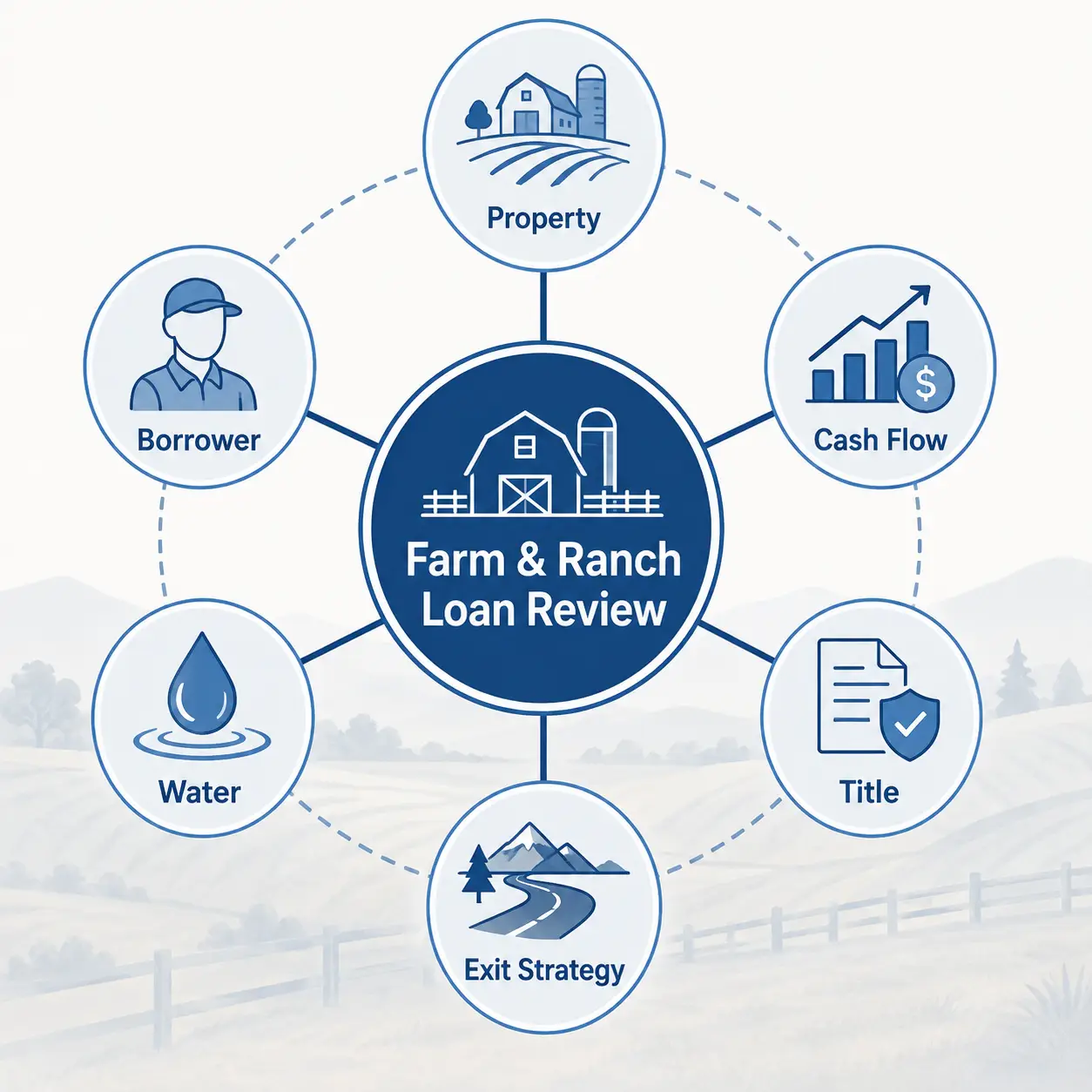
What Do FInancing Sources Review for a Farm or Ranch Loan?
Property and Collateral
The property review may include:
- Total acreage
- Parcel configuration
- Legal access
- Road access and easements
- Zoning and permitted use
- Current agricultural use
- Soil characteristics
- Topography
- Productive versus nonproductive acreage
- Water availability
- Irrigation rights and infrastructure
- Wells, ponds, reservoirs, or surface-water access
- Buildings and improvements
- Fencing and livestock facilities
- Deferred maintenance
Borrower and Guarantor
The borrower review may include:
- Ownership structure
- Credit history
- Prior real estate and agricultural experience
- Liquidity
- Net worth
- Contingent liabilities
- Cash contribution
- Post-closing reserves
- Existing debt obligations
- Tax history
- Litigation or bankruptcy history
- Management capacity
- Experience with the relevant crop, livestock, or agricultural business
- Ability to support the loan if agricultural income is seasonal or volatile
Agricultural Operation
For an operating property, the financing source may review:
- Historical production
- Crop mix
- Livestock counts
- Yield history
- Commodity concentration
- Sales channels
- Customer or processor relationships
- Government program income
- Insurance coverage
- Seasonal working-capital needs
- Equipment dependency
- Labor requirements
- Feed, seed, fertilizer, fuel, and input expenses
- Water reliability
- Operating margins
- Management continuity
Income and Cash Flow
The loan request should identify exactly how proceeds will be used, including:
- Purchase price
- Existing loan payoff
- Delinquent taxes
- Closing costs
- Property improvements
- Infrastructure work
- Business working capital
- Partner buyout
- Equipment-related costs
- Interest reserve
- Operating reserve
- Cash out
- Contingency funds
Exit Strategy
The exit strategy explains how the loan will be repaid. Possible exits may include:
- Refinance into longer-term agricultural financing
- Refinance after improved cash flow or completed repairs
- Sale of the property
- Sale of another asset
- Business recapitalization
- Paydown from documented operating cash flow
- Maturity of another verified capital source
The proposed exit should include timing, assumptions, risks, and a backup plan.
Which financial measurements may affect agricultural property financing?
Loan-to-Value Ratio
Loan-to-value, or LTV, compares the proposed loan amount with the property value accepted for underwriting.
Formula
Proposed Loan Amount ÷ Accepted Property Value = LTV
The accepted value may be based on an appraisal or another approved valuation method.
Loan-to-Cost Ratio
Loan-to-cost, or LTC, compares the proposed loan amount with eligible acquisition, improvement, or project costs.
Formula
Proposed Loan Amount ÷ Total Eligible Project Cost = LTC
LTC may apply to purchases, construction, rehabilitation, or major improvements.
Debt-Service Coverage Ratio
DSCR compares underwritten net operating income with annual debt service when reliable property or business cash flow is available.
Formula
Underwritten Net Operating Income ÷ Annual Debt Service = DSCR
The lender determines which income and expenses are included.
Debt Yield
Debt yield compares underwritten net operating income with the proposed loan amount.
Formula
Underwritten Net Operating Income ÷ Proposed Loan Amount = Debt Yield
Debt yield does not depend directly on the interest rate or amortization schedule.
As-Is, As-Complete and Stabilized Value
As-is value reflects current condition. As-complete value assumes specified improvements are finished. Stabilized value assumes sustainable income, occupancy, production, or performance.
Valuation Note
Not every agricultural transaction relies on all three values. The appraisal scope depends on the property and financing request.
Cost Basis and Reserves
Cost basis may include purchase price and verified improvements. Reserves may support interest, operating expenses, repairs, taxes, insurance, or seasonal shortfalls.
Transaction-Specific Review
Recognized costs and required reserves vary by property, borrower, loan purpose, and financing source.
No maximum LTV, LTC, DSCR, debt-yield threshold, loan amount, rate, or term is represented on this page because those terms require current, transaction-specific verification. Borrowers evaluating federal farm programs may review the USDA Farm Ownership Loan resource and USDA Farm Operating Loan resource.
What Documents Should Be Prepared?
A well-organized submission helps a financing source understand the property, agricultural operation, borrower, requested loan purpose, and proposed exit. Review DPCG’s commercial loan required-documents guide, loan requirement FAQs, and borrower FAQs for additional preparation guidance.
Initial Loan Scenario
- Requested loan amount and loan purpose
- Property address, parcel numbers, acreage, and agricultural use
- Purchase price or estimated value
- Existing debt and requested closing date
- Short business-plan summary
- Borrower and operator experience
- Proposed repayment or exit strategy
Property and Land Documents
- Deed, legal description, parcel map, survey, and title
- Tax bills, zoning, permits, certificates, and site plans
- Appraisal, environmental reports, soil reports, and flood information
- Water rights, well permits, irrigation records, and septic records
- Conservation easements, agricultural-preservation agreements, and mineral, timber, or grazing-right documents
Agricultural Operation Documents
- Farm business plan and operating budget
- Crop or livestock description and production records
- Yield records, sales contracts, processor agreements, and leases
- Equipment list, livestock inventory, and management agreement
- Insurance, crop-insurance, and government-program documentation when relevant
Borrower and Entity Documents
- Loan application and personal financial statement
- Real-estate schedule, liquidity, and bank statements through a secure process
- Resume or agricultural experience summary
- Articles, operating agreement, EIN confirmation, good standing, and ownership schedule
- Borrowing resolutions, signing authority, and trust documents when applicable
Business and Entity Documents
- Articles of organization or incorporation
- Operating agreement
- Bylaws
- Partnership agreement
- EIN confirmation
- Certificate of good standing
- Ownership schedule
- Organizational chart
- Borrowing resolutions
- Signing-authority documents
- Trust documents, when applicable
Financial Documents
- Personal tax returns
- Business tax returns
- Farm schedules
- Profit-and-loss statements
- Balance sheets
- Year-to-date financial statements
- Accounts receivable
- Accounts payable
- Debt schedule
- Bank statements
- Historical operating statements
- Rent roll, when applicable
- Agricultural lease schedule
- Capital-expenditure history
- Projected cash flow
How Does the Farm and Ranch Loan Process Work?
Initial Scenario Review
Preliminary Eligibility Discussion
Document Collection
Financing-Source Review
Preliminary Terms or Indication
Formal Underwriting and Third-Party Reports
Conditions and Final Approval
Closing and Post-Closing Obligations
What Can Delay a Farm or Ranch Loan?
- Incomplete property information: Missing parcel numbers, acreage breakdowns, improvement lists, surveys, or legal descriptions.
- Unclear agricultural use: The file does not explain who operates the property, what is produced, or whether the use is lawful.
- Unsupported value: The expected value is not supported by appraisal evidence, income, productive capacity, restrictions, or property condition.
- Water-right problems: Rights are unverified, disputed, restricted, shared, expired, or not transferable.
- Title and easement issues: Existing liens, access problems, conservation easements, boundary disputes, or undocumented leases.
- Environmental concerns: Fuel tanks, pesticides, waste areas, wetlands, or historical contamination require added review.
- Financials that do not reconcile: Tax returns, production records, bank statements, leases, and projections conflict.
- Insurance or exit-strategy problems: Required coverage is unavailable, or the repayment plan is not adequately supported.
How Can a Borrower Prepare a Stronger Submission?
- Provide a complete one-page transaction summary.
Include location, acreage, use, value, debt, requested amount, income, experience, closing date, and exit. - Separate the real estate from the operating business.
Identify who owns the land, operates the business, receives income, owns equipment, borrows, and guarantees. - Explain water, access, and land restrictions early.
Provide legal and operational documentation. - Reconcile financial information.
Review tax returns, operating statements, production records, leases, and projections before submission. - Document the business plan.
Explain the operation, proposed changes, timeline, costs, reserves, risks, and repayment source. - Disclose title, environmental, credit, permit, insurance, or ownership issues at the beginning.
- Use realistic current and projected information.
- Prepare a backup exit strategy.
- Centralize communication and document versions.
- Protect sensitive information through an approved secure-upload process.
How Does Direct Private Capital Group, Inc. Assist?
Direct Private Capital Group, Inc. serves as a commercial mortgage broker and private real estate financing resource.
For a qualified farm or ranch scenario, DPCG may assist by:
- Reviewing the initial request
- Organizing property and borrower information
- Identifying missing documentation
- Clarifying the requested loan structure and use of proceeds
- Presenting eligible scenarios to possible financing sources
- Communicating questions and conditions
- Helping the borrower understand document requests and next steps
DPCG does not guarantee that a loan will be approved, funded, or closed and should not be described as a direct lender, government agency, bank, debt fund, or owner of committed capital unless current transaction-specific evidence supports that description.
Have a Farm or Ranch Financing Scenario?
Tell us where the property is located, how it is used, the amount requested, the estimated value, existing debt, agricultural income, borrower experience, and how the financing is expected to be repaid. Submitting information does not obligate you to proceed and does not create a commitment to lend.
Farm and Ranch Loan FAQs
A qualifying loan may be used to purchase farm, ranch, or agricultural real estate. The review generally considers the purchase price, property value, agricultural use, borrower equity, experience, income, liquidity, and repayment strategy.
A refinance may be considered for eligible agricultural real estate. The financing source will generally review existing debt, payment history, property value, cash flow, requested cash out, title, insurance, and the reason for refinancing.
Cash-out financing may be considered when sufficient collateral and borrower support exist and the proceeds have a documented business purpose. Approval and available proceeds depend on underwriting and the financing source’s guidelines.
Not automatically. Livestock, equipment, inventory, crops, and other personal property are different from real estate. The financing source must identify which assets are eligible collateral and whether separate documentation or financing is required.
For an operating farm or ranch, historical and projected income may be an important part of underwriting. A financing source may review production, revenue, expenses, seasonality, contracts, leases, and the borrower’s outside income.
Possibly. Unimproved agricultural land may require a strong explanation of property use, legal access, zoning, water, marketability, borrower equity, carrying costs, and the repayment or development plan.
Yes. The financing source must determine the primary property use and whether the transaction is genuinely for a business or investment purpose. This page does not offer consumer-purpose home mortgage financing.
Experience requirements vary. A financing source may evaluate the borrower’s history with agricultural operations, property management, real estate ownership, construction, or the proposed business plan.
A private or commercial farm loan is offered by a nongovernment financing source. USDA FSA direct loans are made and serviced by the agency, while guaranteed loans are issued by approved commercial lenders with an FSA guarantee. Eligibility and procedures differ.
There is no universal closing period. Timing depends on file completeness, appraisal, title, environmental review, survey, water-rights documentation, insurance, legal review, property complexity, financing-source requirements, and resolution of conditions.
Compliance Disclaimer
Direct Private Capital Group, Inc. is a commercial mortgage broker and private real estate financing resource. It is not a government agency, and this page is not an advertisement for or offer of a USDA Farm Service Agency loan.
The information on this page is provided for general educational and informational purposes only. It is not a commitment to lend, loan approval, rate lock, guarantee of terms, guarantee of funding, or guarantee of closing.
Any financing is subject to underwriting; borrower and guarantor qualification; acceptable credit, equity, liquidity, and reserves; collateral review and valuation; confirmation of business purpose; title, survey, access, water-rights, environmental, insurance, zoning, and documentation review; state eligibility; financing-source guidelines; market conditions; and applicable law.
Business-purpose and investment-property financing only. This page does not offer consumer-purpose residential mortgage financing for personal, family, or household use.
Review the Privacy Policy before submitting personal information. For official fair-lending information, review the Consumer Financial Protection Bureau’s Regulation B resource.