

Home > Double Close Funding > B-to-C Closing
B-to-C Closing
A B-to-C closing is the second transaction in a real estate double closing. After the intermediary buyer (B) acquires the property from the original seller (A), B resells the property to the end buyer (C) under a separate purchase agreement. The B-to-C closing often provides the proceeds expected to satisfy the short-term acquisition payoff and other closing obligations.
The B-to-C closing is not automatic merely because the A-to-B transaction is approved or completed. The end buyer, title and escrow file, funding source, settlement figures, property conditions, and legal requirements must independently be ready for the second sale to close.
What Is a B-to-C Closing?
A B-to-C closing is the resale portion of a double-closing real estate transaction. Party B, who acquired or is acquiring the property from Party A, becomes the seller to Party C, the end buyer. The B-to-C transaction uses its own purchase contract, settlement statement, title and escrow file, buyer funding, closing documents, and transfer requirements.
Where Does the B-to-C Closing Fit in a Double Closing?
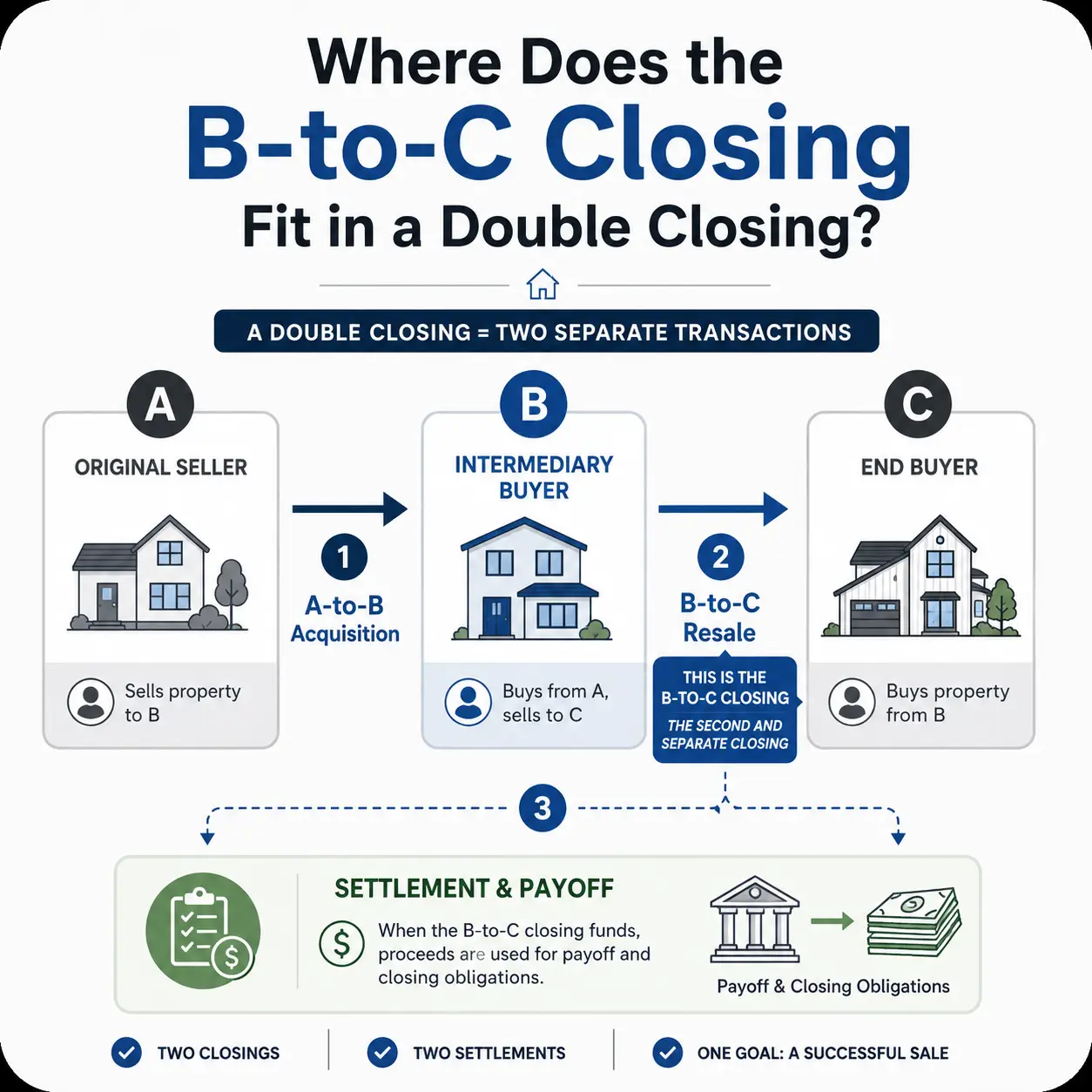
First Transaction: A-to-B
The original seller (A) sells the property to the intermediary buyer (B). If transactional funding is used, the acquisition financing is associated with this first purchase.
Second Transaction: B-to-C
The intermediary buyer (B) sells the property to the end buyer (C). This is the resale closing and often the planned source of funds for satisfying the short-term acquisition payoff.
Final Settlement and Payoff
When the B-to-C closing funds, the settlement process applies the resale proceeds according to the closing statement, title requirements, loan payoff instructions, taxes, liens, credits, and other approved obligations.
Why Is the B-to-C Closing So Important to Transactional Funding?
Expected Exit Event
In many transactional-funding structures, the B-to-C resale is the expected exit event used to repay the short-term acquisition capital.
Resale Proceeds
The short-term acquisition capital used by B is intended to be repaid when C closes and the resale proceeds become available through settlement.
Downstream Closing Risk
A signed resale contract can support the proposed exit, but the financing source also needs to understand whether C is actually positioned to fund and close.
Who Is Party C in a Double Closing?
Party C is the end buyer in the second sale. C may be another investor, an acquisition entity, or another buyer permitted under the applicable business-purpose transaction. The B-to-C closing must accurately identify the end buyer, vesting, purchase price, source of funds, and any financing or closing conditions.
If C is using financing, that lender’s appraisal, title, insurance, property-condition, entity, or other requirements can affect whether the downstream closing is ready.
What Does a Financing Source Review Before Relying on the B-to-C Exit?
Resale Contract
The B-to-C contract establishes the proposed end buyer, resale price, closing date, contingencies, and transaction terms.
End-Buyer Funding Path
The financing source may review whether C is paying cash or using financing and whether meaningful downstream conditions remain.
Title and Settlement Readiness
The title and closing file should support the planned transfer from B to C and the intended payoff flow.
Seller and Buyer Entity Consistency
Names, vesting, authority, and signatures should reconcile across contracts, financing documents, title, and settlement statements.
Transaction Economics
The financing source may compare acquisition price, resale price, closing costs, required payoffs, and expected net proceeds.
Property Issues
Condition, occupancy, access, title defects, or other property-specific matters can affect the end buyer or end buyer’s financing.
Legal and Jurisdictional Issues
Wholesale, assignment, disclosure, licensing, double-closing, and settlement requirements vary by jurisdiction and should not be assumed to be identical everywhere.
Backup Exit
A financing source may need to understand what happens if C does not close as expected.
How Does End-Buyer Funding Affect the B-to-C Closing?
The end buyer’s source of funds is one of the most important dependencies in the B-to-C transaction. The second closing cannot be treated as funded until the settlement agent has the required money or authorized funding under the closing instructions.
Cash End Buyer
A cash buyer can still have verification, wire, entity, title, or settlement requirements. Proof of funds does not by itself equal completed funding.
Financed End Buyer
A financed buyer introduces another lender’s underwriting and closing conditions. Appraisal, title, insurance, entity, property condition, lender documents, funding approval, or banking cutoffs can affect the B-to-C closing.
End-buyer readiness means more than having a signed contract. The downstream buyer’s funds, approvals, documents, title requirements, and settlement conditions must be sufficiently complete for the resale to fund.
How Do B-to-C Settlement Statements and Payoff Figures Work?
The B-to-C settlement statement or closing disclosure used for the transaction shows the resale price and the charges, credits, taxes, commissions, title items, payoffs, and other amounts that affect the final cash movement. The exact form depends on the transaction and closing process.
Estimated Net B-to-C Proceeds
Estimated Net B-to-C Proceeds = Gross Resale Price – Selling and Closing Costs – Taxes and Credits – Required Liens and Payoffs – Other Transaction Obligations
Actual Payoff Amount
Gross resale price is not the same as cash available to repay acquisition financing. The closing agent’s final approved settlement figures determine the actual amount available for payoff.
B-to-C proceeds can be the intended payoff source when the transactional-funding documents and closing instructions allow the downstream sale proceeds to satisfy the acquisition payoff. The exact sequence and use of funds must be coordinated with the financing source and settlement agent.
What Documents Should Be Ready for a B-to-C Closing?
Prepare the resale contract, seller and buyer entity information, title and escrow materials, property items, payoff and funding records, and the backup exit.
B-to-C Contract File
- Executed B-to-C purchase agreement
- All amendments and addenda
- Correct end-buyer name or entity
- Resale price
- Closing date
- Known contingencies
- Deposit information when relevant
Seller B / Intermediary Entity
- Correct vesting and seller name
- Entity formation and authority documents when required
- Authorized-signer information
- Evidence that B can convey title
- Any closing documents requested by title, escrow, counsel, or the financing source
End-Buyer C
- Buyer identity or entity information as required
- Proof of funds when requested
- Financing approval or lender information when C is financed
- Evidence of required deposits when relevant
- Any remaining lender or closing conditions
Title and Escrow
- Updated title commitment or preliminary title information
- Existing payoff and lien information
- Taxes, judgments, or other title items
- Draft or final B-to-C settlement statement
- Closing instructions
- Verified wiring procedures
Payoff and Funding
- Transactional-funding payoff statement when applicable
- Approved payoff instructions
- Confirmation of the amount required to satisfy short-term acquisition financing
- Other lien or obligation payoffs
- Expected net proceeds reconciliation
Property
- Property address and legal description
- Current property information
- Occupancy information when relevant
- Known condition issues that could affect the end buyer or financing
- Appraisal, inspection, or other property items when required by C or C’s lender
Backup Exit
- Alternative end buyer if one is genuinely available
- Longer-term bridge financing path if realistic
- Borrower liquidity available if the resale is delayed
- Other documented repayment source
What Is a Realistic B-to-C Closing Process?
Step 1 – Confirm the B-to-C Contract
Review the resale agreement, buyer, price, deadlines, contingencies, and amendments.
Step 2 – Confirm End-Buyer Funding
Determine whether C is using cash or financing and identify any remaining funding or lender conditions.
Step 3 – Update Title and Vesting
Confirm that the title file supports B’s conveyance to C and identify remaining liens, taxes, or exceptions.
Step 4 – Prepare Settlement Figures
Title or escrow prepares the B-to-C settlement statement and reconciles required charges, credits, payoffs, and proceeds.
Step 5 – Confirm Payoff Requirements
Obtain and verify the transactional-funding payoff and other required lien or obligation payoffs.
Step 6 – Clear Closing Conditions
Complete signatures, insurance, lender conditions, entity documents, property items, and other requirements.
Step 7 – Receive Authorized Funds
The settlement agent confirms required buyer funds or lender funding under the applicable instructions.
Step 8 – Complete the B-to-C Closing
The resale documents are executed and the closing agent completes the transfer in accordance with the approved process.
Step 9 – Disburse and Pay Off
Resale proceeds are applied to approved payoffs, closing obligations, and other disbursements according to the settlement statement.
Step 10 – Record and Finalize
The closing agent completes recording and post-closing requirements as applicable.
- The end buyer’s funds are not available when expected.
- The end buyer’s lender has unresolved underwriting or funding conditions.
- The B-to-C contract contains an unresolved contingency.
- Seller B’s entity, vesting, or signing authority is inconsistent with the title file.
- The A-to-B transaction has not created the title position needed for the resale.
- Title identifies liens, taxes, judgments, probate, ownership, or recording issues.
- Settlement figures do not reconcile with the approved payoff.
- The transactional-funding payoff expires or changes before the resale funds.
- Wire instructions are changed, questioned, or cannot be independently verified.
- Banking cutoff times affect same-day receipt or disbursement.
- Property condition or access creates an issue for C or C’s lender.
- Insurance or lender-required property coverage is incomplete.
- The end buyer changes entity, financing source, price, or closing terms late in the process.
- A state-specific legal, licensing, disclosure, or settlement issue requires additional review.
How Can the Parties Prepare a Stronger B-to-C Closing File?
Send the Resale Contract Early
Do not wait until the first closing is complete to provide the B-to-C contract and amendments.
Verify the End-Buyer Funding Path
Identify whether C is cash or financed and obtain an accurate status of any remaining funding conditions.
Keep Entity Names Consistent
Make sure B and C are named correctly across the contracts, title file, financing documents, and settlement statements.
Engage Title or Escrow Early
The closing team should know that a double-close structure is contemplated and should identify procedural issues before funding.
Reconcile the Payoff
Make sure the expected B-to-C proceeds are sufficient to satisfy required payoffs and closing obligations under the actual settlement figures.
Verify Wires Securely
Follow the closing agent’s approved verification process and independently confirm any wire-instruction changes.
Address Buyer Conditions Before Closing Day
Appraisal, insurance, inspection, lender, title, and entity conditions should be cleared as early as practical.
Prepare for a Failed or Delayed Exit
Understand the borrower’s obligations if C does not close and document a realistic backup plan where one exists.
What Happens if the B-to-C Closing Does Not Fund?
If B has already completed the A-to-B acquisition, a failed B-to-C closing can leave B owning the property and responsible for the short-term debt and other ownership obligations. The actual consequences depend on the purchase agreements, loan documents, title status, and applicable law.
An extension, replacement buyer, refinance, modification, or other accommodation should not be assumed. The borrower should understand the maturity, payment obligations, default provisions, and backup exit before completing the first closing.
The B-to-C resale is an expected exit, not a guaranteed exit. The intermediary buyer should be prepared for the possibility that the second transaction does not close on the planned date.
Is a B-to-C Closing the Same as an Assignment?
No. In an assignment, a contract buyer transfers contractual rights to another buyer if permitted by the contract and applicable law. In a B-to-C closing, B is acting as the seller in a separate resale transaction after or in connection with acquiring title through the A-to-B transaction.
Because the legal and settlement consequences differ, parties should not treat assignment and double closing as interchangeable without reviewing the contracts, title process, disclosures, licensing questions, and applicable law.
When Might a Standard Bridge Loan Be More Appropriate Than a B-to-C Transactional Exit?
A standard bridge structure may be more appropriate when the end buyer is not closing in the near term, the borrower expects to hold the property, the property requires renovation or stabilization, or the B-to-C exit is too uncertain to support a very short transactional-funding structure.
What Are the Main Risks and Limitations of a B-to-C Closing?
- End-buyer risk: C can delay, cancel, or fail to fund.
- End-buyer lender risk: a financing source can add or fail to clear conditions.
- Title risk: B may not be able to convey insurable or acceptable title as expected.
- Settlement risk: closing figures, payoff amounts, or instructions can change.
- Wire risk: fraudulent or incorrect wire instructions can create severe loss.
- Timing risk: banking cutoffs, recording, lender funding, or closing logistics can prevent planned same-day execution.
- Property risk: condition, occupancy, insurance, or appraisal issues can affect the downstream transaction.
- Legal and licensing risk: wholesale and double-closing requirements can vary by jurisdiction.
- Maturity risk: the short-term acquisition debt can remain outstanding if the resale fails.
- Liquidity risk: B may need funds to carry the property or pursue a backup exit.
Related timing information may be available on same-day simultaneous double closes. Related transaction pages may include flash cash loans, wholesale property bridge loan, and wholesale acquisition financing when confirmed live.
For external compliance context, see FTC guidance on truthful advertising claims and CFPB Regulation B guidance.
Why Work With Direct Private Capital Group?
Direct Private Capital Group, Inc. is a commercial mortgage broker and private real estate financing resource. DPCG can review a business-purpose double-closing scenario, organize transaction information, identify missing items, and help present eligible files to possible financing sources.
For a B-to-C closing scenario, that can include organizing the resale contract, end-buyer funding status, seller and buyer entity information, title and escrow contacts, settlement figures, payoff requirements, and backup exit.
DPCG does not guarantee approval, funding, payoff, resale, or closing timing.

Have a Double-Closing File With an Identified End Buyer?
Prepare the A-to-B and B-to-C contracts, property address, acquisition and resale prices, buyer entities, closing dates, title or escrow contact information, end-buyer funding status, requested acquisition funding, and any known downstream conditions.
Scenario review is not a commitment to lend and does not guarantee approval, funding, B-to-C closing, payoff, resale, extension, or closing time.
Frequently Asked Questions About B-to-C Closings
A B-to-C closing is the second sale in a real estate double closing. The intermediary buyer, B, sells the property to the end buyer, C, under a separate contract and closing file.
B is the intermediary buyer who acquired or is acquiring the property from the original seller in the A-to-B transaction and becomes the seller in the B-to-C resale.
C is the end buyer purchasing the property from B in the second closing.
No. The second closing has its own buyer, funding, title, settlement, documentation, and closing conditions. It can be delayed or fail even when the first transaction closes.
That can be the intended structure when the loan documents and closing instructions permit it. The actual payoff sequence is controlled by the financing source, settlement agent, and closing documents.
The file commonly includes the resale contract, buyer and seller entity information, end-buyer funding evidence when requested, title and escrow documents, settlement figures, payoff statements, and transaction-specific property or lender documents.
The end buyer’s lender can have appraisal, title, insurance, property, entity, or other conditions that must be cleared before the B-to-C transaction can fund.
No universal timing rule applies. Timing depends on the contracts, funding structure, closing agent, banking logistics, financing-source requirements, and applicable law.
If B has already acquired the property, B can remain responsible for the property and short-term debt. The available next steps depend on the contracts, loan documents, financing source, and applicable law.
No. DPCG is a commercial mortgage broker and private real estate financing resource. Any financing and closing remain subject to underwriting and the actual transaction requirements.
Important B-to-C Closing and Double-Closing Disclosure
Direct Private Capital Group, Inc. is a commercial mortgage broker and private real estate financing resource. Information on this page is provided for general educational and business-purpose real estate financing purposes only.
A B-to-C closing is a transaction structure and does not create a promise that the end buyer will close, that resale proceeds will be available, or that transactional funding will be approved or repaid as expected.
A scenario review, preliminary discussion, or term indication is not a commitment to lend, loan approval, rate lock, guarantee of terms, guarantee of funding, or guarantee that the A-to-B or B-to-C transaction will close.
Any available financing is subject to underwriting, borrower and guarantor qualification, collateral review, valuation when required, title, insurance, documentation, applicable third-party review, state eligibility, lender, investor or capital-provider guidelines, market conditions, and applicable law.
Wholesale real estate, assignments, double closings, disclosures, licensing, title, escrow, contract rights, and settlement procedures can vary by jurisdiction and transaction. DPCG does not provide legal advice, and transaction-specific questions should be reviewed by qualified counsel and the closing professionals involved.
Business-purpose and investment-property financing only. This page is not legal, tax, accounting, investment, or financial advice. Review the DPCG Privacy Policy before submitting personal information.