

Colorado Proof of Funds
Proof-of-funds guidance for Colorado investment-property and commercial real estate transactions. A proof-of-funds letter helps a seller, broker, title company, or other transaction participant understand whether a buyer appears to have access to the cash or financing resources needed for a proposed purchase. Direct Private Capital Group, Inc. reviews business-purpose real estate scenarios and may help organize a preliminary proof-of-funds request for eligible transactions, subject to verification, underwriting, Colorado eligibility, and capital-provider guidelines.
What Is a Colorado Proof-of-Funds Letter?
A Colorado proof-of-funds letter is a transaction-support document indicating that a buyer or borrowing entity appears to have access to funds or a potential financing source for a stated real estate purchase. Its scope depends on the request and supporting evidence. It does not replace underwriting, final approval, verified cash to close, title review, or a binding loan commitment.
Why Do Colorado Buyers and Brokers Request Proof of Funds?

Proof of funds is commonly requested when a seller or listing representative wants evidence that a buyer can support the proposed purchase price, deposit, equity contribution, or closing costs.
- Competitive or cash-style offers
- Auctions, distressed sales, and time-sensitive acquisitions
- Non-owner-occupied residential investment purchases
- Fix-and-flip, renovation, and construction acquisitions
- Apartment, mixed-use, retail, office, industrial, hospitality, land, and other commercial real estate purchases
- Transactions using short-term bridge financing
- Portfolio or multiple-property acquisitions
Colorado Real Estate Commission purchase contracts distinguish the purchase structure, financing provisions, cash at closing, and acceptable closing funds. The contract itself governs the parties’ obligations; a separate proof-of-funds letter should be accurate, limited to its intended purpose, and consistent with the transaction documents.
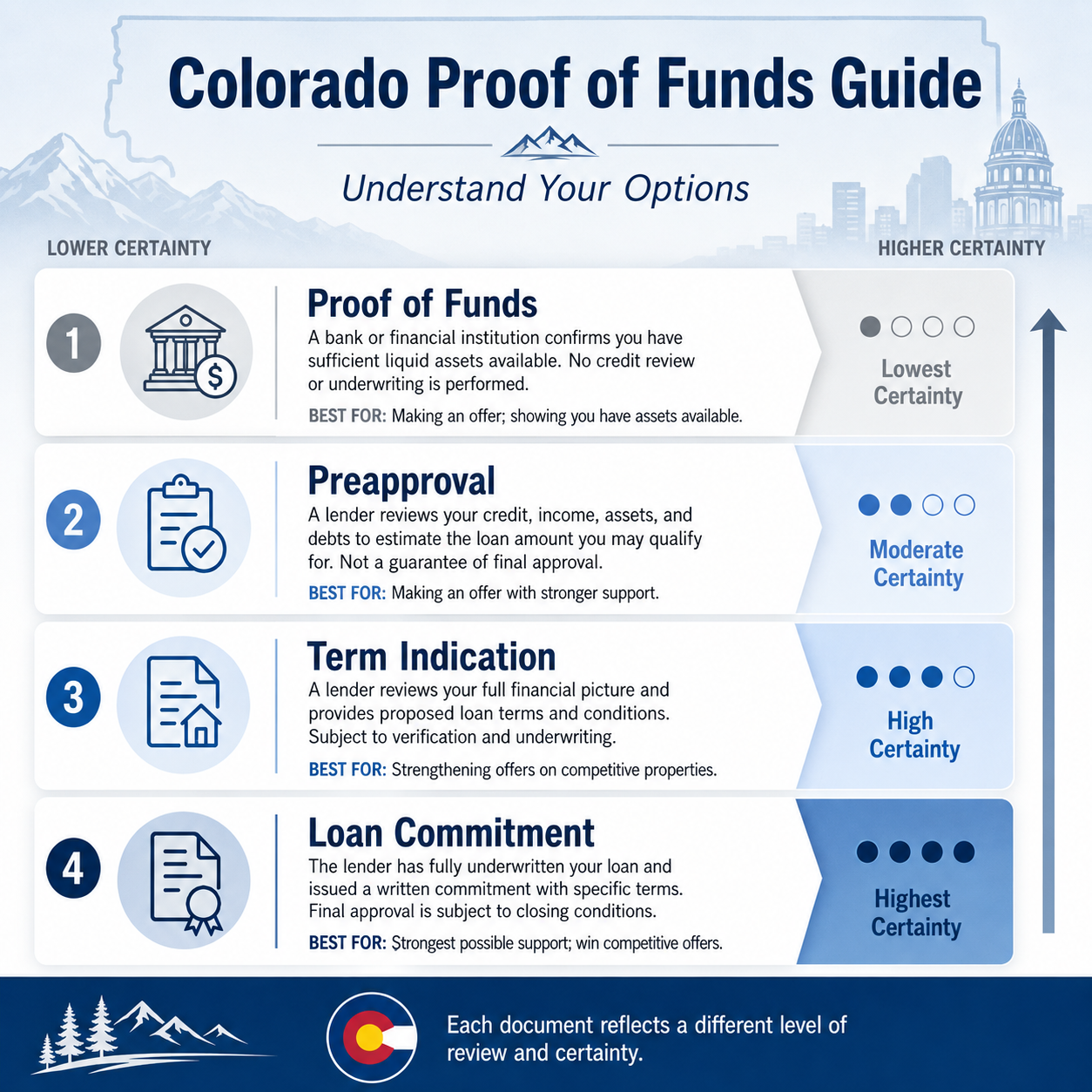
How Is Proof of Funds Different From a Preapproval or Loan Commitment?
Proof of funds: Shows apparent access to cash or financing support for a proposed transaction. It does not guarantee final approval, terms, closing, or cleared cash.
Prequalification or preapproval: Indicates that a financing source has preliminarily reviewed borrower information and may be willing to lend subject to assumptions.
Term indication or term sheet: Summarizes proposed economic and structural terms and remains subject to underwriting and due diligence.
Loan commitment: Sets out approved terms and closing conditions after substantial underwriting. Funding still depends on satisfaction of all conditions.
See the CFPB preapproval letter guidance.
How Do Colorado Contracts Affect the Request?
Colorado Real Estate Commission forms distinguish the purchase price, financing terms, buyer cash at closing, acceptable funds, deadlines, and contingencies. A proof-of-funds request should be consistent with the offer or contract and should not imply that funds are cleared, in escrow, or fully approved unless that fact has been independently verified.
Review the Colorado Real Estate Commission forms and the Colorado sales contract guidance.
When May a Colorado Proof-of-Funds Request Be Appropriate?
Investment Property Purchase
Investment Property Purchase
Fix-and-Flip or Renovation
Fix-and-Flip or Renovation
Commercial Property Purchase
Commercial Property Purchase
Auction or Distressed Sale
Auction or Distressed Sale
Portfolio Acquisition
Portfolio Acquisition
Broker or Acquisition Submission
Broker or Acquisition Submission
What Information Is Reviewed?
Transaction Information
- Property address and property type
- Purchase price, requested loan amount, and estimated cash required
- Signed or draft purchase contract, letter of intent, auction terms, or offer instructions
- Target closing date, due-diligence dates, and material contingencies
- Loan purpose and intended business plan
Buyer and Sponsor
- Legal name of the individual, entity, and guarantor
- Ownership structure and authorized signers
- Relevant ownership, renovation, construction, or operating experience
- Credit, liquidity, net worth, and reserve information when required
Liquidity and Equity
- Recent bank, brokerage, or other liquid-asset statements
- Evidence of deposited equity or documented source of funds
- Partner, member, or guarantor liquidity when relied upon
- Documentation explaining recent large deposits or transfers when material
Property and Valuation
- Current condition, occupancy, income, and known deferred maintenance
- Purchase basis and available valuation support
- Property photos, appraisal, broker opinion, or comparable support
- Rent roll and operating statements for income-producing property
Repayment and Exit Strategy
- Sale, refinance, stabilization, or permanent financing
- Renovation scope, budget, permits, and contractor information when applicable
- Expected timeline and reserves
- Backup repayment strategy when appropriate
Which Review Factors Can Affect the Request?
The review combines transaction details, buyer and entity information, property support, available equity and liquidity, timing, and the proposed repayment or exit strategy.
Buyer
Entity
Property
Equity
Liquidity
Timing
Exit Strategy
Contract and Closing Consistency
All factors should align with the purchase contract and proposed capital structure. The requested amount should be consistent with the purchase price, anticipated financing, buyer equity, earnest money, closing costs, reserves, renovation costs, and any subordinate financing.
How Is the Requested Proof-of-Funds Amount Evaluated?
Estimated Cash Requirement
Purchase price plus closing costs and initial project costs, minus proposed loan proceeds and credited deposits.
Formula
Purchase Price + Closing Costs + Initial Project Costs − Proposed Loan Proceeds − Credited Deposits
Loan-to-Cost Ratio
LTC compares the proposed loan amount with total project cost.
Formula
Proposed Loan Amount ÷ Total Project Cost = LTC
Loan-to-Value Ratio
LTV compares the proposed loan amount with the relevant supported property value.
Formula
Proposed Loan Amount ÷ Supported Property Value = LTV
Liquidity After Closing
Measures verified liquid assets remaining after the estimated cash requirement.
Formula
Verified Liquid Assets − Estimated Cash Required at Closing
Transaction Consistency
Buyer, entity, property, price, financing structure, and available assets should remain consistent.
Review Note
A proof-of-funds letter may need revision if material transaction details change.
No Published Thresholds
No rate, leverage, minimum credit score, or approval threshold is represented without a current approved guideline.
Transaction-Specific Review
Actual requirements vary by property, borrower, loan purpose, seller instructions, and financing source.
For broader preparation guidance, review DPCG’s hard money loan requirements. For consumer background on cash to close, see the CFPB Loan Estimate explainer. No program percentage, rate, minimum credit score, or approval threshold should be published unless supported by a current approved guideline.
What Documents May Be Requested?
A well-organized file should support the transaction, buyer, entity, property, equity, and exit strategy. Sensitive records should be sent only through an approved secure process. Review the CFPB source-of-funds documentation guidance.
Initial Scenario
- Proof-of-funds or financing request summary
- Property address and classification
- Purchase price, requested amount, and estimated closing date
- Buyer or entity contact information
Purchase and Closing
- Purchase contract, letter of intent, assignment agreement, or auction terms
- Earnest-money requirement and evidence of deposit when already paid
- Title commitment or preliminary title information when available
- Seller or listing-agent proof-of-funds instructions
Property-Specific Support
- Current rent roll and operating statements
- Rehabilitation or construction budget and scope of work
- Property photos, valuation, appraisal, broker price opinion, or comparable support
- Existing leases, management information, franchise documents, or environmental reports when relevant
Buyer and Sponsor
- Legal names and authorized signers
- Real-estate ownership and experience summary
- Liquidity, net worth, credit, and reserve information when required
- Source of equity, deposit, and closing funds
Entity and Authority
- Articles of organization or incorporation
- Operating agreement, bylaws, or partnership agreement
- EIN documentation and certificate of good standing when requested
- Borrowing or purchasing resolutions and signer authority
Liquidity and Equity
- Recent bank, brokerage, or other liquid-asset statements
- Evidence of deposited equity or documented source of funds
- Partner, member, investor, or guarantor liquidity information when relied upon
- Explanation of material recent deposits, transfers, or borrowed funds
Purchase and Closing File Checklist
Subheading: Documents that align the offer and closing file
- Executed purchase contract and amendments
- Earnest-money terms and deposit evidence
- Closing deadline and due-diligence dates
- Financing contingencies and assignment provisions
- Title commitment and preliminary closing information
- Seller or listing-agent proof-of-funds instructions
- Existing leases and property disclosures
- Survey and third-party reports when available
How Can a Colorado Buyer Prepare a Stronger Request?
Subheading: Clear, current, and internally consistent information
- Use the exact buyer or entity name shown in the offer
- State the purchase price, requested financing, estimated equity, and closing deadline clearly
- Provide current, legible, complete documents
- Explain the source of the deposit, down payment, equity, and reserves
- Disclose dependence on a partner contribution, asset sale, refinance, or another pending event
- Provide a realistic business plan and repayment strategy
- Confirm what the seller, auction company, or listing representative will accept
- Allow sufficient review time
What Is the Colorado Proof-of-Funds Review Process?
Submit Transaction Summary
Initial Completeness and Fit Review
Provide Requested Documents
Possible Financing-Source Discussion
Proof-of-Funds Consideration
Separate Underwriting and Closing Preparation
Conditions, Valuation, Title, and Insurance
Closing Preparation if Approved
What Can Delay a Proof-of-Funds Letter?
- Amount mismatch: The request does not match the purchase contract or proposed capital stack.
- Unverified equity: Required equity, deposit, or closing funds are not documented.
- Inconsistent statements: Bank or brokerage records are outdated, incomplete, altered, or conflicting.
- Entity problems: The purchasing entity is not formed, not in good standing, or lacks clear authority.
- Guideline mismatch: Property type, use, or location is outside available criteria.
- Incomplete business plan: Renovation budget, timeline, or exit strategy is unclear.
- Misleading language request: The requested letter exceeds what was actually reviewed.
- Unresolved transaction issues: Title, legal, environmental, insurance, or ownership concerns remain open.
- Short deadline: The request is submitted too late for responsible verification.
What Risks and Limitations Should a Buyer Understand?
- A seller may reject the letter or request additional verification.
- The letter may expire, be revised, or be withdrawn.
- Changes to the buyer, entity, property, purchase price, financing structure, or available assets may make the letter inaccurate.
- A proof-of-funds letter does not remove financing, appraisal, title, insurance, legal, environmental, construction, fraud, timing, or market risk.
- Wire fraud: Independently verify wiring instructions with the known title or closing contact using a trusted telephone number.
Do not rely only on emailed wire instructions.
Why Work With Direct Private Capital Group, Inc.?
Direct Private Capital Group, Inc. is a commercial mortgage broker and private real estate financing resource.
For an eligible Colorado business-purpose transaction, DPCG may assist by:
- Reviewing the initial request
- Organizing transaction, entity, liquidity, and property information
- Identifying missing documentation
- Presenting eligible scenarios to possible financing sources
- Communicating questions and next steps
DPCG does not guarantee that a proof-of-funds letter will be issued or accepted and does not guarantee approval, terms, funding, or closing.

Start Your Colorado Transaction Review
Submit the property address, purchase price, requested amount, buyer or entity name, closing deadline, and available supporting documents. A complete and internally consistent request is easier to review than an urgent request submitted without a contract, capital explanation, or transaction details. Submission does not constitute approval, a rate lock, a commitment, or a guarantee of funding or closing.
Colorado Proof of Funds FAQs
The reviewed Colorado sources do not establish a universal rule requiring a separate proof-of-funds letter for every offer. Contract terms, seller instructions, brokerage practices, property type, financing structure, and the parties’ negotiated requirements control the transaction.
Not necessarily. A seller, lender, title company, or capital provider may still request current account statements, source-of-funds documentation, deposit evidence, or other verification.
Yes, when the letter accurately explains that the purchase depends on proposed financing and that financing remains subject to underwriting and conditions. It should not be presented as verified cash when it is not.
No. It is not a commitment to lend, approval, rate lock, or guarantee of terms, funding, or closing.
The required recency varies by the seller, broker, lender, and transaction. Current statements are generally more useful, and the reviewer may ask for updated records before issuing or refreshing a letter.
A property-specific letter may be considered when the buyer, address, purchase price, requested amount, and transaction structure have been reviewed. Any letter should contain appropriate conditions and an expiration date.
A portfolio or aggregate letter may be possible, but the request should identify the properties, total purchase amount, financing plan, equity requirement, and whether the transactions are simultaneous or separate.
The letter should be reviewed and may need to be revised. A buyer should not use an outdated letter for a materially different purchase price, borrower, property, or financing structure.
Highly sensitive information should not be sent through ordinary unsecured forms or unencrypted email. Use an approved secure-upload process.
Submit the property address, purchase price, requested financing amount, buyer or entity name, closing date, and the available contract or offer instructions. DPCG will identify the next documents needed for preliminary review.
Compliance Disclaimer
Direct Private Capital Group, Inc. is a commercial mortgage broker and private real estate financing resource. This page is for general informational purposes and does not constitute a commitment to lend, loan approval, rate lock, verification of cleared funds, legal opinion, or guarantee of terms, funding, acceptance by a seller, or closing.
Any proof-of-funds letter, financing indication, or financing opportunity is subject to complete documentation; borrower, guarantor, and entity qualification; collateral and valuation review; title and lien review; insurance; applicable third-party reports; Colorado and other state eligibility; lender, investor, or capital-provider guidelines; market conditions; and applicable law.
Available structures, documentation requirements, and eligibility vary by transaction. Business-purpose and investment-property financing only unless expressly stated otherwise. This page is not legal, tax, accounting, investment, or financial advice. Consult qualified Colorado legal, tax, real estate, title, and financial professionals regarding the specific transaction.
Review the privacy choices and legal disclaimer before submitting information.