
Home » Bridge Loans » Triplex Bridge Loans
Triplex Bridge Loans for Investment Properties
A triplex bridge loan is short-term, property-backed financing that may help an investor purchase, refinance, renovate, lease, or stabilize a non-owner-occupied three-unit property. Direct Private Capital Group, Inc. reviews the property, borrower, transaction structure, available equity, project plan, and realistic repayment strategy. Financing is subject to underwriting, state eligibility, and lender or capital-provider guidelines.
What is a triplex bridge loan?
A triplex bridge loan is temporary financing secured by a three-unit residential property. An investor may use it when a purchase, refinance, renovation, lease-up, or other transition cannot be completed conveniently with permanent financing. Approval is not based on the property type alone; financing sources also review value, condition, income, equity, borrower strength, loan purpose, and the planned exit. Learn more about bridge loans.
When might an investor need a triplex bridge loan?
Common situations include:
- A purchase contract has a defined closing deadline.
- The property is vacant or partially occupied.
- One or more units require renovation before leasing.
- Current rents do not yet support the intended permanent loan.
- Existing debt is maturing or must be refinanced.
- Title, ownership, partnership, or lien issues must be resolved.
- The investor plans to improve the property and refinance after stabilization.
- The property is being prepared for an orderly sale.
- A documented business-purpose cash-out request must be reviewed.
- A stabilized triplex may instead fit longer-term investment property financing.
How does a triplex bridge loan work?
A bridge loan covers a defined period between the property’s current condition and a planned exit. The borrower should clearly document three connected elements:
- Current position: purchase price or payoff, condition, occupancy, rents, title status, and current value.
- Business plan: renovation, lease-up, management improvement, debt resolution, or sale preparation.
- Exit strategy: refinance, sale, or another documented repayment source.
A bridge loan should not be treated as a substitute for a credible exit plan.
What triplex bridge-loan scenarios may be considered?
Triplex Purchase
Triplex Purchase
Triplex Refinance
Triplex Refinance
Renovation or Unit Turnover
Renovation or Unit Turnover
Vacancy and Lease-Up
Vacancy and Lease-Up
Business-Purpose Cash-Out
Business-Purpose Cash-Out
Ownership or Sale Transition
Ownership or Sale Transition
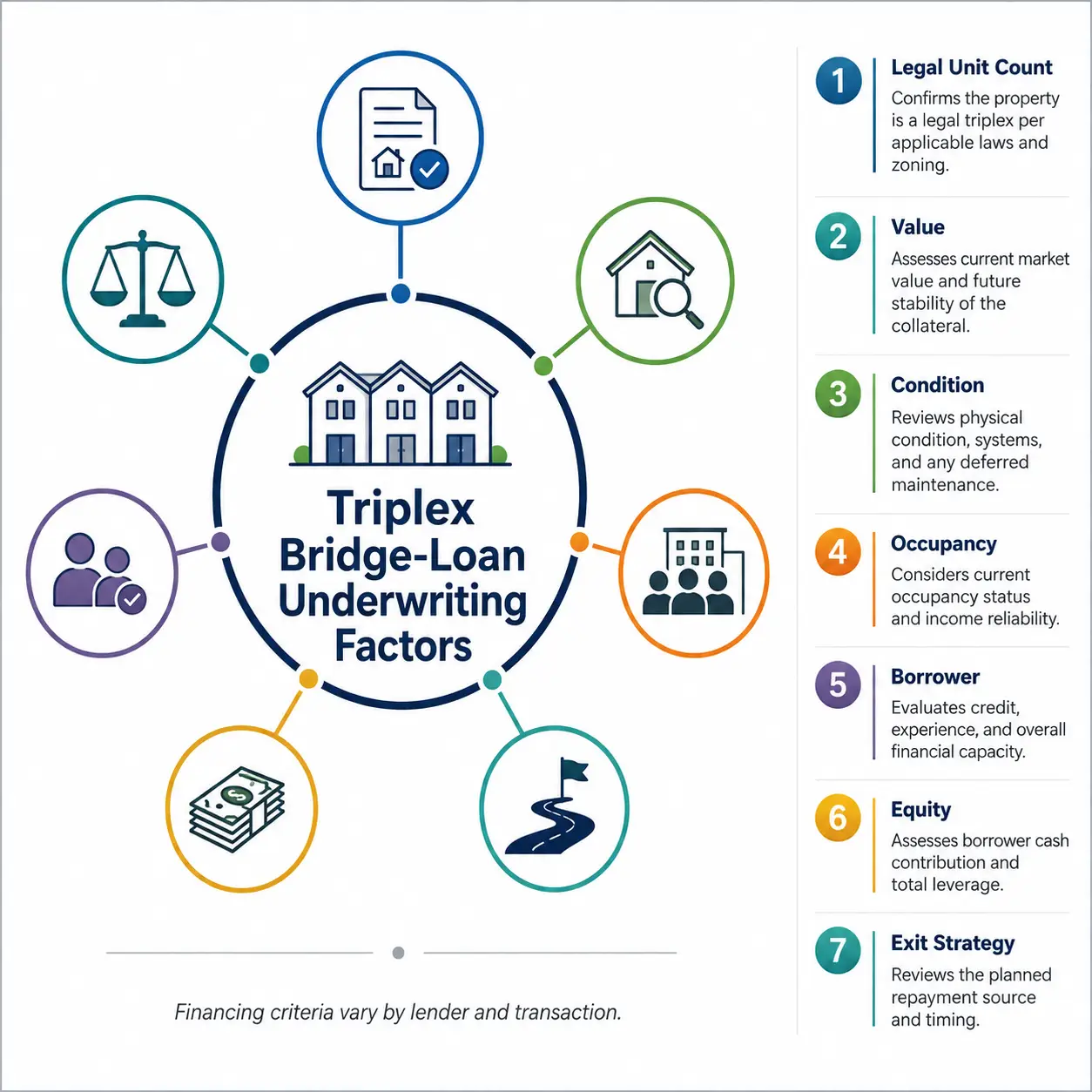
What do financing sources review for a triplex bridge loan?
Property Configuration and Legal Use
- Public property records
- Appraisal description
- Certificate of occupancy
- Zoning and legal use
- Floor plan and unit count
- Permit history
- Utility configuration
- Unpermitted conversions or additions
- Code violations
- Current property condition
- Deferred maintenance
- Marketability in present condition
Occupancy and Rental Performance
- Occupancy by unit
- Current leases
- Monthly rent by unit
- Security deposits
- Rent-payment history
- Delinquencies and concessions
- Market-rent support
- Utility responsibilities
- Pending evictions or disputes
- Expected occupancy after renovation
- Actual or intended owner occupancy
Value, Condition, and Marketability
- Purchase price or cost basis
- Recent comparable sales
- As-is value
- As-completed value
- Stabilized value
- Property condition
- Renovation scope and cost
- Expected market rents
- Local demand for two- to four-unit properties
- Expected marketing time
Borrower, Equity, and Existing Debt
- Credit and mortgage-payment history
- Real estate or renovation experience
- Liquidity and reserves
- Cash to close
- Net worth and contingent obligations
- Existing payoff and lien positions
- Taxes, judgments, and mechanic’s liens
- Entity and guarantor structure
- Bankruptcy, foreclosure, or litigation history
Business Plan and Exit Strategy
- Loan purpose and use of proceeds
- Remaining renovations
- Lease-up assumptions
- Carrying costs and reserves
- Expected refinance or sale timing
- Permanent-loan readiness
- Projected stabilized rent roll
- Backup exit plan
- Ability to support the property if the plan takes longer
For general information about one- to four-unit property classification, review Fannie Mae property guidance. It does not establish private bridge-loan eligibility.
Which financial measurements affect a triplex bridge loan?
Loan-to-Value Ratio
LTV compares the proposed loan amount with the property value accepted for underwriting.
LTV Formula
Proposed Loan Amount ÷ Accepted Property Value = LTV
The accepted value may be as-is, as-completed, or stabilized, depending on the transaction.
Loan-to-Cost Ratio
LTC compares the proposed loan amount with approved acquisition and project costs when renovation is involved.
LTC Formula
Proposed Loan Amount ÷ Approved Total Project Cost = LTC
Each financing source determines which costs are eligible.
Debt-Service Coverage Ratio
DSCR compares qualifying property income with annual debt service when the program uses a cash-flow test.
DSCR Formula
Qualifying Property Income ÷ Annual Debt Service = DSCR
The income and expense method varies by financing source.
Net Operating Income
NOI generally represents effective rental income minus approved property operating expenses.
NOI Formula
Effective Rental Income − Operating Expenses = NOI
Underwriters may normalize rents and expenses.
As-Is and As-Completed Value
As-is value reflects the current condition. As-completed value estimates value after approved work is finished.
Valuation Note
Projected value is not guaranteed and must be supported by an acceptable valuation.
Interest Reserve
An interest reserve is a portion of the loan or project budget set aside for scheduled interest during an approved period.
Reserve Note
Whether a reserve is available, required, financed, or borrower-funded depends on the program.
For additional investment-property financing context, review DPCG’s investment property loans and loan requirement FAQs.
Which documents help support a triplex bridge-loan request?
A well-organized submission helps the financing source understand the property, borrower, requested structure, and exit. Review DPCG’s loan requirement FAQs and borrower FAQs for related preparation guidance.
Initial Loan Scenario
- Property address
- Confirmation of three-unit configuration
- Loan purpose and requested amount
- Purchase price or current payoff
- Estimated current and completed value
- Current occupancy and rent by unit
- Requested closing date
- Business plan and exit strategy
- Borrower, guarantor, and entity names
- Available cash to close and reserves
Property Documents
- Current leases
- Rent roll and payment history
- Operating statement
- Property taxes and insurance
- Utility information
- Property photographs
- Appraisal or valuation reports, if available
- Certificate of occupancy and zoning information
- Code or permit notices
- Property-condition reports
Entity Documents
- Articles of organization or incorporation
- Operating agreement or bylaws
- EIN confirmation
- Certificate of good standing
- Ownership schedule
- Signing resolution
- Trust or partnership documents, when applicable
Purchase or Refinance Documents
- Purchase agreement and addenda
- Earnest-money evidence
- Proof of funds
- Current mortgage statement
- Payoff demand
- Existing note and loan documents, when requested
- Payment history
- Preliminary title report
- List of all liens
- Cash-out use-of-proceeds schedule
Borrower and Guarantor Documents
- Personal financial statement
- Schedule of real estate owned
- Liquidity statements through a secure process
- Credit authorization, when required
- Experience summary
- Explanation of material credit events
- Identification through a secure process
- Background information requested by the financing source
Renovation and Exit Documents
- Detailed scope of work
- Line-item budget and contingency
- Contractor bid, license, and insurance when required
- Plans, permits, and schedule
- Draw schedule
- Projected rent by unit
- Expected permanent-loan type or sale plan
- Projected stabilized rent roll
- Expected completion and exit dates
What is the triplex bridge-loan process?
Submit the Initial Scenario
Initial Eligibility Review
Preliminary Financing Discussion
Document Collection
Formal Underwriting
Valuation and Third-Party Review
Conditions and Closing Preparation
Closing and Post-Closing Obligations
What commonly delays a triplex bridge loan?
- The property is not legally a triplex: A physical three-unit configuration may not match public records, permits, zoning, appraisal, or insurance.
- Incomplete lease or rent information: Missing leases, undocumented cash rents, inconsistent rent rolls, or tenant disputes can delay review.
- Unsupported value: The appraisal or accepted valuation may not support the borrower’s estimate.
- Weak renovation budget: A broad estimate without line items, contractor support, permits, contingency, or schedule may be insufficient.
- Insufficient cash to close: Equity, costs, reserves, taxes, insurance, and unfinanced items must be covered.
- Title or insurance problems: Liens, ownership issues, vacancy, older systems, or renovation activity may require resolution.
- Owner-occupancy conflict: Actual or intended occupancy must be disclosed and may require a different review.
- Unclear exit strategy or late changes: Unsupported refinance assumptions or changes to the borrower, entity, budget, or use of proceeds can restart underwriting.
How can an investor prepare a stronger submission?
- Confirm legal unit count.
Determine whether all three units are recognized by the applicable records and approvals. - Disclose occupancy accurately.
State whether the borrower or a related party will occupy a unit. - Provide leases and a complete rent roll.
Show rent, deposits, occupancy, and payment history by unit. - Explain the transaction clearly.
State the requested amount, purchase price or payoff, use of proceeds, and closing date. - Support current and projected value.
Separate as-is facts from renovation and stabilization projections. - Itemize the renovation scope.
Provide budget, contractor, permits, schedule, and contingency. - Document equity and liquidity.
Show available cash to close and reserves through an approved secure process. - Disclose problems early.
Identify liens, code issues, credit events, title concerns, or tenant disputes. - Prepare a specific exit and backup.
Explain what must occur before refinance or sale and what happens if the plan takes longer. - Protect sensitive information.
Use an approved secure-upload process for confidential records.
How does Direct Private Capital Group assist with triplex bridge financing?
Direct Private Capital Group, Inc. is a commercial mortgage broker and private real estate financing resource.
DPCG may assist by:
- Reviewing the initial triplex loan request
- Identifying missing borrower and property information
- Organizing the transaction for review
- Distinguishing purchase, refinance, renovation, and stabilization needs
- Presenting eligible scenarios to possible financing sources
- Coordinating requests for documents and clarification
- Communicating with the borrower, broker, and relevant transaction parties
DPCG does not guarantee approval, terms, funding, or closing and should not be described as the direct lender, bank, agency lender, servicer, debt fund, or owner of committed capital.

Request a review of your triplex bridge-loan scenario
Send the property address, requested loan amount, purchase price or payoff, current value, occupancy, rents, renovation plan, borrower background, available equity, and expected exit. A scenario review is not an approval, commitment to lend, rate lock, or guarantee of funding or closing.
Frequently Asked Questions About Triplex Bridge Loans
A business-purpose bridge loan may be considered for the purchase of a non-owner-occupied triplex. The financing source will review the purchase contract, property value, legal unit count, borrower contribution, condition, occupancy, renovation plan, and exit strategy.
Vacancy does not automatically make a triplex ineligible. The lender may evaluate the cause of vacancy, property condition, renovation requirements, market rent, lease-up budget, carrying costs, reserves, and expected timeline to stabilization.
Some bridge programs may include approved renovation funds, while others finance only the acquisition or refinance. A detailed scope, budget, contractor information, permits, contingency, inspection process, and draw structure may be required.
The legal unit count is an important review item. A property configured as three units but legally recognized as one or two units may face appraisal, insurance, title, zoning, marketability, and program-eligibility problems.
Owner occupancy must be disclosed before the loan is reviewed. This page is designed primarily for business-purpose investment-property transactions. An owner-occupied request may require a different loan program, legal analysis, disclosure process, or financing source.
Current leases, collected rent, occupancy, market rent, and projected income may be considered. The method used to calculate qualifying income varies by financing source and property condition.
There is no universal minimum that applies to every lender or transaction. Credit requirements depend on the financing source, property, leverage, experience, liquidity, payment history, loan purpose, and other risk factors.
The available loan amount depends on accepted property value, purchase price or cost basis, existing liens, renovation budget, borrower contribution, credit profile, liquidity, property condition, income, and current guidelines.
Timing depends on file completeness, title, valuation, insurance, legal-use confirmation, borrower documentation, renovation review, financing-source approval, and satisfaction of closing conditions. No closing date should be guaranteed before full review.
Common exits include refinancing after renovation and lease-up or selling the property after completing the business plan. The appropriate exit depends on the borrower’s objectives, property performance, market conditions, and future financing eligibility.
Compliance Disclaimer
Direct Private Capital Group, Inc. is a commercial mortgage broker and private real estate financing resource. This page is for general educational and informational purposes concerning potential business-purpose financing for investment real estate.
Nothing on this page constitutes a commitment to lend, loan approval, credit approval, rate lock, guarantee of financing, guarantee of terms, guarantee of proceeds, guarantee of funding, or guarantee of closing. Any financing that may be available is subject to complete underwriting; borrower and guarantor qualification; verification of information; acceptable loan purpose; collateral review; valuation; legal unit count and use; title; insurance; documentation; liquidity; equity; credit; experience; renovation review; third-party reports; state eligibility; market conditions; applicable law; and the current guidelines and approval of the applicable lender, investor, or capital provider.
This page is intended primarily for business-purpose and investment-property financing. Borrowers must disclose actual and intended occupancy. Review the CFPB’s official Regulation Z commentary on business-purpose credit for general regulatory information.
This page is not legal, tax, accounting, investment, insurance, construction, engineering, environmental, appraisal, zoning, or financial advice. Borrowers should consult their own qualified advisers.