
Townhome Bridge Loans
Townhome bridge loans are short-term, property-backed financing structures for qualified business-purpose and investment-property transactions. Direct Private Capital Group, Inc. reviews townhome purchases, refinances, renovations, completions, lease-ups, portfolios, and other transitional scenarios. Approval, terms, funding, and availability depend on underwriting, state eligibility, property classification, valuation, documentation, and lender or capital-provider guidelines.
What is a townhome bridge loan?
A townhome bridge loan is one type of business-purpose bridge financing used when a non-owner-occupied townhome, townhome portfolio, or townhome development is not yet ready for permanent financing or another final exit. It may support an acquisition, refinance, renovation, construction completion, lease-up, title resolution, or portfolio strategy while the borrower completes a defined repayment plan.
When can townhome bridge financing be relevant?
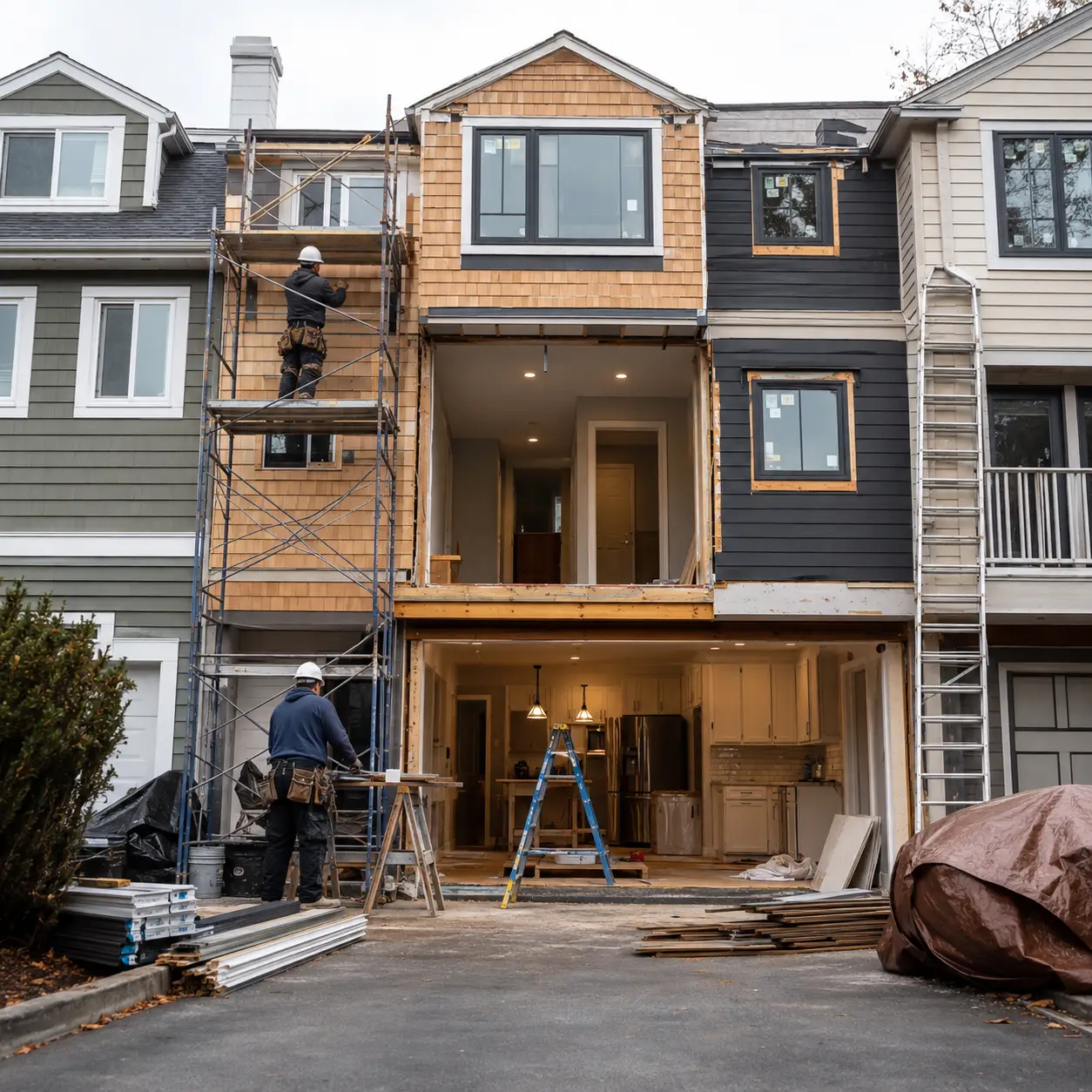
Common business-purpose situations include:
- Purchasing a non-owner-occupied townhome under a time-sensitive contract.
- Acquiring several townhomes as a rental portfolio.
- Refinancing maturing or short-term debt.
- Completing unfinished construction or common improvements.
- Funding or refinancing a defined renovation program.
- Carrying completed units through lease-up or sale.
- Resolving title, subdivision, certificate-of-occupancy, or association issues.
- Repositioning vacant units into income-producing rentals.
- Bridging to a sale, DSCR refinance, portfolio loan, or another permanent exit.
- Providing short-term capital during an ownership or partnership transition.
How is How Is a Townhome Classified for Financing?
The word “townhome” commonly describes a multi-level residence attached to one or more neighboring residences. Physical appearance alone does not determine how the property will be financed.
The lender or capital provider may need to confirm how each parcel or unit is legally owned, insured, transferred, taxed, and governed.
- Fee-simple townhome
- Condominium townhome
- Townhome portfolio
- Townhome development
What townhome bridge-loan scenarios may be considered?
Investment Townhome Acquisition
Investment Townhome Acquisition
Townhome Portfolio Acquisition
Townhome Portfolio Acquisition
Maturing-Debt Refinance
Maturing-Debt Refinance
Renovation or Value-Add
Renovation or Value-Add
Construction Completion
Construction Completion
Lease-Up or Pre-Sale Inventory
Lease-Up or Pre-Sale Inventory
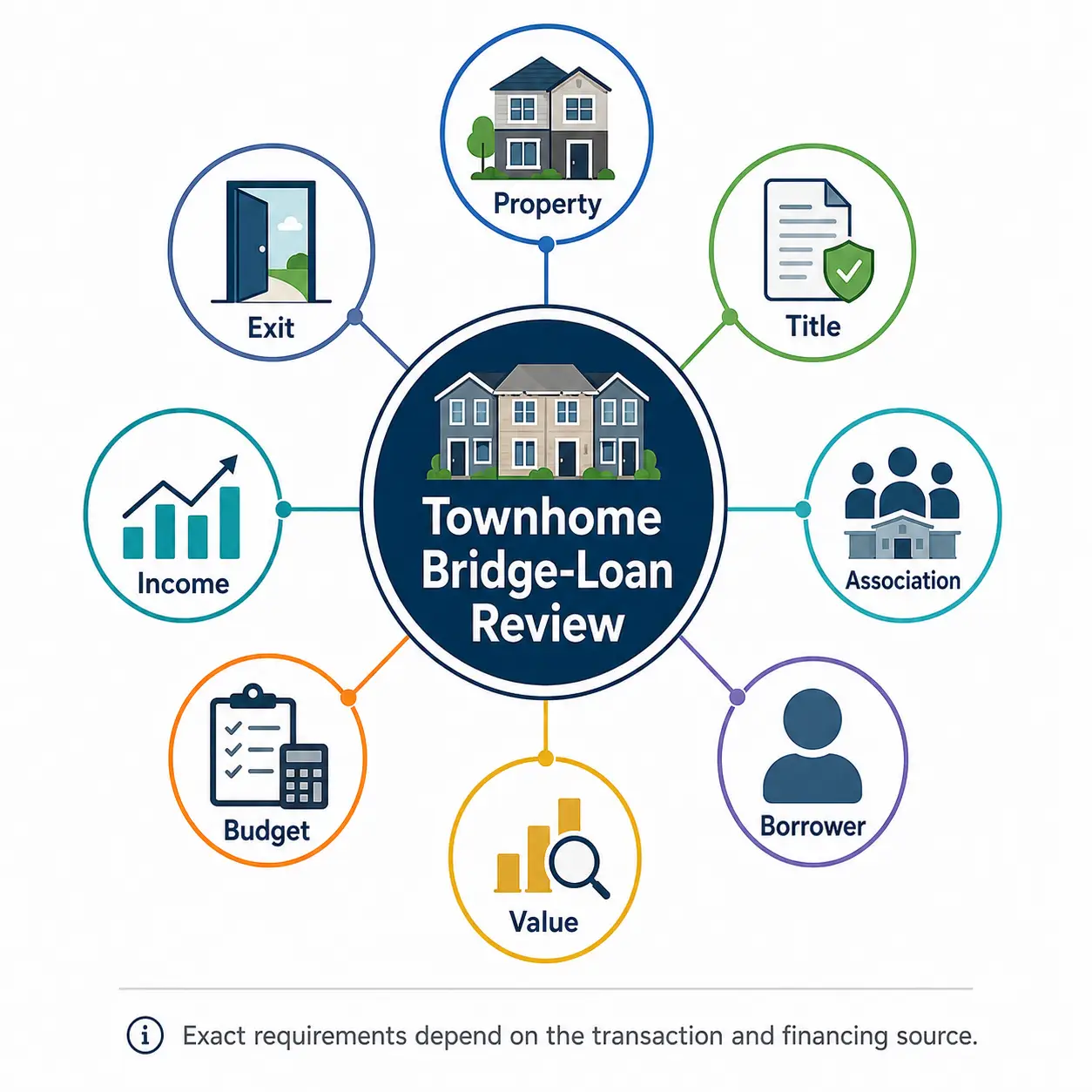
What do financing sources review for a townhome bridge loan?
Property and Legal Structure
The review may include:
- Property address and legal description
- Fee-simple, condominium, planned-community, leasehold, or other ownership form
- Number of units and tax parcels
- Recorded plat or condominium map
- Easements, party-wall, access, and maintenance agreements
- Current title vesting and liens
- Zoning, legal use, permits, and certificates of occupancy
- Physical condition and deferred maintenance
Association and Insurance
The financing source may review:
- Declaration, bylaws, and rules
- Association budget and reserves
- Master insurance coverage
- Special assessments and delinquencies
- Pending litigation
- Rental or transfer restrictions
- Maintenance responsibilities
- Common-area condition
- Unit-owner insurance obligations
Occupancy and Property Income
The financial review commonly examines:
- Current rent roll and executed leases
- Occupancy and vacancy
- Collections and delinquencies
- Concessions and market rents
- Association dues
- Taxes and insurance
- Utilities and management costs
- Historical and projected operating statements
- Unit-level income and expenses for portfolios
Borrower and Existing Debt
A complete review may identify:
- Borrowing entity and guarantors
- Credit history and relevant experience
- Liquidity, net worth, and cash to close
- Current lender and payoff
- First, second, and other liens
- Payment history and maturity date
- Taxes, judgments, assessments, or mechanics’ liens
- Existing contingent liabilities
Use of Proceeds and Exit
The financing source may evaluate:
- Purchase funds or existing payoff
- Eligible closing costs
- Renovation or completion budget
- Interest and operating reserves
- Requested cash-out and business purpose
- Sale, DSCR refinance, portfolio refinance, or other takeout
- Expected timing and backup exit
- Borrower capacity if the plan takes longer than expected
For environmental due-diligence context, see the EPA All Appropriate Inquiries guidance.
Which financial measurements affect townhome bridge financing?
Loan-to-Value Ratio
Compare the loan with accepted property value
Loan-to-value, or LTV, compares the proposed loan amount with the property value accepted for underwriting.
LTV Formula
Calculate the collateral ratio
Proposed Loan Amount ÷ Accepted Property Value = LTV
The accepted value may be the current as-is value rather than a projected retail or future value.
Loan-to-Cost Ratio
Compare the loan with eligible project cost
Loan-to-cost, or LTC, compares the loan amount with the total eligible project cost for an acquisition, renovation, or completion plan.
LTC Formula
Calculate the project-cost ratio
Proposed Loan Amount ÷ Eligible Project Cost = LTC
Eligible-cost definitions vary by lender and transaction.
Debt-Service Coverage Ratio
Measure rental income against debt payments
DSCR compares underwritten net operating income with annual debt service when the townhomes generate rental income.
DSCR Formula
Calculate income coverage
Underwritten Net Operating Income ÷ Annual Debt Service = DSCR
DSCR may affect a proposed rental-property refinance exit.
Net Operating Income
Estimate property operating performance
NOI generally represents effective property income minus approved operating expenses before debt service, income taxes, and depreciation.
NOI Formula
Calculate property NOI
Effective Operating Income − Approved Operating Expenses = NOI
The underwriter may normalize unsupported or nonrecurring items.
As-Is, As-Complete, and Bulk Value
Match valuation to the collateral and exit
A lender may consider current value, completed value, stabilized value, individual unit values, or bulk portfolio value.
Valuation Note
Avoid adding projected retail prices
The total of projected individual retail prices does not necessarily equal the value of a portfolio or unfinished development.
Interest and Operating Reserves
Plan for carrying and project costs
A bridge structure may include or require reserves for interest, taxes, insurance, association dues, utilities, construction, or lease-up.
Reserve Note
Understand reserve limitations
Reserve treatment varies and does not eliminate the borrower’s repayment or performance obligations.
Borrowers planning a rental-property exit may review DPCG’s DSCR loan resources. For official flood-map research, use the FEMA Flood Map Service Center.
Which documents help support a townhome bridge-loan request?
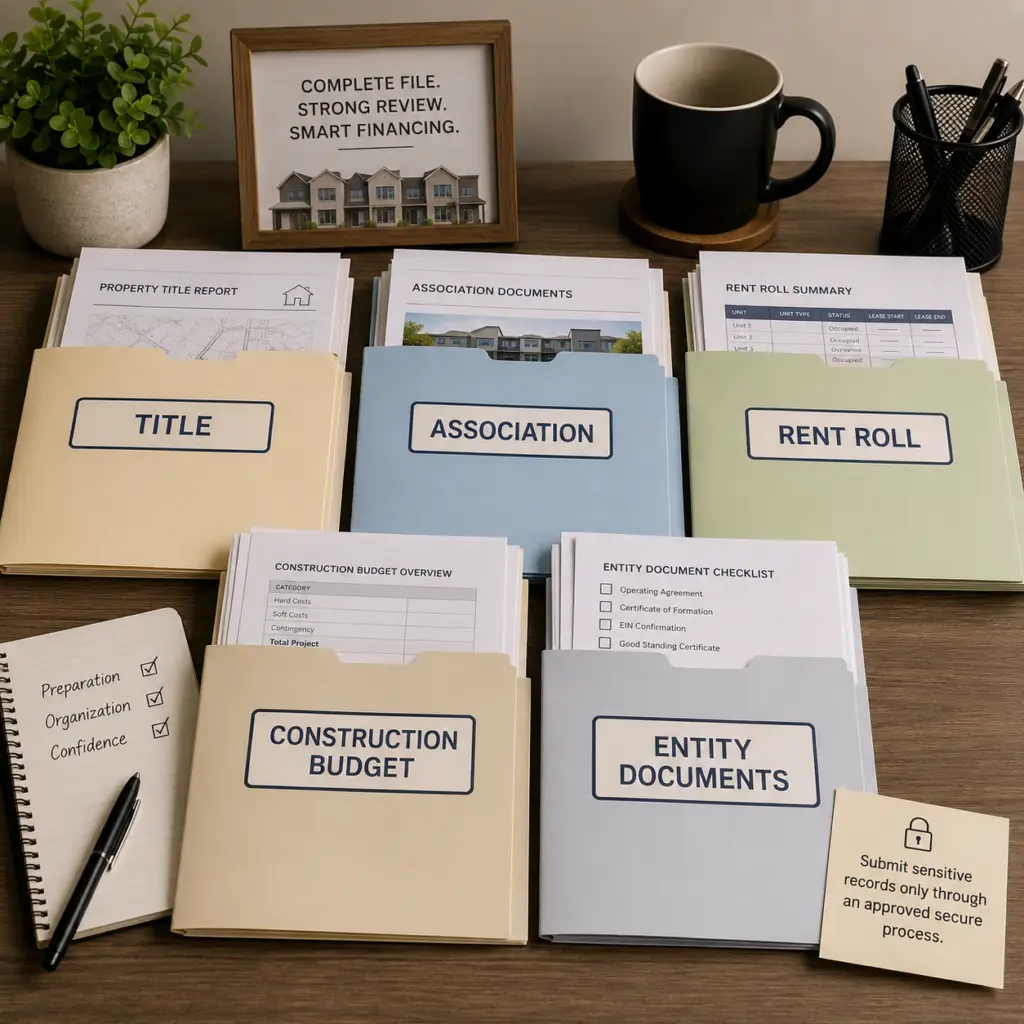
A well-organized submission allows the financing source to understand the property, legal ownership, borrower, use of proceeds, project status, and proposed exit. Review DPCG’s loan requirement FAQs for additional preparation guidance.
Initial Loan Scenario
- Property address
- Number of townhomes
- Legal property type
- Loan purpose
- Requested loan amount
- Purchase price or current payoff
- Estimated current value
- Current occupancy
- Renovation or completion status
- Use of proceeds
- Borrower cash to close
- Proposed exit strategy
Property and Association Documents
- Deed and legal description
- Preliminary title report
- Survey, plat, or condominium map
- Declaration, bylaws, and CC&Rs
- Association budget and financials
- Master insurance
- Special-assessment and litigation information
- Tax bills
- Permits and certificates of occupancy
- Property-condition reports
Entity Documents
- Articles of organization or incorporation
- Operating agreement, bylaws, or partnership agreement
- Employer Identification Number confirmation
- Certificate of good standing, when required
- Ownership chart
- Authorized-signatory resolution
- Foreign registration, when applicable
- Trust or estate documents, when relevant
Existing Debt and Refinance Documents
- Current mortgage statement
- Formal payoff demand
- Note and deed of trust or mortgage
- Payment history
- Existing loan maturity date
- Current lien schedule
- Property-tax status
- Association balance and assessment status
- Explanation of requested cash-out
Borrower and Guarantor Documents
- Loan application
- Personal financial statement
- Real estate owned schedule
- Liquidity verification
- Relevant project résumé
- Schedule of completed and current projects
- Credit authorization, when required
- Identification and bank statements through an approved secure process
Renovation, Completion, and Exit Documents
- Detailed scope of work
- Itemized budget
- Cost-to-complete report
- Project timeline
- Plans and permits
- Contractor agreement and insurance
- Draw schedule and lien releases
- Rent roll or presale schedule
- Permanent financing indication or sale support
- Backup exit plan
What is the townhome bridge-loan process?
Initial Scenario Review
Property Classification
Document Collection
Preliminary Financing Discussion
Formal Underwriting
Valuation and Third-Party Reports
Conditions and Documentation
Closing and Post-Closing Obligations
What commonly delays a townhome bridge loan?
- Unclear Legal Classification: The property may be described as a townhome even though title shows a condominium, planned community, portfolio, or other ownership form.
- Association Issues: Missing financials, weak master insurance, litigation, assessments, rental restrictions, or deferred common-area maintenance can delay review.
- Title Inconsistencies: Unreleased liens, tax issues, party-wall disputes, missing access rights, or conflicting legal descriptions may require correction.
- Unsupported Value: Individual retail values may not support the bulk or portfolio value used for underwriting.
- Incomplete Construction Information: A general estimate is not a substitute for a scope, budget, cost-to-complete analysis, permits, and contractor documentation.
- Insurance Problems: Gaps between unit-level and master coverage can affect closing.
- Unclear Use of Proceeds: Cash-out or working-capital requests should be itemized and tied to a valid business purpose.
- Weak Exit Strategy: An exit based only on future appreciation or an unidentified future lender may receive additional scrutiny.
How can a borrower prepare a stronger townhome submission?
- Confirm the legal property type.
Obtain the deed, title report, plat, condominium declaration, and association documents. - Write a one-page transaction summary.
Explain the borrower, property, requested amount, use of proceeds, known issues, and expected repayment. - Provide a unit-level schedule.
For portfolios, list each address, parcel, occupancy, rent, condition, value, debt, taxes, insurance, and association dues. - Reconcile the financial information.
The rent roll, leases, deposits, operating statements, taxes, insurance, and association obligations should tell a consistent story. - Separate completed work from remaining work.
Document costs already paid, unpaid obligations, remaining budget, contingency, and equity still available. - Disclose known issues early.
Identify association litigation, assessments, open permits, code violations, title disputes, casualty damage, or contractor liens. - Support the exit with evidence.
Provide sale support, permanent-loan requirements, stabilized income assumptions, or a credible completion plan. - Use a secure process for sensitive records.
Do not send government identification, tax returns, or complete bank statements through an unsecured public form.
How does Direct Private Capital Group assist with townhome financing?
Direct Private Capital Group, Inc. is a commercial mortgage broker and private real estate financing resource.
DPCG may assist by:
- Reviewing the initial townhome financing scenario
- Identifying missing property, association, borrower, or project information
- Helping distinguish the legal and financing classification of the property
- Organizing documents for possible lender or investor review
- Clarifying the requested use of proceeds
- Reviewing the proposed business plan and exit
- Presenting eligible scenarios to possible financing sources
- Communicating follow-up requests during the process
DPCG does not guarantee approval, terms, funding, or closing and should not be described as the direct lender, bank, debt fund, servicer, or owner of committed capital.
Have a townhome purchase, refinance, renovation, or completion scenario?
Provide the property address, number of townhomes, legal ownership type, requested loan amount, purchase price or payoff, estimated value, occupancy, renovation or construction status, borrower experience, use of proceeds, and proposed exit. DPCG can conduct an initial review and identify the next information needed.
Frequently Asked Questions About Townhome Bridge Loans
A bridge loan may be considered for the business-purpose purchase of a non-owner-occupied townhome when the borrower has a defined investment plan and repayment strategy. Approval depends on the borrower, collateral, purchase terms, ownership structure, value, documentation, state eligibility, and lender guidelines.
This page is limited to business-purpose and investment-property financing. A loan primarily for personal, family, or household use requires a different legal and financing analysis and should not be submitted as an investment-property bridge loan.
A townhome may be treated differently depending on its legal ownership and project structure. It may be fee-simple, condominium, part of a planned community, held in a portfolio, or included in a development. Title and governing documents must be reviewed.
A lender may consider multiple townhomes in one portfolio transaction, subject to ownership, title, unit count, property locations, occupancy, value, income, association matters, collateral structure, and release strategy.
Renovation funds may be considered when supported by a detailed scope, budget, contractor information, project schedule, property review, valuation, borrower contribution, draw structure, and exit plan. Availability and funding procedures vary.
Partially completed townhomes may require construction-completion financing rather than a standard acquisition or refinance bridge. Review may include permits, plans, cost to complete, contractor status, inspections, liens, utilities, common improvements, and remaining equity.
Yes. Association documents, finances, insurance, maintenance responsibilities, litigation, assessments, rental restrictions, and property condition can affect value, marketability, insurance, and the proposed exit.
The valuation process depends on the lender, property, collateral structure, loan purpose, and available information. A lender may require an appraisal or another approved valuation method. Borrowers should not assume that a prior appraisal will be accepted.
A portfolio may be evaluated using individual unit values, bulk value, income, marketability, occupancy, release assumptions, or a combination of approaches. The total of projected retail prices does not necessarily represent the value available for loan underwriting.
Submit the property address, number of townhomes, legal ownership type, requested loan amount, purchase price or payoff, estimated value, occupancy, borrower experience, use of proceeds, and exit strategy to Direct Private Capital Group, Inc. for review.
Compliance Disclaimer
Direct Private Capital Group, Inc. is a commercial mortgage broker and private real estate financing resource. The information on this page is provided for general informational and educational purposes concerning possible business-purpose and investment-property financing.
Nothing on this page constitutes an approval, commitment to lend, loan offer, rate lock, or guarantee of any rate, loan amount, leverage, fee, term, funding date, closing date, or other result. Any financing that may be available is subject to complete underwriting; borrower and guarantor qualification; verification of information; acceptable collateral; valuation; title; lien position; insurance; association and condominium review; property condition; environmental, engineering, or construction review where applicable; documentation; state eligibility; lender, investor, or capital-provider guidelines; market conditions; and applicable law.
This page addresses business-purpose and investment-property financing only and is not intended to advertise consumer-purpose residential mortgage financing. It is not legal, tax, accounting, investment, construction, engineering, environmental, insurance, or financial advice.
For official fair-lending information, review the Consumer Financial Protection Bureau’s Regulation B resource.