
Rural Land Loans
Financing rural land requires more than a property address and purchase price. Access, legal description, permitted use, utilities, water, environmental conditions, marketability, valuation, borrower strength, and a realistic exit strategy all affect whether a transaction can move forward. Direct Private Capital Group, Inc. helps borrowers and brokers organize rural land financing scenarios and present eligible files to possible financing sources.
Business-purpose and investment-property financing only. All financing is subject to underwriting, collateral review, state eligibility, lender or capital-provider guidelines, and applicable law.
What is a rural land loan?
A rural land loan is business-purpose financing secured by acreage outside a typical improved commercial-property setting. The collateral may be raw, partially improved, agricultural, recreational, timber, ranch, specialty-use, or development land. Review generally focuses on legal access, title, zoning, utilities, water, environmental and site conditions, value, borrower strength, equity, and a credible repayment or exit strategy. It is one type of commercial real estate financing.
What types of rural land scenarios may be reviewed?
Common business-purpose scenarios include:
- Purchasing raw or undeveloped rural acreage.
- Refinancing maturing debt secured by rural land.
- Replacing short-term or bridge financing.
- Obtaining qualified business-purpose cash-out from land already owned.
- Acquiring neighboring parcels or assembling multiple tracts.
- Financing partially improved land with roads, utilities, grading, fencing, or preliminary approvals.
- Holding land while zoning, subdivision, entitlement, engineering, or infrastructure work is completed.
- Financing agricultural, ranch, timber, recreational, or specialty-use land when the transaction fits the financing source’s guidelines.
This list is educational, not a representation that every property type, use, location, or transaction is eligible.
Why is rural land financing different from financing an improved property?
An improved commercial property often has buildings, tenants, operating income, replacement-cost evidence, and a broader group of potential buyers. Rural land may have no current cash flow, limited comparable sales, uncertain development timing, private roads, wells or septic systems, agricultural restrictions, easements, wetlands, flood exposure, or mineral and water-right questions.
A financing source generally needs to understand what the property is today, what the borrower intends to do with it, what approvals or infrastructure are still required, how much cash the borrower will invest, and how the debt will be repaid.
A construction loan may be more appropriate when the main request involves a permitted and fully budgeted ground-up project. A stabilized commercial property loan may be more appropriate when operating cash flow is the principal repayment source.
How is rural land classified for financing review?
Raw or Undeveloped Land
Raw or Undeveloped Land
Improved or Partially Improved Land
Improved or Partially Improved Land
Agricultural or Support Land
Agricultural or Support Land
Recreational or Specialty Land
Recreational or Specialty Land
Timber and Ranch Land
Timber and Ranch Land
Development or Commercial-Use Land
Development or Commercial-Use Land
What do financing sources review for a rural land loan?
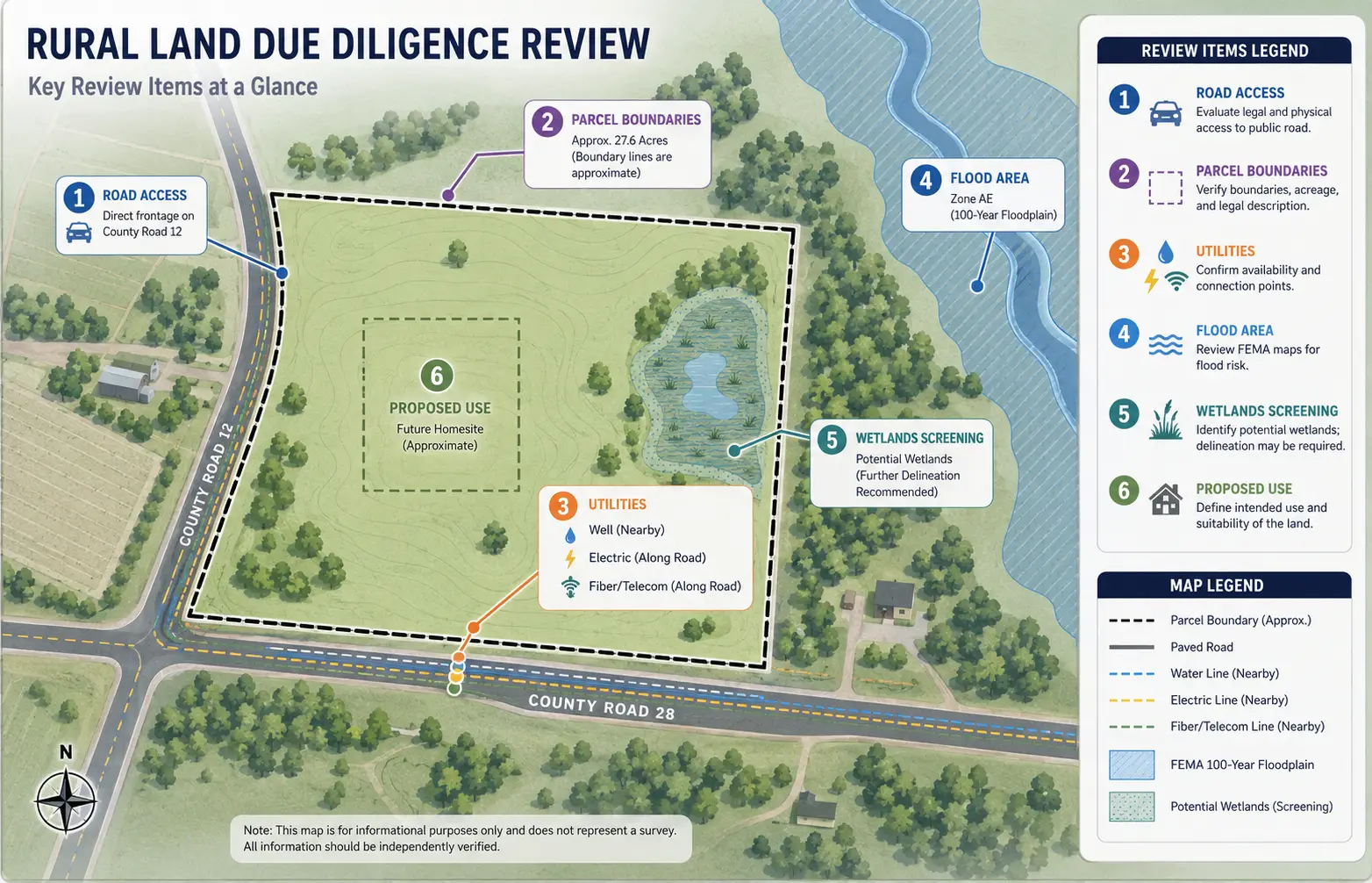
Access, Survey and Title
- Public-road connection and recorded legal access
- Private-road agreements, maintenance obligations, gates, and seasonal access
- Survey, acreage, parcel lines, encroachments, easements, and legal description
- Title commitment, liens, leases, options, rights of first refusal, and ownership interests
- Mineral, timber, grazing, water, utility, and conservation rights or restrictions
Zoning, Utilities and Site Feasibility
- Zoning, overlays, subdivision status, conditional-use requirements, and pending approvals
- Electric, gas, communications, water, sewer, septic, well, and road infrastructure
- Capacity, testing, connection rights, extension distance, easements, and estimated cost
- Topography, drainage, soils, buildable area, and site constraints
Preliminary soil information may be reviewed through the USDA NRCS Web Soil Survey.
Environmental, Flood and Wetlands
- Prior dumping, storage, mining, fuel, industrial, or agricultural-chemical activity
- Flood-zone exposure, wetlands, drainage, erosion, and protected areas
- Environmental reports, agency records, and the need for additional investigation
- Insurance availability and excluded hazards
Useful screening resources include FEMA’s Flood Map Service Center, the USFWS Wetlands Mapper, and the EPA All Appropriate Inquiries resource.
Borrower, Equity and Business Plan
- Borrowing entity, guarantors, ownership structure, and signing authority
- Relevant land, development, agricultural, construction, operating, or property-management experience
- Equity, liquidity, reserves, contingent liabilities, and funds to close
- Credit history and existing obligations
- Sources and uses, timeline, consultants, approvals, improvements, and carrying costs
Value, Marketability and Exit Strategy
- As-is value, purchase price, prior appraisal, relevant land sales, and broker support
- Parcel size, location, access, utilities, restrictions, highest and best use, and exposure time
- Depth of the local buyer market and the property’s resale limitations
- Permanent financing, sale, entitlement completion, construction financing, or another documented exit
- Backup repayment plan if timing, cost, value, or approvals do not meet expectations
Topographic and mapping information may be reviewed through the USGS National Map.
Which financial measurements may affect rural land financing?
Loan-to-Value Ratio
Loan-to-value, or LTV, compares the proposed loan amount with the property value accepted for underwriting.
Formula
Proposed Loan Amount ÷ Accepted Property Value = LTV
The accepted value may be based on an appraisal or another approved valuation method.
Loan-to-Cost Ratio
Loan-to-cost, or LTC, compares the proposed loan amount with eligible acquisition, infrastructure, entitlement, improvement, or project costs.
Formula
Proposed Loan Amount ÷ Total Eligible Project Cost = LTC
LTC may apply when the request includes acquisition, site work, infrastructure, entitlement, construction, or major improvements.
Debt-Service Coverage Ratio
DSCR may be considered when reliable property, lease, or business cash flow supports repayment.
Formula
Underwritten Net Operating Income ÷ Annual Debt Service = DSCR
The financing source determines which income and expenses are included.
Debt Yield
Debt yield compares underwritten net operating income with the proposed loan amount when dependable income is available.
Formula
Underwritten Net Operating Income ÷ Proposed Loan Amount = Debt Yield
Debt yield does not depend directly on the interest rate or amortization schedule.
As-Is, As-Complete and Stabilized Value
As-is value reflects current condition and rights. As-complete value assumes specified work or approvals are completed. Stabilized value assumes sustainable use, occupancy, income, or performance.
Valuation Note
Not every rural land transaction relies on all three values. The appraisal scope depends on the property, present legal status, proposed use, and financing request.
Cost Basis, Equity and Reserves
Cost basis may include purchase price and verified eligible costs. Equity and reserves help support closing, carrying costs, professional fees, infrastructure, approvals, taxes, insurance, and delays.
Transaction-Specific Review
Recognized costs, required equity, reserves, recourse, and financial thresholds vary by property, borrower, loan purpose, and financing source.
No maximum LTV, LTC, DSCR, debt-yield threshold, loan amount, rate, or term is represented on this page because those terms require current, transaction-specific verification. Borrowers evaluating government-backed rural business programs may review the USDA Rural Development Business & Industry Loan Guarantees resource.
What documents help evaluate a rural land loan?
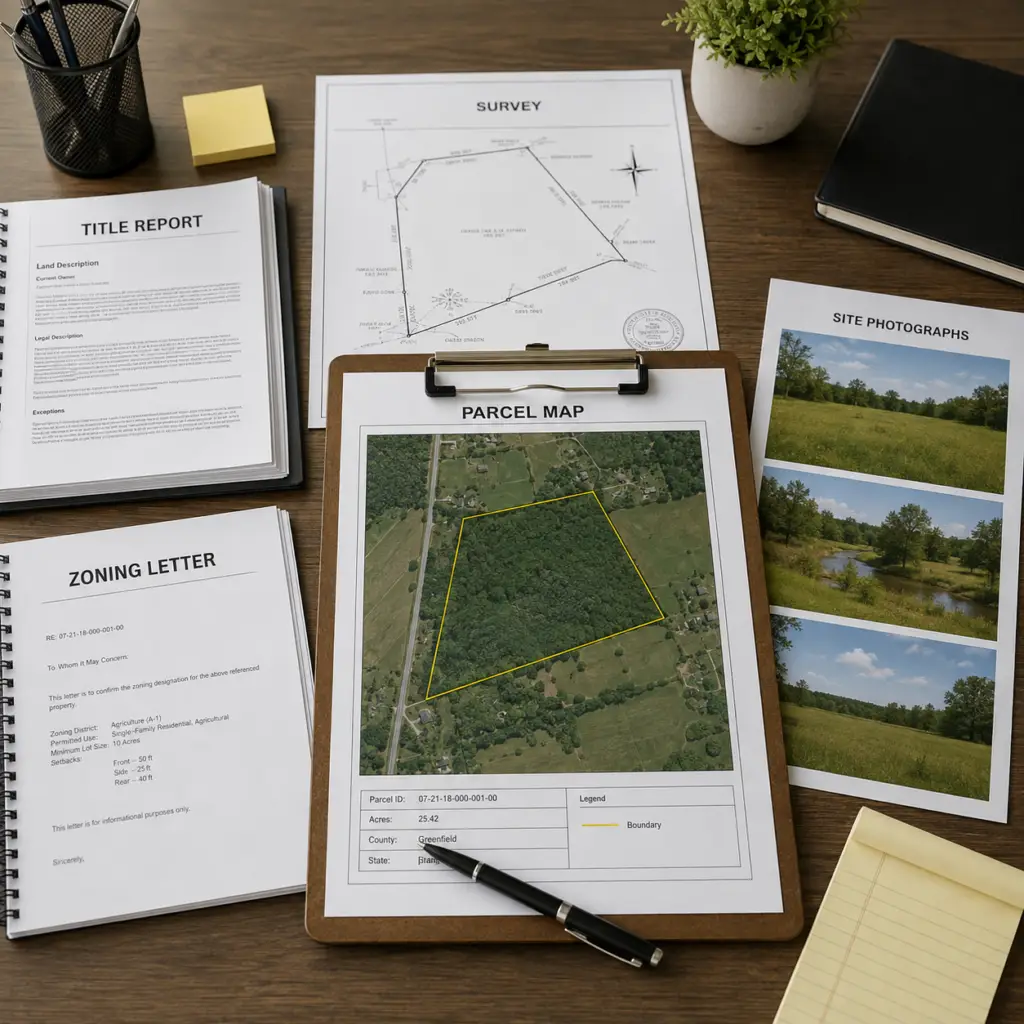
A well-organized submission helps a financing source understand the parcel, access, legal use, physical condition, current value, borrower, requested use of proceeds, and proposed exit. Review DPCG’s commercial loan required-documents guide for additional borrower, entity, property, title, and financing-document guidance.
Initial Scenario Information
- Property address, parcel number, county, state, acreage, and legal description if available
- Requested loan amount, loan purpose, purchase price or payoff, and requested closing timing
- Current use, proposed use, concise business plan, and estimated as-is value
- Borrower, borrowing entity, guarantors, and relevant experience
- Itemized sources and uses, proposed exit, expected timing, and backup plan
Property, Access and Title Documents
- Purchase agreement and amendments for an acquisition
- Deed, legal description, parcel map, survey, title commitment, and tax records
- Access easements, private-road agreements, maintenance agreements, and utility easements
- Leases, options, conservation restrictions, mineral, timber, grazing, and water-right documents
- Existing notes, mortgages, payoff demands, lien information, and ownership agreements
Land Use and Site Documents
- Zoning confirmation, overlays, subdivision records, permits, approvals, and entitlement correspondence
- Utility availability, capacity letters, well and septic records, and infrastructure estimates
- Topographic, drainage, soil, flood, wetlands, engineering, and site-feasibility information
- Environmental reports and records concerning prior use
- Maps, aerials, photographs, improvement lists, and condition information
Borrower and Entity Documents
- Loan application and personal financial statement
- Real-estate schedule, liquidity, and bank statements through a secure process
- Resume or relevant land, development, agricultural, operating, or management experience
- Articles, operating agreement, EIN confirmation, good standing, and ownership schedule
- Borrowing resolutions, signing authority, guarantor information, and trust documents when applicable
Financial and Existing-Debt Documents
- Personal and business tax returns transmitted securely when requested
- Profit-and-loss statements, balance sheets, lease income, and year-to-date financials when relevant
- Debt schedule, current mortgage statement, payoff demand, note, security instrument, and payment history
- Property taxes, insurance, maintenance, association, road, utility, and other carrying costs
- Itemized use-of-proceeds schedule for acquisition, refinance, cash-out, approvals, infrastructure, or improvements
Business Plan, Budget and Exit Documents
- Sources and uses, down-payment evidence, closing-cost estimate, and reserve plan
- Consultant proposals, entitlement schedule, infrastructure budget, scope of work, permits, and contingency
- Development, agricultural, leasing, timber, ranch, recreational, or commercial-use plan as applicable
- Timeline for approvals, improvements, construction, marketing, sale, or refinance
- Primary and backup exit documentation
What is the rural land loan process?
Initial Scenario Review
Preliminary Eligibility Discussion
Document Collection and File Organization
Financing-Source Review
Preliminary Terms or Indication
Formal Underwriting and Third-Party Reports
Conditions and Final Approval
Closing and Post-Closing Obligations
What commonly delays a rural land loan?
- Unverified legal access: Physical access exists, but the title or survey does not establish an insurable right to reach the property.
- Boundary or acreage conflicts: Deeds, assessor records, marketing materials, and surveys do not agree.
- Unclear legal use: The proposed plan is described as approved even though zoning, subdivision, permits, or entitlements remain unresolved.
- Unsupported value: The expected value relies on distant, outdated, differently zoned, or physically dissimilar sales.
- Utility and water assumptions: Capacity, connection rights, testing, easements, distance, or cost have not been documented.
- Flood, wetlands, soil, drainage, or environmental concerns: Additional professional or agency review is required.
- Title restrictions and rights: Easements, leases, conservation restrictions, mineral, timber, grazing, or water rights affect control or resale.
- Weak sources and uses or exit strategy: Costs, reserves, timing, and backup repayment plans are incomplete or inconsistent.
How can a borrower prepare a stronger rural land loan submission?
- Start with the parcel facts.
Provide location, parcel number, acreage, legal description, current use, and ownership. - Document access early.
Provide the survey, title, easements, road agreements, and maintenance obligations. - Separate current legal status from the future plan.
Identify what is approved, pending, conceptual, or not yet submitted. - Verify utilities and water.
Provide availability, capacity, testing, connection distance, rights, easements, and estimated cost. - Organize title and property rights.
Gather leases, restrictions, conservation, mineral, timber, grazing, and water documents. - Support the value.
Provide the purchase contract, prior appraisal, broker analysis, and relevant recent sales. - Show complete sources and uses.
Itemize purchase, payoff, closing costs, professional fees, improvements, cash-out, equity, and reserves. - Build a realistic timeline.
Include approvals, consultants, permitting, infrastructure, construction, marketing, and a time cushion. - Explain the primary and backup exit.
- Submit one consistent file and use an approved secure-upload process for sensitive documents.
How does Direct Private Capital Group assist with rural land financing?
Direct Private Capital Group, Inc. is a commercial mortgage broker and private real estate financing resource.
DPCG may assist by:
- Reviewing the initial rural land scenario
- Identifying incomplete or inconsistent information
- Organizing property, access, title, borrower, entity, debt, site, and business-plan documents
- Clarifying the requested loan purpose, sources and uses, timeline, and exit strategy
- Presenting eligible transactions to possible financing sources
- Coordinating information requests during underwriting
- Helping compare proposed financing structures
- Communicating with the borrower, broker, and transaction parties as the file progresses
DPCG does not guarantee approval, pricing, leverage, timing, funding, or closing and should not be described as the direct lender, bank, government agency, servicer, debt fund, or owner of committed capital.
Have a rural land transaction to review?
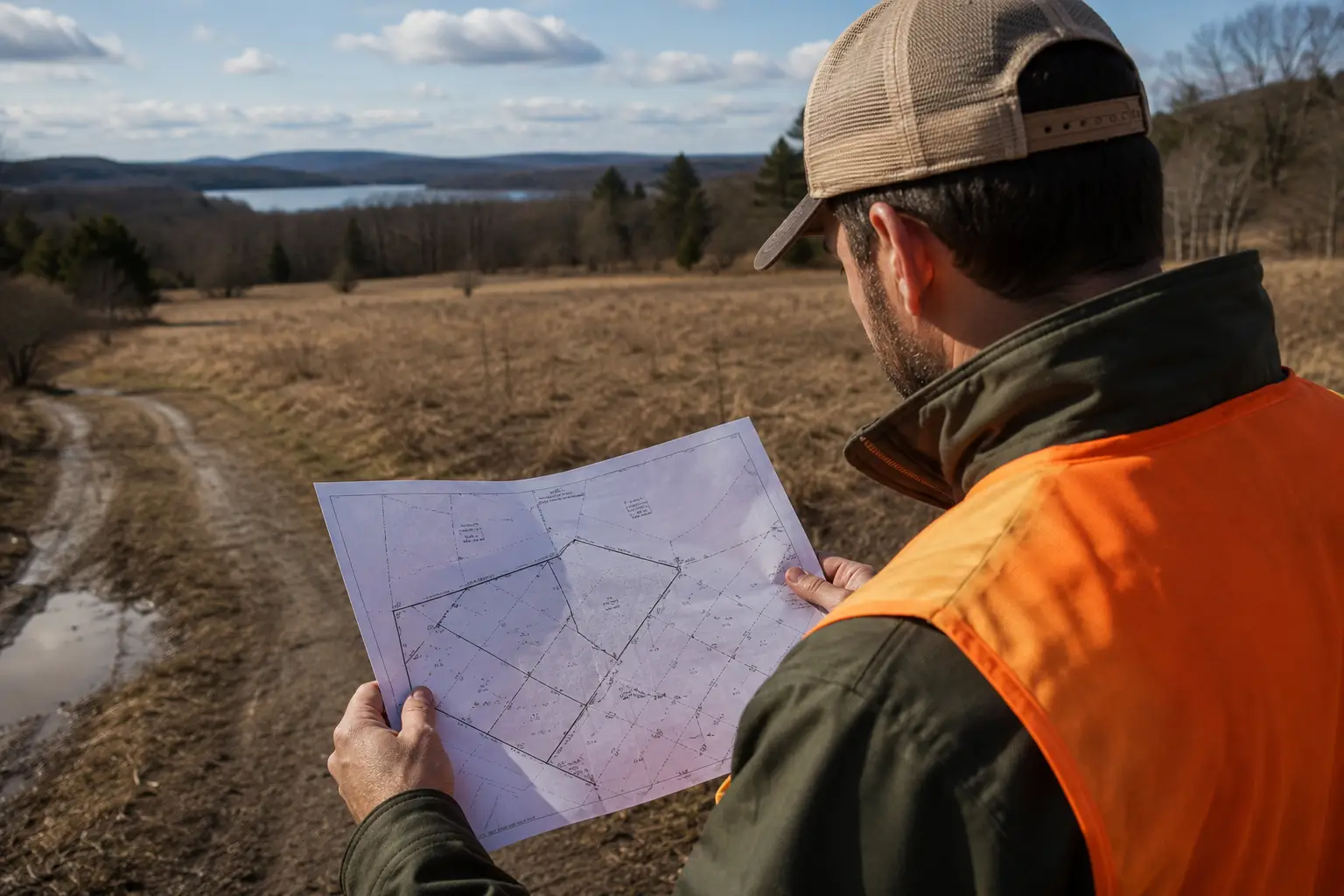
Provide the property location, parcel number, acreage, loan purpose, requested amount, estimated value, current use, proposed business plan, legal access, utilities, equity, timing, sources and uses, and exit strategy. A complete initial summary helps identify the right questions before costly reports are ordered.
Initial review is not an application approval, commitment to lend, rate lock, or guarantee that a financing source will accept the transaction.
Rural Land Loan FAQs
Not always. Some rural land transactions are evaluated primarily on collateral, borrower strength, equity, liquidity, business purpose, and exit strategy. When repayment depends on property or business income, the financing source will also review the quality and reliability of that income.
A pre-entitlement or predevelopment scenario may be reviewed, but the financing source will examine current legal use, access, infrastructure, approval risk, timeline, carrying costs, borrower experience, equity, and the plan for repayment. Future approvals should not be presented as guaranteed.
A survey is often important because acreage, boundaries, access, easements, encroachments, and the legal description can directly affect title and value. The exact survey requirement depends on the property, title company, financing source, and transaction.
An appraiser typically considers relevant land sales, location, acreage, access, topography, utilities, zoning, restrictions, improvements, highest and best use, market demand, and exposure time. A listing price or future development projection is not automatically the current market value.
A business-purpose cash-out request may be considered when the borrower can document value, title, existing debt, use of proceeds, remaining equity, liquidity, and a credible repayment strategy. Eligibility and structure depend on current financing-source guidelines.
Lack of insurable legal access is a major concern and can prevent a transaction from moving forward. Physical access alone may not be sufficient. The title, survey, easements, road agreements, and applicable legal rights must be reviewed.
No. A loan secured by agriculturally zoned or farm-used land may be structured as private or commercial real estate financing, while farm ownership, operating, rural housing, or government-guaranteed programs have separate purposes and rules. The correct path depends on the borrower, property, use, and repayment source.
There is no universal closing time. Timing depends on file completeness, title and access, appraisal, survey, environmental and site issues, insurance, entity documentation, legal review, financing-source underwriting, and the borrower’s response to conditions.
Send a concise summary with the property address or parcel number, acreage, purchase price or payoff, requested loan, estimated value, current and proposed use, access, utilities, borrower experience, equity, timing, sources and uses, and exit strategy. Sensitive documents should be provided only through an approved secure process.
Compliance Disclaimer
Direct Private Capital Group, Inc. is a commercial mortgage broker and private real estate financing resource. The information on this page is provided for general informational and educational purposes only.
Nothing on this page constitutes an approval, commitment to lend, loan offer, rate lock, or guarantee of pricing, leverage, proceeds, funding, or closing. Any financing that may be available is subject to complete underwriting, borrower and guarantor qualification, collateral review, valuation, title, survey, legal access, insurance, documentation, environmental and site review, zoning and land-use review, third-party reports, state eligibility, applicable lender, investor, or capital-provider guidelines, market conditions, and applicable law.
Loan structures, requirements, costs, rates, leverage, reserves, recourse, prepayment terms, and closing timelines vary by transaction and financing source. Business-purpose and investment-property financing only where applicable.
DPCG is not the United States Department of Agriculture, USDA Rural Development, another government agency, a bank, or a direct lender. References to government resources are educational and do not imply endorsement, affiliation, eligibility, or participation.
This page is not legal, tax, accounting, investment, engineering, environmental, land-use, appraisal, insurance, or financial advice.