

Apartment Renovation Loans
Apartment renovation loans can help qualified owners, buyers, and real estate investors finance the acquisition, rehabilitation, repositioning, or improvement of an apartment property. The financing structure depends on the property condition, renovation scope, budget, occupancy, income, borrower experience, equity, and exit strategy.
Business-purpose and investment-property financing only. Financing is subject to underwriting, borrower and guarantor qualification, collateral review, valuation, state eligibility, and lender or capital-provider guidelines.
What Is an Apartment Renovation Loan?
An apartment renovation loan is business-purpose financing used to purchase, refinance, repair, renovate, or reposition an apartment property. Depending on the approved structure, proceeds may cover acquisition costs, existing debt, eligible improvements, approved closing expenses, reserves, or other documented project costs.
Apartment renovation financing is one type of commercial real estate financing for qualified investment-property transactions.
When Is Apartment Renovation Financing Used?
Common apartment renovation financing needs include:
- Purchasing an apartment property that requires immediate repairs.
- Refinancing existing debt while completing renovations.
- Replacing a maturing bridge or construction loan.
- Renovating vacant or outdated apartment units.
- Correcting deferred maintenance.
- Replacing roofs, plumbing, electrical, HVAC, windows, or other building systems.
- Improving common areas, parking, security, laundry facilities, or amenities.
- Completing accessibility or life-safety improvements.
- Funding a value-add business plan.
- Completing a partially finished renovation after a delay or budget shortage.
A property needing short-term transitional financing may also be evaluated under bridge-loan financing. One-to-four-unit investment projects may be better suited to fix-and-rent financing.
How Does Apartment Renovation Financing Work?
The financing structure is generally built around the current property, proposed renovation, total project cost, sponsor resources, and planned repayment strategy.
Funds may be divided into two components:
- Proceeds available at closing for the purchase, refinance, payoff, approved closing expenses, or other immediate uses.
- Renovation funds held back and released through approved draws as eligible work is completed.
Not every renovation loan uses the same draw structure. The final terms and disbursement procedures are established by the financing source and loan documents.
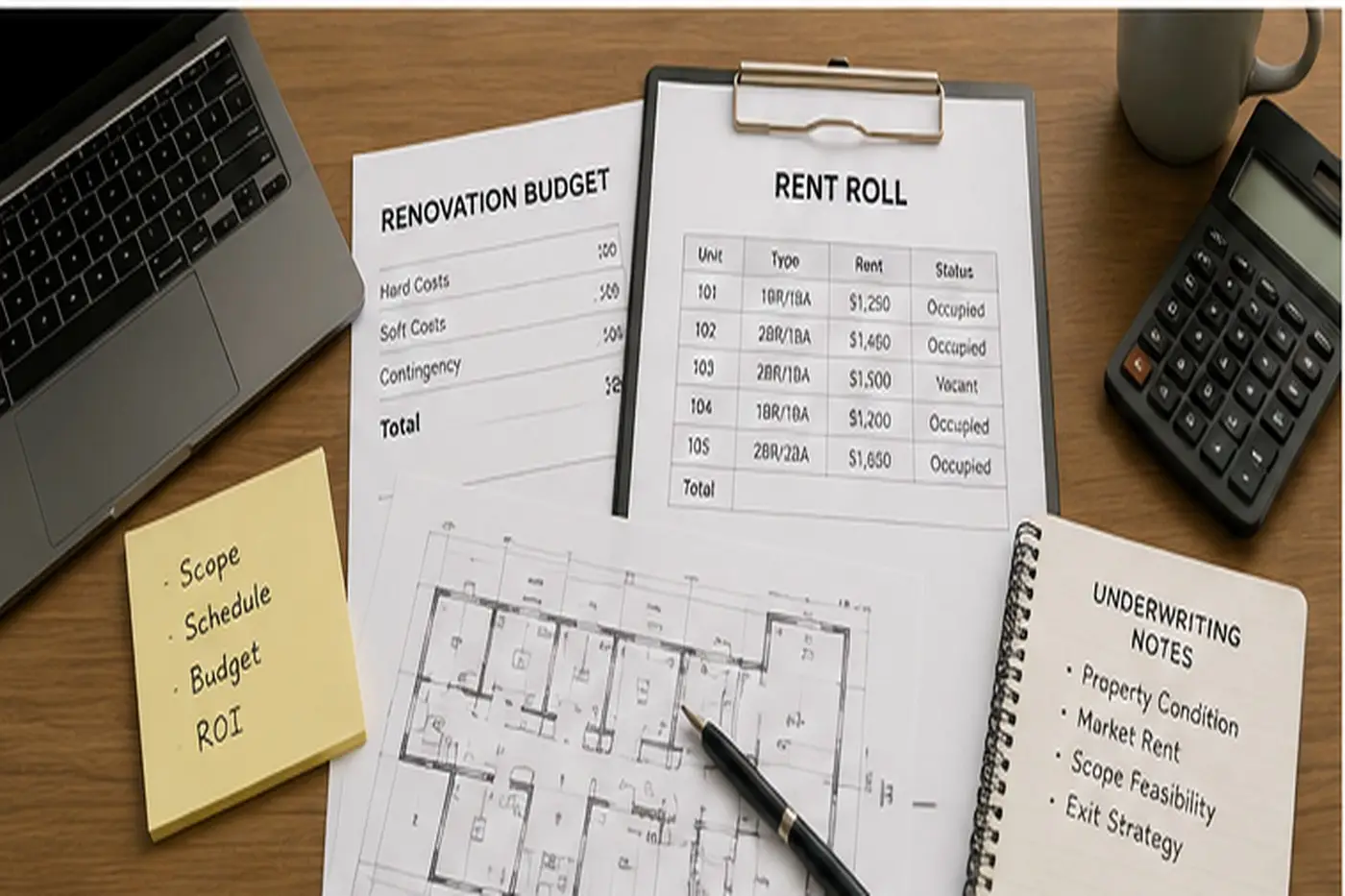
What Types of Apartment Improvements May Be Reviewed?
Interior Unit Improvements
Interior Unit Improvements
Building-System Improvements
Building-System Improvements
Exterior and Site Improvements
Exterior and Site Improvements
Common-Area Improvements
Common-Area Improvements
Occupied Renovation Planning
Occupied Renovation Planning
Renovation-Completion Financing
Renovation-Completion Financing
What Do Financing Sources Review for an Apartment Renovation Loan?
Property and Collateral
- Property address and legal description
- Number and type of units
- Current occupancy and rent roll
- Property age and construction
- Deferred maintenance
- Zoning and legal use
- Code violations
- Parking and utilities
- Insurance and flood information
- Environmental concerns
- Title and lien status
- Current and projected value
Renovation Scope
The renovation package should explain:
- What work will be performed
- Why the work is necessary
- Where the work will occur
- Which units or building areas are affected
- Who will perform the work
- How much each line item costs
- When each phase will begin and end
- Which permits and approvals are required
- Whether tenants will remain in place
- Whether units will be temporarily unavailable
- How the project will be monitored
- How contingency funds will be handled
Property Income and Operations
For an occupied property, lenders commonly examine the effect of renovations on operations.
Relevant questions include:
- How many units are currently occupied?
- How many units will be renovated at one time?
- Will tenants be relocated?
- How much rental income may be interrupted?
- Are current rents collected consistently?
- What operating expenses are expected during construction?
- Are concessions needed during the renovation?
- Is the renovation plan consistent with the local market?
- How long is the expected lease-up period?
Borrower and Sponsor
The review may include:
- Ownership structure
- Guarantor information
- Credit profile
- Real estate ownership history
- Apartment ownership or management experience
- Renovation or construction experience
- Contractor oversight experience
- Liquidity
- Net worth
- Cash available to close
- Contingency resources
- Existing real estate obligations
- Pending lawsuits, bankruptcies, foreclosures, or other disclosed matters
- The borrower’s plan for managing the property during renovations
Contractor and Project Team
A lender may request:
- General contractor information
- Contractor license, where required
- Insurance certificates
- Resume and project history
- References
- Executed construction contract
- Subcontractor information
- Schedule of values
- Payment schedule
- Lien-waiver process
- Architect or engineer information
- Property manager information
- Construction manager information
- Third-party cost or feasibility review
Business Plan and Exit Strategy
The exit strategy explains how the renovation loan is expected to be repaid.
Possible exits may include:
- Refinance after renovation and stabilization
- Sale of the completed property
- Refinance through a bank, debt fund, agency program, credit union, or other permanent financing source
- Paydown from other documented business proceeds
- A combination of refinance, sale, or sponsor capital
A planned refinance is not guaranteed. The property and borrower must qualify under the future lender’s requirements at the time of the refinance.
Which Financial Measurements Affect Apartment Renovation Financing?
Loan-to-Value Ratio
Loan-to-value compares the proposed loan amount with the property value accepted for underwriting.
Formula
Proposed Loan Amount ÷ Accepted Property Value = LTV
The accepted value may be current, completed, stabilized, or otherwise defined by the financing source.
Loan-to-Cost Ratio
Loan-to-cost compares the proposed loan amount with the eligible project cost.
Formula
Proposed Loan Amount ÷ Eligible Project Cost = LTC
Eligible project cost may include approved acquisition, renovation, and transaction costs.
Loan-to-After-Renovation Value
This measurement compares the proposed loan amount with a supported after-renovation value.
Formula
Proposed Loan Amount ÷ Supported After-Renovation Value = LTARV
The projected value is an appraisal assumption, not a guaranteed sale price.
Net Operating Income
NOI generally represents effective property income minus eligible operating expenses.
Formula
Effective Property Income − Eligible Operating Expenses = NOI
Underwriters may adjust reported income and expenses.
Debt-Service Coverage Ratio
DSCR compares underwritten net operating income with annual debt service.
Formula
Underwritten NOI ÷ Annual Debt Service = DSCR
Current, projected, and stabilized coverage may be reviewed.
Interest and Operating Reserves
Reserves may support interest, operating expenses, taxes, insurance, or approved project costs during renovation.
Transaction-Specific Review
Reserve requirements and amounts depend on the property, project, loan documents, and financing source.
No rate, leverage limit, loan amount, credit-score threshold, DSCR minimum, debt-yield requirement, term, or closing time should be assumed unless confirmed in current written guidelines for the specific financing source.
Which Documents Help Support an Apartment Renovation Loan Request?
A complete file helps the financing source understand the property, borrower, renovation plan, budget, and exit strategy. Review DPCG’s commercial loan required-documents guide and borrower FAQs for related preparation guidance.
Initial Loan Scenario
- Property address
- Number of units
- Loan purpose
- Requested loan amount
- Purchase price or payoff
- Current value
- Projected value
- Renovation budget
- Current occupancy
- Cash available to close
- Borrower experience
- Exit strategy
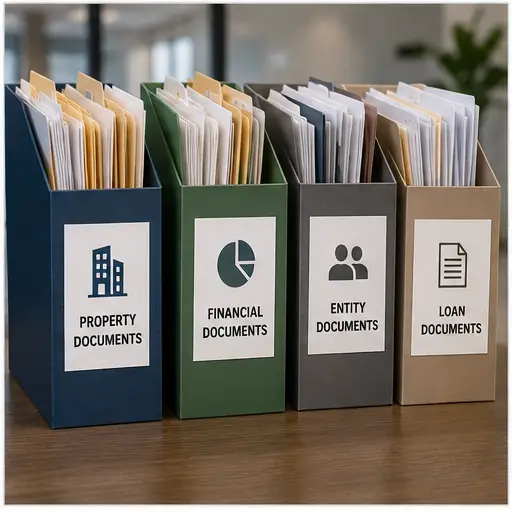
Property Documents
- Current rent roll
- Trailing 12-month statement
- Year-to-date statement
- Unit mix
- Delinquency and concession reports
- Property tax information
- Insurance information
- Property photographs
- Existing appraisal or valuation
- Property-condition report
- Survey or site plan
- Title report
Entity Documents
Borrowing entity and ownership authority
- Articles of organization or incorporation
- Operating agreement, bylaws, or partnership agreement
- Employer Identification Number confirmation
- Certificate of good standing
- Ownership schedule
- Organizational chart
- Transaction resolutions
- Foreign registration when applicable
- Beneficial-ownership information
Renovation Documents
- Detailed scope of work
- Line-item budget
- Schedule of values
- Construction timeline
- Contractor bids
- Executed construction agreement
- Plans and specifications
- Permits or applications
- Contingency budget
- Draw schedule
- Change orders
- Completed-work ledger
- Invoices and lien waivers
Borrower and Guarantor Documents
- Loan application
- Personal financial statement
- Schedule of real estate owned
- Liquidity verification
- Experience summary
- Credit authorization
- Explanation of material credit events
- Identification through secure process
- Bank statements through secure process
- Tax returns when required and transmitted securely
Acquisition, Refinance, and Exit Documents
- Executed purchase agreement when applicable
- Current mortgage statement
- Payoff statement
- Existing loan documents
- Itemized use of proceeds
- Source of closing funds
- Stabilized rent roll
- Projected income and expenses
- Market-rent support
- Refinance assumptions
- Sale analysis when applicable
- Backup exit plan
What Is the Apartment Renovation Loan Process?
Submit the Initial Scenario
Preliminary Review
Financing-Source Review
Preliminary Terms or Indication
Formal Underwriting
Third-Party Reports
Conditions and Documentation
Closing, Draws, and Completion
What Commonly Delays an Apartment Renovation Loan?
- Incomplete or inconsistent documents: The application, rent roll, budget, purchase contract, payoff, and borrower explanation should agree.
- Unclear scope of work: Broad descriptions without quantities, locations, contractor details, or phases are difficult to underwrite.
- Unsupported project costs: Costs may be questioned when contractor bids, plans, or other support are missing.
- Insufficient contingency: Older properties can contain concealed conditions and unexpected cost overruns.
- Permit or zoning problems: Open violations, unapproved units, missing permits, or illegal use may delay closing.
- Title and lien issues: Mechanic’s liens, judgments, ownership discrepancies, or incorrect entity documents may require correction.
- Insurance or environmental concerns: Renovation activity, property condition, flood exposure, or environmental history may require additional review.
- Contractor or project-team issues: Licensing, insurance, incomplete contracts, disputes, or limited experience may affect approval.
- Weak exit strategy: A future refinance or sale must be supported by reasonable assumptions and a backup plan.
How Can a Borrower Prepare a Stronger Submission?
- Provide a one-page executive summary. Explain the property, requested financing, renovation plan, budget, and exit.
- Use one consistent requested loan amount. Reconcile the application, budget, and use-of-proceeds schedule.
- Submit a detailed line-item budget. Separate labor, materials, soft costs, reserves, and contingency.
- Identify completed and remaining work. Include invoices, photographs, change orders, and unpaid costs.
- Support current and projected rents. Separate actual operating results from projections.
- Document cash available to close. Show the borrower contribution and contingency resources.
- Address known problems early. Disclose title, permit, insurance, environmental, contractor, or legal issues.
- Prepare a primary and backup exit. Explain how the loan will be repaid if the project takes longer than expected.
- Protect sensitive information. Use an approved secure-upload process for confidential documents.
How Does Direct Private Capital Group Assist With Apartment Renovation Financing?
Direct Private Capital Group, Inc. is a commercial mortgage broker and private real estate financing resource.
DPCG may assist by:
- Reviewing the initial apartment renovation scenario
- Organizing transaction information
- Identifying missing documents
- Clarifying the proposed use of proceeds
- Reviewing the renovation budget for presentation
- Helping package the borrower and property file
- Presenting eligible scenarios to possible financing sources
- Communicating document requests and preliminary feedback
- Assisting with coordination during the financing process
DPCG does not guarantee that a financing source will issue terms, approve the loan, fund the transaction, accept the renovation scope, approve every draw, or close by a specific date.

Have an Apartment Renovation Project to Finance?
Send DPCG the property information, requested loan amount, current value, renovation budget, borrower background, and exit strategy. A more complete submission allows for a more useful initial review.
Frequently Asked Questions About Apartment Renovation Loans
A purchase and renovation request may be considered as one transaction when supported by the purchase agreement, borrower equity, property value, renovation budget, project timeline, and exit strategy. The financing source determines which costs are eligible and how proceeds are disbursed.
A refinancing request may include funds for approved apartment improvements. The financing source will normally review the existing payoff, current property value, income, lien position, renovation scope, remaining equity, borrower qualifications, and planned exit.
Renovation funds may be held in a controlled account and released through draws rather than disbursed entirely at closing. The exact method depends on the financing source, project, budget, loan documents, and approved uses of proceeds.
Experience requirements vary. A financing source may consider the borrower’s ownership history, construction experience, contractor, property manager, equity, liquidity, project size, and support team.
An occupied renovation may be considered, but the plan should explain unit sequencing, tenant safety, access, rental-income interruption, relocation obligations, permits, insurance, and separation of construction from occupied areas.
An appraiser may analyze the property under current and hypothetical completed conditions. The analysis may consider the proposed scope, market rents, operating expenses, comparable properties, capitalization rates, and other market evidence.
The borrower may be required to cover cost overruns, use an approved contingency, revise the project, or obtain approval for a budget change. Additional loan proceeds are not guaranteed.
The payment process depends on the loan documents and draw procedures. Funds may be released to the borrower, contractor, title company, escrow agent, or another approved party after required documentation and inspections are completed.
Many financing sources require an appraisal or another valuation, but requirements vary. A transaction may also require a property-condition assessment, environmental report, cost review, or construction inspection.
The appropriate exit depends on the property and business plan. Common strategies include refinancing after completion and stabilization or selling the property. A backup strategy is important because future financing and sale conditions can change.
Compliance Disclaimer
Direct Private Capital Group, Inc. is a commercial mortgage broker and private real estate financing resource. This page is provided for general informational and educational purposes only.
Nothing on this page constitutes an approval, commitment to lend, loan offer, rate lock, or guarantee of terms, proceeds, funding, draw approval, or closing. Financing is subject to complete underwriting, borrower and guarantor qualification, collateral review, valuation, title, insurance, documentation, third-party reports, state eligibility, applicable financing-source guidelines, market conditions, and applicable law.
Loan structures, renovation holdbacks, draw procedures, rates, leverage, reserves, recourse, prepayment provisions, and closing timelines vary by transaction and financing source. Business-purpose and investment-property financing only where applicable.
This page is not legal, tax, accounting, investment, valuation, engineering, construction, environmental, insurance, or financial advice. Borrowers should consult qualified advisers.
Review the Consumer Financial Protection Bureau’s Regulation B resource for official equal-credit-opportunity information. Environmental due diligence may involve the EPA All Appropriate Inquiries guidance, and flood information may be reviewed through the FEMA Flood Map Service Center.